Multi-lender sunroom financing for contractors and dealers.
No house program, or a room it doesn’t cover? The homeowner applies once under your brand, on their own phone, and participating lenders weigh it in order. Ottri bills you nothing.
Sunrooms, screen rooms, enclosures and covers.
For dealers and independents, any brand.
Paid by the lender on eligible programs.
Your name on it; never sold as a lead.
No setup fee · No subscription · No minimums to sign up

Banks and Lenders
20
Finance projects up to
$750K
Full credit coverage
300–850
One application. Eligible lenders, considered in sequence.
Ottri is a customer financing platform for sunroom, screen room and patio enclosure contractors: one branded application for the room, foundation, wiring and heating, which participating lenders consider in turn, beside any house program. Ottri Global LLC is a licensed loan broker (NMLS 2776988), not a lender.
Sunroom promotions often cost the installer. Ottri costs you nothing.
A promotional plan usually carries a fee that comes out of the room’s margin. Here’s what one published schedule costs, beside Ottri.
−$3,600
A 12-month promo
On a $45,000 four-season room, a 2019 national lender rate sheet put the installer’s cost of 12 months same-as-cash at 7.99%, about $3,600, and 24 months at 13%, about $5,850.
$1,500+
A yearly platform fee
Subscription platforms bill $1,500 to $6,000 a year, whether the room sells in spring or not at all.
$0
Ottri never charges you
No sign-up fee, no subscription and no share of the room. On eligible programs the lender pays your company, and if a lender’s promotion has its own fee, you choose whether to offer it.
No setup fee · No subscription · No minimums to sign up
Promotion costs: a 2019 national lender schedule, explained here: 7.99% for 12 months same-as-cash, 13% for 24. Platform fees: published plan prices, July 2026.
Everything a sunroom company needs to offer financing.
Sales and the office
Jobs run from an insulated cover on a slab to a four-season room waiting on permits and the factory. Every application and payment, in one place.

Run financing from one dashboard
Every room’s offers, open items and payment status, from design visit to final inspection.

Track every application
See which homeowners started an application after the design visit and stopped.

Track funded volume
See funded rooms by design consultant and by month.
Manage supported promotions
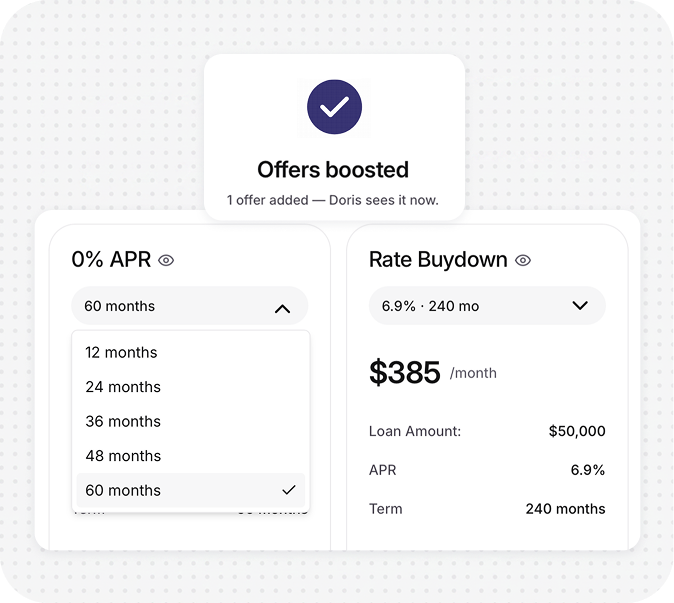
Choose the lender promotions you’ll offer, each with its cost to you shown first.
Design visits
Consultants leave the link with the drawing and the itemized price. Owners see which consultants’ visits become submitted applications.

Work from the field
Leave a QR code with the drawing, or send the link by text with the proposal.

Measure tools and rep adoption
Compare consultants by the applications their visits start.

Measure every entry point
See if homeowners begin from the drawing’s QR code, a texted link or your website.

Keep the experience branded
Your logo and name stay on every screen, so the homeowner knows the application is yours.
The homeowner applies after the design visit, on their own phone, with your name on it.

One application, multiple programs
The room, base, wiring and heat pump share one application, which participating lenders review one after another.

Direct-to-business funding
On eligible programs, approved funds go from the lender to your company.

Links, QR codes, and messages
A QR code on the drawing, a link texted after the visit, or one in the proposal email.

Homeowner-friendly experience
Each offer’s full terms open on the homeowner’s phone, and they decide after the designer has gone.

Your business stays front and center
From the design visit to the final inspection, the application carries your company’s name.

Available promotions
See what a lender promotion costs your company before it goes on a sunroom proposal.
Spot rooms stuck before the order, and who starts applications.

Spot what’s waiting
Find rooms waiting on a signature, a document request or the inspector.
Keep follow-up in one place
Clear the lender’s open items before you send the factory order.
Keep crews scheduled
The office sees which rooms have financing settled before footings are poured.
See what starts applications
Compare QR codes on drawings, follow-up texts, emails and web buttons by applications started.
Compare consultants
See which design consultants’ visits turn into applications.
Improve distribution
Put the link on drawings, follow-up texts and your sunroom gallery page.
One no shouldn’t end the design: 20 lenders in Ottri’s network. All in one place.
With
A disconnected process
Room, foundation and heat pump on separate plans.
A first decline, and the drawing sits in a folder.
A homeowner rushed to sign before the designer leaves.
Promotion costs discovered after the room is paid.
Approved, then stalled waiting on a permit copy.
With Ottri
The whole contracted room on one application.
Another eligible lender reviews it, no new form.
A link they finish later, with every term shown.
What each promotion costs you, before you offer it.
Open items and funding status for each room, together.
What sunroom installers ask before offering financing.
Updated
Laura Bennett
Example: $45,000 four-season room, 12×16
Prime installment loan
Lender 1
Second-look loan
Lender 2
Installment loan, 144 months
Lender 3
Offer received
144-month installment loan for the whole room
Every term opens on the homeowner’s own phone.
Our brand or franchise has a financing program. Why add Ottri?
To sit beside it. A house or factory program covers some homeowners and some rooms; when it declines, its limit falls short of the quote or you carry another brand, the homeowner applies once under your name and participating lenders consider it in turn. If a dealer agreement names a required lender, follow it.
- Quote the same price whether the homeowner pays cash or finances the room.
- No dealer agreement or brand affiliation is needed to use Ottri.
- Ottri bills your company nothing, whichever participating lender approves.
Sources: Regulation Z advertising rules, 12 CFR 1026.24.
Sunroom costs by type, August 2025 guides
HomeGuide (August 2025)
| Job | Typical cost | Programs that often fit |
|---|---|---|
| Insulated patio cover | $6,000–$12,000 | CashInstallment |
| Screen room or enclosure | $8,000–$30,000 | Installment |
| Three-season, new base | $15,000–$50,000 | Installment |
| Four-season room | $20,000–$80,000 | Installment |
| Four-season, 12×16 | $38,500–$63,500 | Installment |
| Solarium, glass roof | $30,000–$100,000 | Installment |
What does a sunroom cost to build in 2026?
It depends on the category and the base. Guides put three-season rooms at $8,000 to $50,000 and four-season rooms at $20,000 to $80,000, with a 12×16 four-season room around $38,500 to $63,500. Foundation, glass, roof, wiring and a heat pump drive the spread, and a solarium with a glass roof runs $30,000 to $100,000.
- Foundation runs $1,000 to $6,000; a ductless mini-split, $2,000 to $6,000.
- No federal tax credit covers a sunroom, so leave tax savings out of the pitch.
- Cost vs Value hasn’t priced a sunroom since 2015; leave resale percentages out.
Sources: HomeGuide, sunroom cost and covered patio cost (August 2025); IRS, energy efficient home improvement credit (April 2026); Remodeling, Cost vs Value national reports (2015; none since, through 2025); Fannie Mae Selling Guide B4-1.3-05 (October 2026), appraisal area.

Framed after the permit
What decides the permit and the build date on a sunroom?
The category and the permit. Building departments want it named: screen, glass but unheated, heated and closed off from the house, or open to the house, the only habitable one. Expect building, electrical and often zoning review, snow and wind design, and HOA approval. Order the room only after the permit issues.
- A patio cover needs two walls 65% open or glazed; enclose more and it isn’t one.
- Some counties have the owner sign the room’s category on an affidavit.
- Rooms closed off from the house get a lighter energy-code path than open ones.
Sources: International Residential Code sunroom definition and categories, quoted by Horry County, SC in its sunroom affidavit (2021 IRC) and Ross Township, PA in its submittal guide (2015 IRC); patio cover rules (Appendix AH) in Tazewell County, IL’s handout; City of Poway, CA, patio bulletin; Michigan R 408.30547d (isolated sunrooms; version in effect until August 2025).
Karen Whitfield
Example: 12×16 four-season room
Design visit, time to cancel ended
You and the homeowner
Offer accepted, permit in hand
Lender and building department
Room built and glazed
Your crew
Inspected; homeowner signs off
Building inspector and homeowner
Lender pays your company
On eligible programs
Next step
Homeowner confirms the room is finished
How should a sunroom be sold in the home, and when do we get paid?
With time to decide. A home sale of $25 or more gives the homeowner 3 business days to cancel, invited design visit or not, and a first-visit price doesn’t change that. Keep the deposit within your state’s cap and order after the permit. Most programs pay after completion; some pay at signing.
- Beyond the down payment, California bars collecting ahead of the work, even from a lender.
- Californians 65 and older get 5 business days to cancel a sale made at home.
- An application or conditional offer doesn’t release funds, so don’t order on one.
Sources: FTC Cooling-Off Rule (16 CFR 429); California §7159.5 (contractor down payments) and Civil Code §1689.6 (buyers 65 and older); deposit limits: Maryland §8-617, Pennsylvania §517.9, New York §71-a, Massachusetts c. 142A §2 and Florida §489.126.
Sunroom financing questions, answered.

How can sunroom and patio enclosure contractors offer customer financing?
Put it on the itemized proposal as a payment option next to cash and any house program you carry. The homeowner completes one application under your brand on their own phone, participating lenders weigh it in order, and on eligible programs the lender pays your company. It’s credit for the homeowner, not net terms for you, and Ottri never bills you.
Can the room, foundation, electrical and heat pump go on one application?
Yes, if it’s one contracted room with one price. List the room, foundation or slab, roof tie-in, wiring, heating and cooling, and permits so the lender sees the whole scope, and leave furniture and hot tubs off. Network programs start at $1,000, lenders set their own top amounts, and a large solarium may need a cash portion.
What’s the difference between a three-season and a four-season room?
Heat, and the category on the permit. A three-season room has glass but no heat, Category II or III of the five model-code categories; a four-season room is heated or cooled, either closed off from the house with its own control (IV) or open to it (V, the only habitable one). Screen rooms are Category I.
What happens if the first lender declines a sunroom?
Nobody retypes anything: the application passes to the next eligible lender, and before each lender’s step the screen shows whether that credit check is soft or hard. Another lender may come back with a smaller amount; resize the room or change the glass before you order. If none approves, a screen room or insulated cover may fit the budget.
Can we enclose a homeowner’s existing patio cover?
Sometimes, but close it in too far and it stops being a patio cover. Model code limits covers to outdoor use, never habitable rooms, with two walls at least 65% open or glazed, and some cities allow covers in side or rear yards only while they’re open on three sides. Check zoning and the structure with the building department before you price it.
Will the appraiser count a sunroom as square footage?
That’s the appraiser’s call. Fannie Mae requires the ANSI measuring standard, and areas that don’t meet its finished-area definition are reported as unfinished; screen and three-season rooms usually aren’t counted. Permitted rooms can also raise the property tax assessment, so keep value and tax claims off the proposal.
How much deposit can we take before the room is built?
Often less than the factory order. California allows $1,000 or 10%, whichever is less, and nothing ahead of the work, even from a lender; Maryland stops at one-third; Pennsylvania and Massachusetts make room for custom materials; New York wants money taken before completion held in escrow or bonded. In Florida, a deposit over 10% starts the permit clock.
What does a sunroom company need to sign up?
Sign up online with your EIN, company details, contractor license, insurance certificate, a sample room contract, the owner’s ID and the deposit account. No franchise or dealer agreement is needed. If you sell rooms and sub out the install, say so; lenders treat that differently. Ottri checks every company before switching it on, and each lender then sets its own bar, such as time in business.
Who approves the financing and pays for the room?
Each lender decides on its own and sets the terms; on eligible programs it pays your company directly. Most programs pay after the homeowner confirms the room is finished; some pay at signing. Ottri Global LLC is a licensed loan broker, NMLS 2776988, and is not a lender.
How should designers present a “zero interest, zero payments” plan?
As deferred interest, with the end spelled out: interest builds from the start and is charged back if the balance isn’t paid by the deadline, so never call it 0% or interest-free. Show the room’s price, rate, term and total together, and let the homeowner read each lender’s terms on their own phone after the visit.