Multi-lender deck and patio financing for contractors.
A homeowner shouldn’t settle for wood over composite because one lender said no. Ottri sends one branded application to participating lenders in sequence and charges your business nothing.
Your brand from design visit to funding; never sold as leads.
One application for the deck, patio cover, railings and lights.
On eligible programs the lender pays you, not the homeowner.
Keep the lender you use now; add Ottri for the rest.
No setup fee · No subscription · No demo · No minimums

Banks and Lenders
20
Finance projects up to
$750K
Full credit coverage
300–850
One application. Eligible lenders, considered in sequence.
Ottri is a financing platform for deck builders and outdoor living contractors: one branded application for the whole outdoor project, which participating lenders consider in turn. Ottri Global LLC is a licensed loan broker (NMLS 2776988), not a lender.
Deck promotions usually cost the builder. Ottri costs you nothing.
What deck builders typically give up to offer promotional financing, next to what Ottri charges.
−$1,600
A 12-month promo
A 2019 lender schedule priced 12 months same-as-cash at 7.99% of the loan: about $1,600 on a $20,000 deck, and 24 months at 13%, about $2,600.
$1,500+
A yearly platform fee
Financing subscriptions run $1,500 to $6,000 a year, the same in a slow season as a busy one.
$0
Ottri never charges you
No sign-up fee, no subscription and no percentage of the job. On eligible programs the lender pays your business, not the homeowner. Some lender programs, such as promotional plans, can carry a lender fee; offering them is up to you.
No setup fee · No subscription · No demo · No minimums
Promo costs: a national lender’s 2019 rate sheet (12 months same-as-cash at 7.99%; 24 months at 13%). Platform fees: published plan prices, July 2026.
Everything a deck builder needs to sell with financing.
Builds and inspections
Deck jobs sell in winter, pass three inspections and finish in spring. Keep every application, offer and funding step in one place.

Run financing from one dashboard
Every deck job’s application, offer and funding step in one place, from the design visit to the final inspection.

Track every application
See which homeowners applied after the design visit and which are still deciding.

Track funded volume
Track funded decks by designer, office and month.
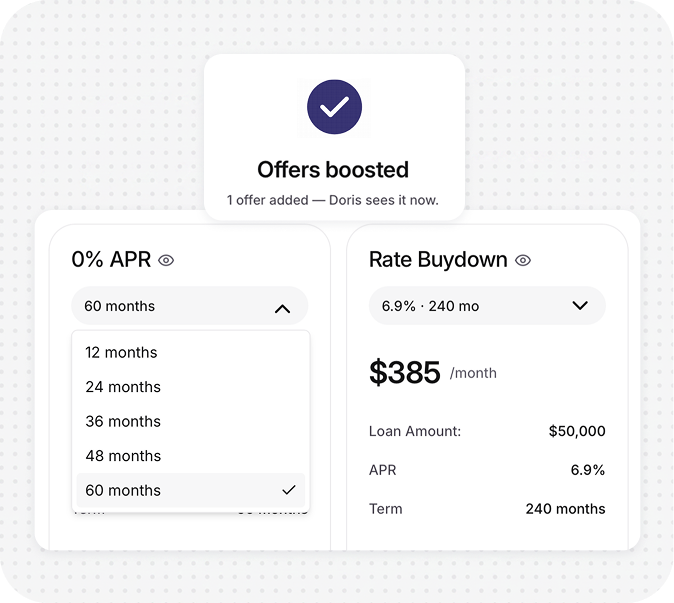
Manage supported promotions
Offer the plans your lender programs allow and see each option’s monthly payment before you present it.
Design visits and home shows
Designers send the application at the kitchen table or after a home-show lead. Owners see which people and events turn designs into financed decks.

Work from the field
Share a link or QR code at the design visit, or text it with the drawings and the price.

Measure tools and rep adoption
Compare application starts and completions by designer, home show and website button.

Measure every entry point
See whether applications start from proposal QR codes, home-show follow-ups or your website.

Keep the experience branded
Your logo and colors throughout the application, so it reads as your company’s.
Homeowners apply on their own phone, under your brand, once the design is set.

One application, multiple programs
Homeowners apply once for the full outdoor scope, and participating lenders consider it one by one.

Direct-to-business funding
On eligible programs, funds go to your business, not the homeowner.

Links, QR codes, and messages
A QR code on the proposal, a link with the drawings or a text after the home show.

Homeowner-friendly experience
Each step tells the homeowner up front whether it’s a soft or a hard credit check.

Your business stays front and center
Your company’s name on every screen, from the application to the funding notice.

Available promotions
Offer a lender’s promotional plan where one exists, knowing what it costs your business before you quote it.
See which deck jobs need action and what brings in applications.

See what needs action
Spot jobs waiting on a document, a signature or the homeowner’s sign-off after the final inspection.
Keep follow-up in one place
Open the application, see what the lender still needs and keep the build date on track.
Keep deck jobs moving
Before the spring rush, show the office which decks are financed and which still wait on a lender.
See what starts applications
Compare starts from proposal QR codes, home-show texts, website buttons and emails.
Compare designers
See which designers get applications started and finished, and where they stall.
Improve distribution
Put the link on the proposal, in the home-show follow-up and on your website.
One no shouldn’t cost the season. A network of 20 keeps the sale going. All in one place.
With
A disconnected process
The homeowner is declined and settles for wood.
The pergola gets split into a second sale.
A fee on every promotional deck.
Paperwork chased after the final inspection.
Home-show leads sent to a lender’s website.
With Ottri
Another eligible lender can consider the composite price.
One application for the whole outdoor scope.
No Ottri fee to price into the deck.
Each job’s funding step, visible to the office.
Your brand from the home show to funding.
What deck builders ask before they offer financing.
Updated
Mike Alvarez
Example: $28,000 deck, pergola and lighting
Prime installment loan
Lender 1
Promotional installment plan
Lender 2
Installment loan, 120 months
Lender 3
Offer received
Installment loan, 120 months, for the whole scope
Lender 3 confirms the amount against the signed contract.
Can one application cover the deck, railings, stairs, pergola and lighting?
Yes, if it’s all in one signed contract and within each program’s limits. Price the full outdoor room once, and the homeowner applies for that amount; participating lenders consider it in turn, and each confirms the amount against your scope. If one declines the bigger total, the next eligible lender sees the same application before anyone shrinks the job.
- A deck with a roof cover runs about $5,000 to $18,000 for 200 square feet.
- Custom pergolas run about $4,300 to $9,400; outdoor kitchens average about $16,000.
- Each lender sets its own maximum, so a big backyard total may fit some programs, not all.
- A cover or outdoor kitchen may need its own permit.
Sources: Harvard Joint Center for Housing Studies, Improving America’s Housing 2025; HomeGuide, cost to build a deck (February 2026); HomeGuide and Fixr pergola, covered-deck and outdoor-kitchen cost guides (2024–2026).
Installed deck cost, 2025–2026
HomeGuide (2026); Cost vs Value (2025)
| Deck or material | Typical cost | Programs that often fit |
|---|---|---|
| Pressure-treated wood | $25–$50 per sq ft | CashInstallment |
| Composite | $40–$80 per sq ft | Installment |
| Aluminum | $100–$125 per sq ft | Installment |
| 20×20 replacement, wood | $12,000–$22,000 | Installment |
| Same deck in wood | $18,263 | Installment |
| Same deck in composite | $25,096 | Installment |
How should we price a composite upgrade when the homeowner finances?
Quote both options with one price each, the same for cash or financing. On the same deck, composite cost about 37% more than wood in 2025: $25,096 against $18,263. Show each option’s full price, let the homeowner apply once for the one they choose, and keep monthly figures out of ads unless every term is shown.
- Trex estimates wood is still about 75% of decking sold.
- Composite resale estimates swung from 68.2% in 2024 to 88.5% in 2025; promise no payback.
- Producer prices for softwood lumber rose 14.2% in a year; aluminum mill shapes, 25.2%.
- Duties for most Canadian mills fell to 24.75% on October 19, 2026, plus a 10% Section 232 duty.
Sources: HomeGuide, cost to build a deck (February 2026); Zonda, Cost vs Value 2025; Trex 2025 annual report (Form 10-K); Trex fourth-quarter 2025 earnings call (March 2026). Bureau of Labor Statistics Producer Price Index, September 2026; U.S. Department of Commerce softwood lumber orders and the Section 232 timber and lumber proclamation (2025–2026).
Karen Doyle
Example: composite deck, 16×20
Contract signed, permit issued
You and the homeowner
Footing and framing inspections passed
Building inspector
Final inspection
Building inspector
Completion confirmed
Homeowner
Paid to your business
Lender, on eligible programs
Next step
The final inspection passes, then the homeowner confirms
When does a deck builder get paid on a financed job?
Usually at completion, so line up the homeowner’s sign-off with the final inspection. Most Ottri network programs release payment once the homeowner confirms the deck is finished; some pay at signing. Inspectors typically check footings, framing and the finished deck, and many jurisdictions bar use until the final passes. Keep deposits within your state’s limits.
- In California the down payment is limited to $1,000 or 10%, whichever is less.
- Maryland caps deposits at one-third of the contract price.
- Florida: take more than 10% down and the permit application is due within 30 days.
- Beyond the down payment, California bars collecting ahead of the work, even from a lender.
Sources: California Business and Professions Code §7159.5; Maryland Business Regulation §8-617; Florida Statutes §489.126(2). Montgomery County, Maryland: required residential deck inspections (2026).

Most decks need a permit
Does a deck need a permit, and what does code mean for the job?
Most decks need one. The model code exempts only freestanding decks of 200 square feet or less, no more than 30 inches high, that don’t serve an exit door, and many cities are stricter. Plan the inspections and any HOA approval before the start date, and send the application once the scope and price are final.
- The code bars attaching a ledger to brick or stone veneer or a bay window.
- The code had no prescriptive ledger fastening until 2009, so many decks due for replacement predate it.
- Approvals expire; check that the offer runs past the build date before you schedule.
Sources: International Residential Code (2021) R105.2 and R507, as adopted locally; ICC Building Safety Journal, “Is your deck safely connected to your house?”.
Deck and patio financing questions, answered.

How do deck builders offer financing to customers?
Deck builders offer financing at the design visit or the home-show follow-up, once the plan and price are set. With Ottri, you send one branded application by link, QR code or text, each participating lender reviews it in turn, and eligible programs pay your business directly. Ottri charges nothing. Already have a lender? Keep it, and add Ottri for the homeowners it declines or approves for less than the job.
What does a new deck cost in 2026?
About $25 to $50 a square foot in pressure-treated wood and $40 to $80 in composite, installed. A 20×20 pressure-treated deck runs $10,000 to $20,000 new and $12,000 to $22,000 as a replacement; in composite, about $18,000 to $28,000. The $14,000 average many pages quote dates from 2023.
Can we tell homeowners a composite deck pays for itself?
No. Resale estimates move too much to promise: one national survey had composite decks recouping 68.2% of their cost in 2024 and 88.5% in 2025, against 94.9% for wood in 2025, and the composite upgrade itself returned about 71% of its extra cost. Describe upkeep and lifespan as the manufacturer states them, and let the homeowner choose.
Does the permit have to be issued before the homeowner applies?
No. The homeowner can apply once the scope and price are final, but don’t start work before the permit and any HOA approval. Inspectors usually check the footings, the framing and the finished deck, and many jurisdictions don’t allow use until the final passes; most programs pay after the job is complete.
How much deposit can a deck builder take?
It depends on the state. California allows $1,000 or 10%, whichever is less, and no payment ahead of the work, even from a lender; Maryland caps deposits at one-third, as Pennsylvania does on larger jobs; Florida adds permit and start deadlines above 10%; New York requires an escrow account or a bond. Check your state’s rules first.
Does the 3-day right to cancel apply to deck sales?
Yes for sales of $25 or more signed at the homeowner’s home, even at a visit they booked, and $130 or more at a home show or fair. California gives buyers 65 and up 5 business days. Hold the composite and railing order until the window closes; home-equity credit adds its own 3-day rescission before work starts.
What if the first lender turns the homeowner down?
The same application goes to the next eligible lender, and the homeowner doesn’t start over. Lenders judge by their own standards, so a second one can reach a different answer. If none approves the full amount, the homeowner can pay part another way or you can phase the scope, such as the deck now and the cover later.
What do I need to sign up?
Register online, then upload your EIN, company details, contractor license, insurance certificate, a sample deck contract, the owner’s ID and the account for deposits. Ottri sets no minimum to join; lenders review your business one by one and each sets its own requirements, such as time in business.
Who approves the financing and sends the funds?
Each participating lender reviews the application, decides and sets the terms; on eligible programs it pays your business directly. Ottri Global LLC is a licensed loan broker, NMLS 2776988, and is not a lender.
Will a winter approval hold until a spring build?
Not always. Each lender sets how long an approval lasts, and an offer accepted in February can expire before a May build. For a build months out, check the expiry before the homeowner accepts, date your quote, and if the offer lapses, the homeowner can reapply for the same scope, which may mean a new credit check.