Multi-lender concrete financing for contractors.
Customer financing for homeowners, not an equipment loan. When tear-out and stamping stretch the budget, they apply once on your branded application; participating lenders take it one after another. You pay Ottri nothing.
Driveways, patios, steps and stamped work.
Tear-out, apron and walk on one application.
Eligible programs pay your company directly.
Sent under your name; never sold as a lead.
No setup fee · No subscription · No minimums to sign up

Banks and Lenders
20
Finance projects up to
$750K
Full credit coverage
300–850
One application. Eligible lenders, considered in sequence.
Ottri is a customer financing platform for concrete contractors: one branded application for driveways, patios, walks, steps and stamped work, which participating lenders consider in turn. Ottri Global LLC is a licensed loan broker (NMLS 2776988), not a lender.
Concrete promotions usually cost the contractor. Ottri costs you nothing.
Promotional plans carry dealer fees that come out of thin flatwork margins. Here’s what they typically cost, next to Ottri.
−$920
A 12-month promo
On an $11,500 driveway, a national lender’s 2019 rate sheet put the contractor’s fee at 7.99% for 12 months same-as-cash, about $920, and 13% for 24 months, about $1,495.
$1,500+
A yearly platform fee
Subscription platforms bill $1,500 to $6,000 a year, including the winter months when few crews pour.
$0
Ottri never charges you
Joining is free, there’s no monthly charge and Ottri takes nothing from the pour. On eligible programs the lender pays your company directly. If a lender’s promotional plan carries a fee, you choose whether to offer it.
No setup fee · No subscription · No minimums to sign up
Promo costs: a 2019 dealer-fee schedule from a national lender: 7.99% for 12 months same-as-cash and 13% for 24 months. Platform fees: published plan prices, July 2026.
Everything a concrete company needs to offer customer financing.
Estimating and the office
Jobs run from a front walk to a stamped driveway that waits on an apron permit and a dry week. Every application and its funding sit in one view.

Run financing from one dashboard
Offers, applications and funding for every pour, from the estimate to the homeowner’s sign-off.

Track every application
See who applied after the estimate and who still has a step left.

Track funded volume
Track funded jobs by estimator and month.
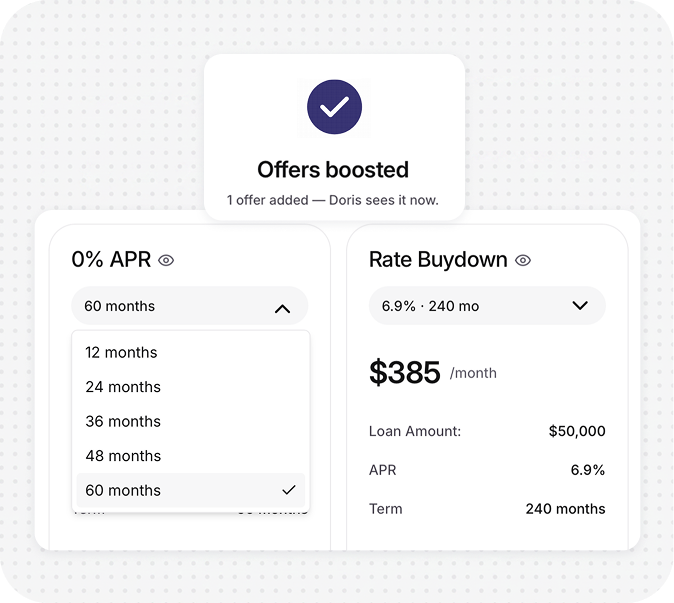
Manage supported promotions
Turn on the promotions your lender programs allow and see each one’s cost before you quote it.
Estimators on site
Estimators send it from the driveway or with the emailed quote. Owners see which estimators turn site visits into financed pours.

Work from the field
Hand the homeowner a QR code at the walkthrough, or text the link with the quote.

Measure tools and rep adoption
Compare starts and completions for each estimator.

Measure every entry point
See which applications begin from the quote’s QR code, a texted link or your website.

Keep the experience branded
Your logo and colors on the application, the same as on your quotes.
After the walkthrough, homeowners apply under your name from their own phone.

One application, multiple programs
One application for the tear-out, pour, apron and walk; participating lenders consider it in turn.

Direct-to-business funding
On eligible programs, approved funding goes straight to your company.

Links, QR codes, and messages
A QR code on the estimate, a link texted after the walkthrough, or one in your email.

Homeowner-friendly experience
The homeowner reads every offer’s terms on their phone and can decide after you leave.

Your business stays front and center
The application carries your company’s name from the estimate through the pour.

Available promotions
If a lender runs a promotion, see what it costs you before you put it on a quote.
See which pours wait on financing and who starts applications.

Find what’s waiting
Spot jobs held up by a document, an unsigned offer or the homeowner’s sign-off.
Keep follow-up in one place
Clear what each lender still needs before the ready-mix is ordered.
Keep crews scheduled
Show the office which jobs have financing in place before forms go in.
See what starts applications
Compare starts from estimate QR codes, texted links, website buttons and emails.
Compare estimators
See which estimators’ quotes turn into applications.
Improve distribution
Add the link to every estimate, follow-up email and your website.
One decline shouldn’t cancel a pour, with 20 lenders on the network. All in one place.
With
A disconnected process
The stamped upgrade dropped to fit the budget.
One lender says no, and the pour slips a season.
Switching estimating software to change lenders.
Concrete ordered inside the 3-day window.
Promos offered without the terms.
With Ottri
The full scope, stamped finish included, on one application.
The next eligible lender reviews the same application.
A link on any estimate, next to the financing you have.
Dig and order once the window closes.
Terms on the homeowner’s phone before they decide.
What concrete companies ask before they offer financing.
Updated
Marcus Bell
Example: $11,500 driveway tear-out, apron and front walk
Prime installment loan
Lender 1
Promotional same-as-cash plan
Lender 2
Installment loan, 84 months
Lender 3
Offer received
84-month installment loan for the driveway, apron and walk
The homeowner reviews every term on their own phone.
Should the homeowner lift, resurface or replace the driveway?
It depends on what failed. Lifting suits a sunken panel, at about $660 to $1,880, and resurfacing a worn surface at $3 to $7 a square foot. A broken base or heaved slab needs replacement, and a two-car tear-out and pour runs about $4,650 to $12,050. Put tear-out, haul-away and the apron on their own lines.
- Foam lifting runs $5 to $25 a square foot, so a whole driveway can rival replacement.
- A lift that becomes a replacement changes the job type and may need a new application.
- A single-panel lift often sits near the network’s $1,000 floor; cash may fit better.
Sources: Angi, mudjacking cost (August 2026); HomeGuide, mudjacking cost (October 2023); HomeGuide, concrete resurfacing cost (May 2025); HomeGuide, concrete driveway cost (June 2025).
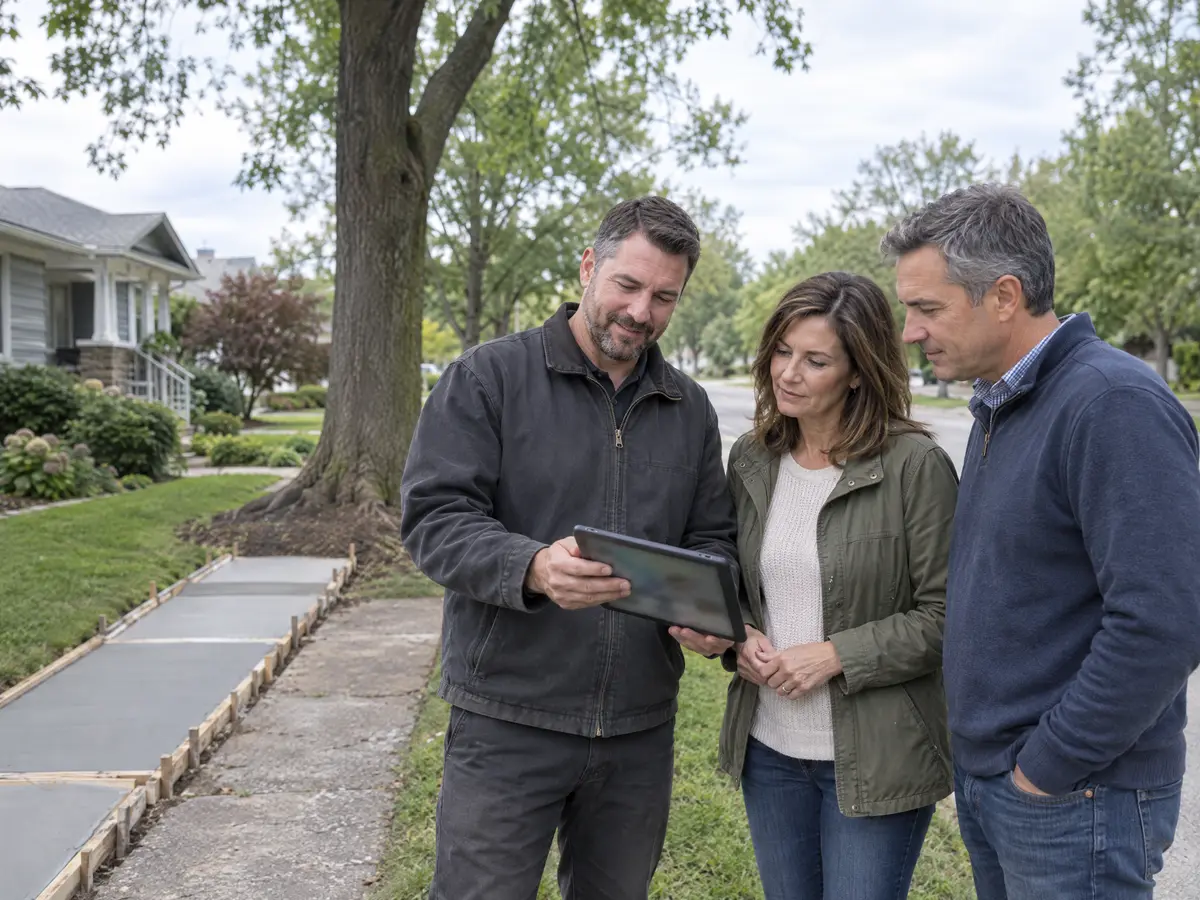
Sidewalk panels to city spec
Who pays when the city orders a sidewalk repair?
In many cities, the homeowner. New York gives owners 75 days before the city may repair the sidewalk and bill them, with a lien if the bill goes unpaid, and Portland gives 60 days, with permit fees of $2.23 a square foot. Minneapolis owners averaged $1,255 in 2024. The owner can usually hire a licensed contractor first; financing doesn’t change the city’s deadline.
- California law makes owners keep the sidewalk in front of their lot safe.
- Chicago’s shared-cost program is voluntary, at about $1,000 to $2,400 a home.
- A D.C. home past 2,100 sq ft of hard surface pays $33.92 more a month for stormwater.
Sources: NYC DOT, sidewalk repair; Portland, sidewalk repair notices (fees July 2026–June 2027); Minneapolis, sidewalk repair and replacement (January 2026); California Streets and Highways Code §5610; City of Wheaton, Illinois, driveway rules; DC Water, impervious area charge (fiscal 2026); Chicago Shared Cost Sidewalk Program overview (December 2025); International Residential Code R105.2.
Concrete costs, sources 2025–2026
HomeGuide (2025–2026); Angi (2026)
| Job | Typical cost | Programs that often fit |
|---|---|---|
| Mudjacking, typical job | $660–$1,880 | Cash |
| Resurfacing, two-car driveway | $1,200–$2,900 | CashInstallment |
| Front walk, 4 by 50 feet | $1,400–$3,400 | CashInstallment |
| Patio, 20 by 20, broom | $1,600–$4,800 | CashInstallment |
| Patio, 20 by 20, stamped | $3,200–$7,600 | Installment |
| Two-car driveway replaced, 24 by 24 (Ottri’s sum) | $4,650–$12,050 | Installment |
| Stamped driveway replaced, 24 by 24 (Ottri’s sum) | $8,050–$13,850 | Installment |
What does concrete flatwork cost in 2026?
Guides put a new two-car driveway at about $6 to $15 a square foot, or $2,400 to $8,600, but that leaves out tearing out the old one, at $2 to $6 a square foot. A 20-by-20 patio runs $1,600 to $4,800 broom-finished and $3,200 to $7,600 stamped. Date every figure: guides price different scopes in different years.
- Producer prices for cement fell 1.2% in a year, while steel mill products rose 27.6%.
- New anti-dumping duties on imported rebar took effect in 2026.
- Stamping adds about $4 to $7 a square foot to a patio.
Sources: HomeGuide, concrete driveway cost (June 2025); HomeGuide, concrete slab and patio cost (February 2026); HomeGuide, stamped concrete cost (July 2025); HomeGuide, concrete sidewalk cost (February 2026); Angi, concrete driveway cost (November 2025); Bureau of Labor Statistics Producer Price Index, September 2026: cement, steel mill products (series WPU1017); Federal Register, rebar anti-dumping order on Algeria (April 2026), and on Bulgaria, Egypt and Vietnam (September 2026).
Jordan Ellis
Example: driveway tear-out, apron and front walk
Application approved
Lender
Apron permit issued, 3 days passed
City and homeowner
Old slab out, new driveway poured
Your crew
Cured, homeowner confirms
Homeowner
Paid to your business
Lender, on eligible programs
Next step
Homeowner confirms the driveway is complete
How do weather and curing affect when a concrete job gets paid?
Most programs pay after the homeowner confirms the job is complete, and some pay at signing, so define complete in the contract: poured and cured enough to use, not the sealing visit 28 days later. Below 40°F counts as a cold-weather pour, and cars wait 7 to 10 days. Many crews sell in winter and pour in spring.
- Beyond the down payment, California bars collecting ahead of the work, even from a lender.
- Don’t dig or order concrete until the 3-day cancellation window closes.
- An approval with open items isn’t funding; clear them before you book the ready-mix.
Sources: California Business and Professions Code §7159.5; 16 CFR 429 (FTC Cooling-Off Rule); deposits: Maryland Business Regulation §8-617, Pennsylvania, 73 P.S. §517.9, Florida Statutes §489.126, New York General Business Law §771; Tennessee Concrete Association, ACI 332-20 driveway highlights; American Concrete Institute PRC-306-16 (cold weather, formerly 306R-16); HomeGuide cure times (June 2025).
Concrete financing questions, answered.

Should concrete contractors offer financing, and how?
Yes, as one way to pay beside cash, check and card: homeowners search for concrete companies that offer financing. A homeowner who would say “we’ll wait” or drop the stamped finish has another option, and cash buyers still pay cash. Once scope and price are set, your estimator texts the branded link; participating lenders take it one after another, and Ottri never bills your business.
Can one application cover the tear-out, apron, walk and steps?
Yes, if it’s one job on one contract and fits the program’s limits; the lender reviews the total against the scope you list. Put tear-out, haul-away, base, apron and steps on their own lines. If a plain driveway turns stamped after approval, sign a change order before that work and ask the lender whether the larger total needs a new approval.
Is a small repair or a single-panel lift worth financing?
Usually not. Network programs start around $1,000, and crack sealing or lifting one sunken panel often costs less, so those jobs are usually paid by card or check. Financing fits replacements, stamped or decorative work and full front-yard jobs, where a driveway, apron, walk and steps can reach $9,000 to $20,000.
Does a driveway replacement need a permit?
Often not for the slab itself, since the model code exempts driveways, but work on the apron or curb cut usually needs a city right-of-way permit, and some cities permit every replacement. Wheaton, Illinois, requires one for any apron change and limits driveways at homes with up to a two-car garage to 20 feet wide. Call 811 before any dig.
A lender turned the homeowner down. Is the driveway job lost?
Not necessarily. The same application can go to the next eligible lender, so nobody fills it out twice, and before each lender’s check the homeowner’s screen says whether it’s soft or hard. Each lender sets its own standards, so a later one may approve. If none does, the homeowner can pay part in cash, or you can price a broom finish instead of stamped.
How much deposit can we take for a concrete job?
It depends on the state. In California, the down payment tops out at $1,000 or 10%, whichever is less, and special orders get no exception. Elsewhere: one-third in Maryland, one-third over $5,000 in Pennsylvania plus special-order materials, which ready-mix rarely is, permit and start clocks above 10% in Florida, and escrow or a bond in New York.
Can we pour in winter, and will the approval last until spring?
Below 40°F is a cold-weather pour: the slab needs protection until it gains strength, and no deicers the first winter. Many crews sell in winter and pour in spring, but offers expire on each lender’s schedule, so match the approval to the pour date and put a date on your quote.
What do I need to sign up?
Open an account online, then upload your EIN and company details, a contractor license where your state issues one, your insurance certificate, a sample job contract, ID for the owner and the account you want funds sent to. Joining Ottri has no minimum; each lender reviews your company against its own standards, such as time in business.
Who approves the financing and sends the funds?
The lender approves the homeowner, sets the terms and, on eligible programs, pays your company directly; most pay after the job is complete, and some pay at signing. Ottri Global LLC is a licensed loan broker, NMLS 2776988, and is not a lender.
Can we tell homeowners a new driveway adds value?
No. Cost guides repeat value figures such as 5% to 10% or a 50% to 80% return without citing a study. Sell what the homeowner can see: no more trip hazards, a slope that sends water away from the house, and a written spec for thickness, mix and joints.