Multi-lender foundation repair financing for contractors.
Pier jobs often reach five figures, and insurance rarely pays. Ottri sends one branded application for the repair to participating lenders in turn; eligible programs pay your business, and Ottri charges you nothing.
For pier jobs, wall repair and crawl space work.
One price, cash or financed, with no fee from Ottri.
Already offer financing? Add Ottri for the declines.
Your brand on it; never sold as leads.
No setup fee · No subscription · No minimums to sign up

Banks and Lenders
20
Finance projects up to
$750K
Full credit coverage
300–850
One application. Eligible lenders, considered in sequence.
Ottri is a customer financing platform for foundation repair contractors: one branded application for piers, wall repair and crawl space work, which participating lenders consider in turn. Ottri Global LLC is a licensed loan broker (NMLS 2776988), not a lender.
Foundation promotions usually cost the contractor. Ottri costs you nothing.
What a foundation company can give up in dealer fees to match a big brand’s promotion, next to what Ottri charges.
−$1,440
A 12-month promo
A national lender’s 2019 rate sheet charged 13% of the loan for 24 months same-as-cash, about $2,340 on an $18,000 pier job, and 7.99% for 12 months, about $1,440.
$1,500+
A yearly platform fee
One subscription platform lists $2,000 to $6,000 a year, whether you pier five homes or fifty.
$0
Ottri never charges you
No setup charge, no monthly bill and nothing taken from the repair. On eligible programs the lender pays your company, not the homeowner. Promotional plans from a lender can carry their own fee, and offering them is up to you.
No setup fee · No subscription · No minimums to sign up
Promo costs: a national lender’s 2019 rate sheet (12 months same-as-cash at 7.99%, 24 months at 13%). Platform fees: published plan prices, July 2026.
Everything a foundation company needs to run a financing program.
Inspections and repair plans
Foundation jobs run from a same-week slab lift to pier jobs that wait on engineers, permits and closings. One dashboard holds each application and funding step.

Run financing from one dashboard
Each repair’s application, offer and funding status in one view, from the first inspection to completion.

Track every application
See which homeowners applied after the inspection and which haven’t finished yet.

Track funded volume
Track funded repairs by estimator and month.
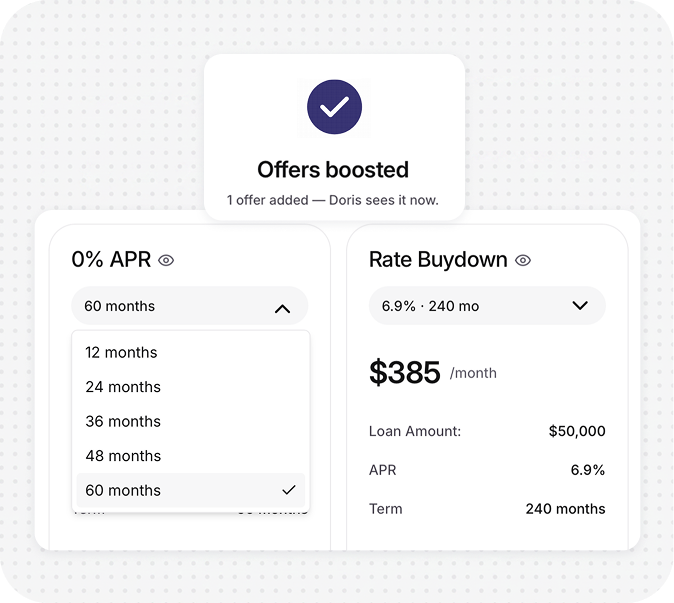
Manage supported promotions
Switch on the plans your lender programs allow and know what each costs your company before you quote.
Estimators in the field
Estimators send it with the written repair plan, after the inspection. Owners see which estimators turn plans into financed repairs.

Work from the field
Share a link or QR code at the inspection, or text it with the repair plan and pier layout.

Measure tools and rep adoption
See application starts and completions for each estimator.

Measure every entry point
See whether applications start from repair-plan QR codes, texted links or your website.

Keep the experience branded
Your logo and colors on the application the homeowner fills out.
Homeowners apply on their own phone, under your name, once the repair plan is set.

One application, multiple programs
One application for the piers, engineering and build-back, reviewed by participating lenders one at a time.

Direct-to-business funding
Eligible programs pay your company directly, not the homeowner.

Links, QR codes, and messages
A QR code on the repair plan, a texted link or an email after the inspection.

Homeowner-friendly experience
The homeowner reads each offer’s terms on their own phone and decides without a deadline from you.

Your business stays front and center
Your company’s name on the application, from the inspection to funding.

Available promotions
Offer a lender’s promotional plan only after you’ve seen what it costs your company.
See stalled repairs and the estimators who get applications started.

See what needs action
Spot repairs stalled on paperwork, an unsigned offer or the homeowner’s sign-off at completion.
Keep follow-up in one place
Check what the lender still needs and settle it before the crew mobilizes.
Keep pier crews booked
Show the office which repairs have financing in place before crews and equipment are scheduled.
See what starts applications
Compare starts from repair-plan QR codes, texted links, website buttons and emails.
Compare estimators
See whose inspections lead to applications and whose don’t.
Improve distribution
Put the link on the repair plan, in the follow-up text and on your website.
A no shouldn’t cut the pier count. A 20-lender network helps. All in one place.
With
A disconnected process
A decline shrinks the job to what one lender approved.
Financing pushed before the homeowner sees other bids.
Platform subscriptions billed every month.
“0% interest” ads without the terms.
Funding status chased by phone after the install.
With Ottri
The application moves to the next eligible lender.
Offers the homeowner reads later, on their own phone.
No Ottri fee on any foundation job.
Full terms shown before the homeowner accepts.
Funding step and sign-off in one dashboard.
What foundation repair companies ask before they offer financing.
Updated
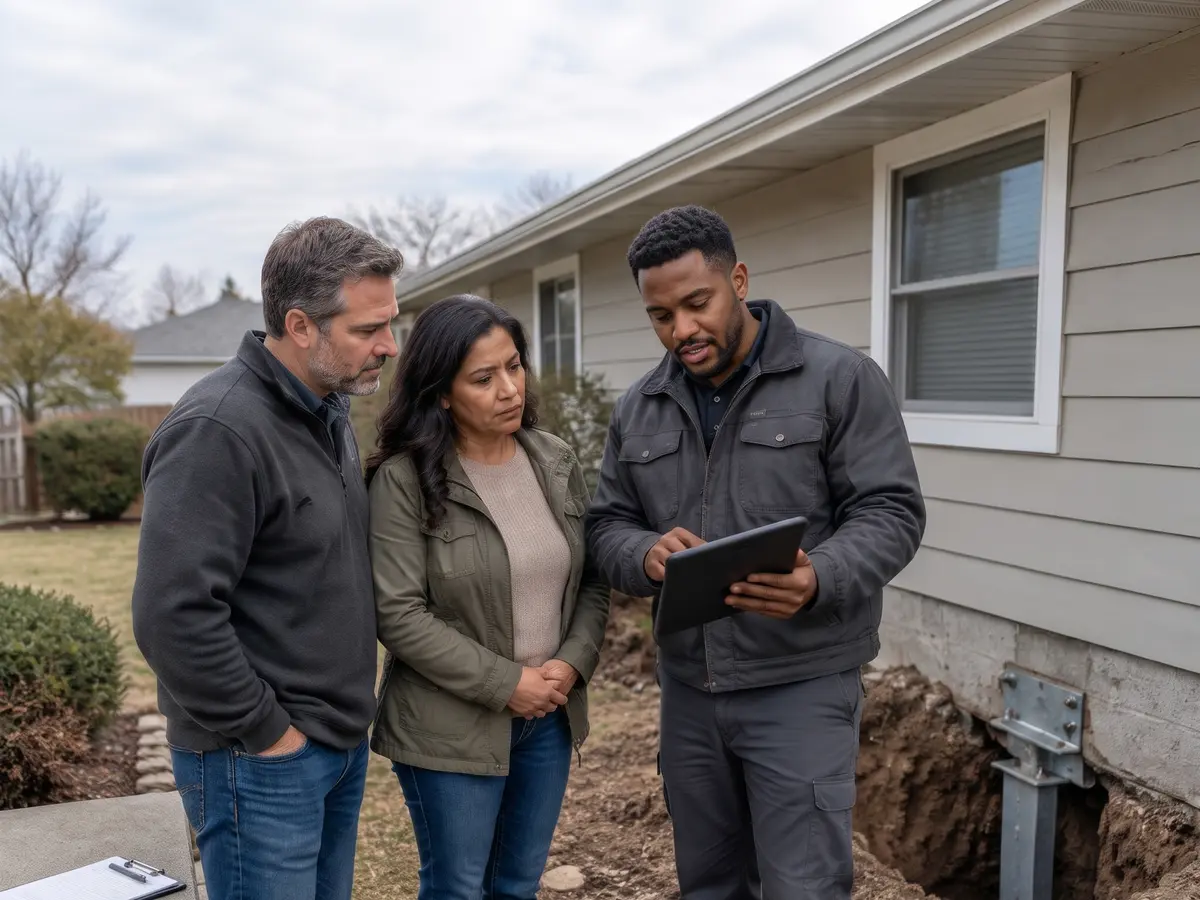
The buyer’s lender sets the deadline
The buyer’s inspection found settling and closing is in 30 days. What now?
Start with what the buyer’s lender needs: Fannie Mae wants the settlement corrected or a professional report that it isn’t structural, and FHA treats continuing settlement as a defect. A seller credit can only cover closing costs, so it won’t pay for the repair. Each lender decides on its own timeline, so no approval is guaranteed before closing.
- Hand the buyer the engineer’s letter, the permit sign-off and the warranty paperwork.
- Warranty transfers often must happen within 10 to 90 days of closing, for a fee.
- In Texas, the seller’s disclosure asks about previous structural repairs.
Sources: Fannie Mae Selling Guide B4-1.3-06, property condition; HUD Handbook 4000.1 II.D.3 (defective conditions); Fannie Mae Selling Guide B3-4.1-02, interested party contributions; Texas Real Estate Commission seller’s disclosure (OP-H).
Foundation repair costs, 2025–2026
Fixr (2025–2026); This Old House (2026)
| Job | Typical cost | Programs that often fit |
|---|---|---|
| Engineer’s evaluation | $300–$1,000 | Cash |
| Crawl space encapsulation | $1,500–$15,000 | CashInstallment |
| Slab lifting | $500–$1,900 | CashInstallment |
| Steel push pier, each | $1,000–$3,000 | Installment |
| Helical pier, each | $1,750–$2,700 | Installment |
| Typical pier job (6–12 piers) | $8,000–$30,000 | Installment |
| Wall bracing | $4,000–$12,000 | Installment |
| House leveling | $20,000–$30,000 | InstallmentHome equity |
What does foundation repair cost in 2026?
The $5,200 average many guides quote blends crack sealing with pier work. Steel push piers run about $1,000 to $3,000 each and helical piers $1,750 to $2,700, so a typical job of 6 to 12 piers with engineering and build-back comes to $8,000 to $30,000. Quote the real pier count.
- An engineer’s evaluation averages about $600, usually $300 to $1,000.
- Fixr notes slab lifting isn’t permanent without fixing the underlying cause.
- Show the pier count and spacing on the estimate the lender sees.
- Fixr prices a whole underpinning job at $10,000 to $40,000.
Sources: Fixr, foundation repair cost (January 2026); This Old House, foundation repair cost (October 2026); This Old House, foundation inspection cost (October 2026); This Old House, crawl space encapsulation cost (March 2026); Acculevel, helical pier pricing (2026).
Priya Shah
Example: $18,000 pier job, not covered by insurance
Prime installment loan
Lender 1
Promotional same-as-cash plan
Lender 2
Installment loan, 120 months
Lender 3
Offer received
120-month installment loan covering the whole repair
The homeowner reviews the terms on their own phone.
Will homeowners insurance pay for foundation repair?
Usually not. Standard policies exclude settling, cracking and earth movement, and cracks in a house that’s still standing aren’t covered. The exceptions are damage from a covered event, endorsements some insurers sell, Florida sinkhole coverage and earthquake policies. When insurance won’t pay, the homeowner can apply to finance the repair.
- Some Texas insurers sell a foundation and slab endorsement; standard policies don’t.
- Florida sinkhole claims pay as the work is done, and a contractor rebate is a felony.
- Connecticut’s crumbling-foundation fund pays up to $205,000 for eligible homes.
Sources: Homeowners 3 special form (HO 00 03 10 00), exclusions; Texas Department of Insurance, homeowners insurance guide (June 2026); Florida Statutes §627.706 and §627.707; Connecticut Foundation Solutions Indemnity Company, FAQs (2026).
Grace Okafor
Example: 10-pier stabilization
Engineer’s report, contract signed
You and the homeowner
Application approved
Lender
Piers set, house lifted
Your crew
Plumbing test, final inspection
Plumber and inspector
Paid to your business
Lender, on eligible programs
Next step
Homeowner confirms the repair is complete
When does a foundation company get paid on a financed job?
Usually at completion: most programs on the Ottri network pay your company once the homeowner confirms the work is done; some pay at signing. Some lifetime warranties depend on full payment and a passed plumbing test, so line up the final inspection, the sign-off and the warranty paperwork together.
- Beyond the down payment, California bars collecting ahead of the work, even from a lender.
- Most pier warranties cover the piered area, not the whole house; say so in writing.
- Texas and California treat selling a repair the house doesn’t need as deceptive.
Sources: California Business and Professions Code §7159.5; 16 CFR 239 (FTC guides on warranty advertising); 16 CFR 429 (FTC Cooling-Off Rule); Texas Business and Commerce Code §17.46; California Civil Code §1770(a)(15); City of Houston, foundation repair permits.
Foundation repair financing questions, answered.

How do foundation repair companies offer financing to customers?
With the written repair plan, once the pier count and price are set, so the homeowner can compare bids. With Ottri, your estimator sends one branded application under your company’s name; participating lenders review it in turn, and eligible programs pay your business directly. Ottri doesn’t charge your company anything.
Does homeowners insurance cover foundation repair?
Usually not. Standard homeowners policies exclude settling, cracking and earth movement, so most foundation repairs fall on the homeowner. The exceptions are damage from a covered event such as a burst pipe, a foundation endorsement some insurers sell, Florida sinkhole coverage and earthquake policies.
Do we need an engineer’s letter?
It depends on the city, the buyer’s lender and any insurance claim. Houston, for example, wants plans prepared by a Texas-licensed engineer before it permits pier work on a slab. An engineer’s evaluation averages about $600, usually $300 to $1,000, and buyers trust an independent one.
What does a lifetime transferable warranty cover?
Usually the piers you install and the area they support, against movement past a stated limit, for the life of the structure. Most exclude cosmetic damage, plumbing leaks and drainage, and must be transferred within 10 to 90 days of a sale, often for a fee. An ad that says lifetime should say whose life.
Florida sinkhole claim: how does payment work?
Repairs follow the insurer’s engineer, and the homeowner signs a repair contract within 90 days. The insurer pays as the work is done, can’t make the homeowner pay up front and can pay you directly with the lienholder’s approval. The sinkhole deductible is the homeowner’s, and a contractor rebate is a felony.
Can we offer 0% financing like the big foundation brands?
Only where a participating lender’s program includes one, and your company usually pays its fee: one 2019 rate sheet charged 13% for 24 months, about $2,340 on an $18,000 job. Many no-interest ads are deferred-interest plans that charge back the interest if the balance isn’t paid in time. Show the full terms in any ad, and quote one price, cash or financed.
Does the 3-day right to cancel apply to a pier job sold at the home?
Usually yes. A contract of $25 or more signed at the home can be canceled until midnight of the third business day, even when the homeowner called you; in California, a buyer 65 or older gets 5 business days. The emergency exception needs a dated waiver in the homeowner’s own handwriting and rarely fits settling, so schedule crews after the window closes.
What do I need to sign up?
Set up your account online, then add your EIN, insurance certificate, a contractor license where your state or city issues one, a sample repair contract, the owner’s ID and the account for deposits. Joining Ottri has no minimum; each lender reviews your business separately, decides which repairs it finances and sets its own requirements, such as time in business.
Who approves the financing and sends the funds?
A participating lender reviews the homeowner’s application and sets the terms, and on eligible programs it pays your company, most often once the repair is signed off. Ottri Global LLC is a licensed loan broker, NMLS 2776988, and is not a lender.
What if the first lender turns down a pier job?
The application goes on to the next eligible lender without the homeowner filling it out again, and that lender decides on its own; the homeowner sees whether it pulls a soft or hard credit report before it does. If no program approves the full repair, the homeowner can cover the difference another way; cutting piers to fit a loan is a decision for the engineer, not the lender.