Multi-lender basement finishing financing for contractors.
Customer financing for homeowners’ basements: a bath, a bedroom and an egress window often top $40,000. They apply once, under your name, and participating lenders consider it in turn. Ottri charges your business nothing.
Family rooms, baths and egress bedrooms.
Works beside the lender you already have.
On eligible programs, the lender pays you.
Never sold as a lead; branded as yours.
No setup fee · No subscription · No minimums to sign up

Banks and Lenders
20
Finance projects up to
$750K
Full credit coverage
300–850
One application. Eligible lenders, considered in sequence.
Ottri is a customer financing platform for basement finishing contractors: one branded application for the finish, baths, bedrooms with egress and wet bars, which participating lenders consider in turn. Ottri Global LLC is a licensed loan broker (NMLS 2776988), not a lender.
Basement promotions usually cost the contractor. Ottri costs you nothing.
On a job this size, a promotional plan’s dealer fee is real money. What it typically costs, next to Ottri.
−$3,040
A 12-month promo
On a $38,000 basement, a national lender’s 2019 rate sheet charged the contractor 7.99% for a year of same-as-cash, about $3,040, and 13% for two years, about $4,940.
$1,500+
A yearly platform fee
Subscription platforms charge $1,500 to $6,000 a year, in slow months and busy ones.
$0
Ottri never charges you
There’s nothing to join, no monthly fee and no share of the basement. On eligible programs the lender pays your company. Some lender promotions carry their own fee; offering one is your decision.
No setup fee · No subscription · No minimums to sign up
Promo costs: a national lender’s 2019 dealer-fee schedule (7.99% for 12 months same-as-cash, 13% for 24). Platform fees: published plan prices, July 2026.
Everything a basement contractor needs to offer financing.
Design and the office
Jobs run from one family room to a whole level with a bath, a bedroom and egress, inspected at each stage. Every application and payment, in one place.

Run financing from one dashboard
Every basement’s offers, funding status and next steps, from the design meeting to the final inspection.

Track every application
See which families applied after the layout review and which haven’t finished.

Track funded volume
Track funded basements by project manager and month.
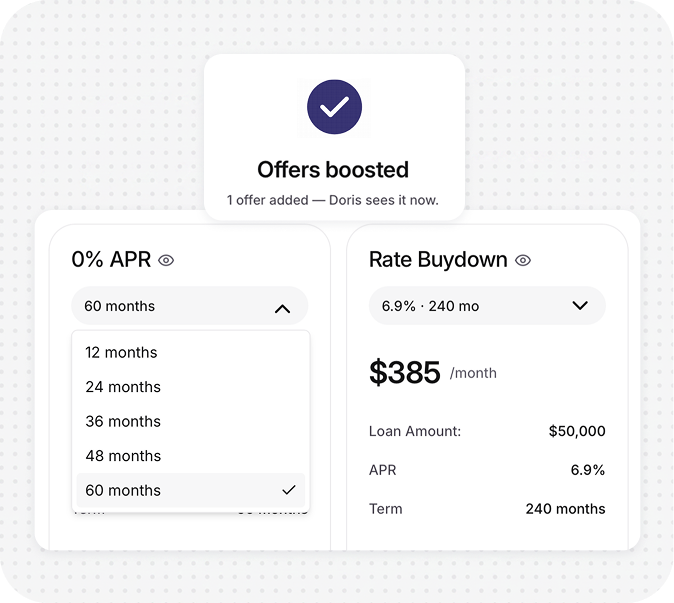
Manage supported promotions
Choose which lender promotions to show and check what each costs you before you propose it.
Designers and walkthroughs
Designers send it with the layout and price, or after the walkthrough. Owners see which designers turn layouts into financed basements.

Work from the field
Text the homeowner a link during the walkthrough, or print the QR code on the layout.

Measure tools and rep adoption
See which designers’ walkthroughs lead to finished applications.

Measure every entry point
Find out if homeowners start from the QR code on a layout, a text or your website.

Keep the experience branded
Every application carries your logo and colors, like your proposals do.
Once the layout and price are set, the homeowner applies under your brand from home.

One application, multiple programs
The finish, bath, egress and permits go on one application, which participating lenders review in turn.

Direct-to-business funding
Approved funds go to your company on eligible programs.

Links, QR codes, and messages
A QR code on the layout, a link texted after the walkthrough or one in your proposal.

Homeowner-friendly experience
Each offer’s full terms show on the homeowner’s phone, with time to talk it over before accepting.

Your business stays front and center
Your company’s name is on the application from layout to final inspection.

Available promotions
Before you include a lender’s promotion, see what it would cost your company.
Find stalled basements and designers who bring in applications.

See what’s holding a job
Find basements waiting on a document, an unsigned offer or the final walkthrough.
Keep follow-up in one place
Clear the lender’s open items before drywall goes up.
Keep crews scheduled
Tell the office which basements have financing in place before framing starts.
See what starts applications
Compare layout QR codes, texted links, proposal emails and website buttons by starts.
Compare designers
Find out which designers’ layouts become applications.
Improve distribution
Put the link on every layout, proposal email and your project gallery.
One decline shouldn’t shrink the basement. The network has 20 lenders. All in one place.
With
A disconnected process
The bath and bedroom cut to fit savings.
A lender says no, and the job waits a year.
A new design tool just to add a lender.
Promos sold without the full terms.
An egress window ordered inside the 3-day window.
With Ottri
The whole finish on one application.
Another eligible lender sees the application next.
A link on the layout, beside any financing you offer now.
The homeowner sees every term before accepting.
Order materials once the cancellation period ends.
What basement contractors ask before they offer financing.
Updated
Egress sized to code
When does a basement need an egress window?
Every bedroom needs one, and a basement needs at least one rescue opening; in an existing basement the model code requires it only for new sleeping rooms, though many cities want one anyway. The opening must clear 5.7 square feet, 24 inches high and 20 inches wide, with the sill no higher than 44 inches.
- A below-grade egress window runs $2,500 to $7,000 with the dig, well and permit.
- Wells must be at least 9 square feet, with a ladder once they’re deeper than 44 inches.
- A bedroom added after approval needs egress and a written change order.
Sources: International Residential Code 2021, R310 and R314–R315 (egress is R319 in the 2024 edition; as adopted locally); IRC 2021, R105.2 and R108.6 (permits); Fixr, egress window installation cost (August 2025); HomeGuide, egress window installation cost (June 2023); This Old House, egress window cost (October 2026).
Nora Fitzgerald
Example: $38,000 basement with radon and egress
Prime installment loan
Lender 1
Promotional same-as-cash plan
Lender 2
Installment loan, 144 months
Lender 3
Offer received
144-month installment loan for the finished basement
The homeowner reviews every term on their own phone.
What has to happen before a basement is finished?
Fix the water first: waterproofing typically runs $6,000 to $18,000. EPA says to test for radon before converting a basement and again after, and to fix levels at 4 pCi/L or higher. On the walls, put foam against the concrete and skip plastic behind the drywall; the code exempts basement walls from vapor retarders.
- A radon mitigation system typically costs $1,200 to $2,000.
- Under the 2021 code, living space needs a 7-foot ceiling, with beams and ducts down to 6 feet 4 inches.
- Foam on the walls needs a thermal barrier, usually half-inch drywall.
Sources: EPA, A Citizen’s Guide to Radon (2016); Building Science Corporation, Info 511: Basement Insulation (2008); International Residential Code 2021, R305 and R316.4 and R702.7 (ceiling and foam are R313 and R303.4 in 2024); HomeGuide, basement waterproofing cost (January 2026); HomeGuide, radon mitigation cost (February 2026).
Basement costs, sources 2024–2026
HomeGuide (2024–2026); Fixr (2025); Cost vs Value (2025)
| Job | Typical cost | Programs that often fit |
|---|---|---|
| Permits and inspections | $200–$2,000 | Cash |
| Radon mitigation | $1,200–$2,000 | CashInstallment |
| Egress window, below grade | $2,500–$7,000 | Installment |
| Half bath | $3,000–$10,000 | Installment |
| Full bath | $10,000–$25,000 | Installment |
| Open-plan finish, 600 to 1,000 sq ft | $18,000–$40,000 | Installment |
| Family room, office, half bath, egress (Ottri’s sum) | $34,000–$57,000 | Installment |
What does it cost to finish a basement in 2026?
Contractor finishes run about $25 to $65 a square foot. One guide prices a three-room finish of 700 to 800 square feet at $28,000 to $40,000; add a half bath and one egress window and a family room and office lands near $34,000 to $57,000. The $7 to $23 figure some guides print sits beside their own $32,000 average and fits partial finishes.
- A half bath adds $3,000 to $10,000; a full bath, $10,000 to $25,000.
- Producer prices rose 14.2% for softwood lumber and 1.4% for drywall in a year.
- Cost vs Value 2025 priced a 600 sq ft basement with a bar and bath at $52,012.
Sources: HomeGuide, basement remodel cost (February 2026); HomeGuide, cost to finish a basement (October 2024); HomeGuide, cost to add a bathroom (July 2025); Angi, cost to finish a basement (July 2026); Cost vs Value 2025, basement remodel; Fixr, basement remodeling cost (January 2025); Bureau of Labor Statistics Producer Price Index, September 2026: softwood lumber and gypsum products (series WPU137).
Erin Walsh
Example: family room, office, half bath and egress window
Application approved, permit issued
Lender and city
Egress cut, rough-in inspected
Your crew and inspector
Drywall, flooring and finish
Your crew
Final inspection, homeowner confirms
Inspector and homeowner
Paid to your business
Lender, on eligible programs
Next step
Homeowner confirms the finished basement is complete
How does a contractor get paid on a 4- to 16-week basement job?
Most network programs pay after the homeowner signs off on the basement, and some pay at signing, so schedule homeowner progress payments within your state’s deposit rules to carry rough-in, inspections and drywall. A bath or bedroom added after approval is a written change order; ask the lender whether it needs a new approval.
- Beyond the down payment, California bars collecting ahead of the work, even from a lender.
- Price the whole scope first; the largest builds can pass some programs’ limits.
- A wet bar is part of the house; a range plus a separate entrance can read as a second unit.
Sources: California Business and Professions Code §7159.5; California Civil Code §1689.6 (buyers 65 and older); 16 CFR 429 (FTC Cooling-Off Rule); 12 CFR 1026.23 (right of rescission); International Residential Code 2021, definition of dwelling unit; Fannie Mae Selling Guide B4-1.3-05 (June 2025).
Basement finishing financing questions, answered.

Should basement contractors offer financing, and how?
Yes, even for buyers with equity, as one more way to pay beside cash and savings; homeowners do look for finishers that offer financing. Present it with the design and price, then send one application for the whole finish, under your company’s name, once the layout is set. Participating lenders then consider it in turn, and your business pays Ottri nothing.
Can one application cover the egress window, bathroom and waterproofing?
Yes, when they’re one contracted job priced once and within each program’s limits. List the drainage, radon system, egress window, bath, finish and permits as separate lines. Test for radon and look for water before you price it; if demolition still turns up more work, put it on a signed change order and ask the lender whether the new amount needs its own approval.
Does a finished basement need a permit?
In most places, yes: framing, electrical, plumbing and ductwork aren’t exempt finish work, and work started without a permit can carry added fees. A permitted finish usually brings smoke and carbon monoxide alarms up to current code throughout the house, so price that in before the homeowner applies.
Will a finished basement count as square footage?
Not as above-grade living area. Fannie Mae has appraisers report any partly below-grade level separately from above-grade area and room count, whatever the quality of the finish. Resale value depends on the local market, so sell the room the family will use, not a payback.
Can we add a kitchen or a separate entrance?
A wet bar is a normal part of a finished basement. A range, a separate entrance and a lockable door together can make the space a second dwelling under local zoning, and that’s a different kind of project with its own rules. If the homeowner wants a rental unit, keep it off this application and check local rules first.
Our buyers have home equity. Why offer financing at all?
Because equity isn’t always usable. A recent purchase, a thin cushion or a bank’s minimum loan size can put a home-equity line out of reach, and some owners won’t borrow against the house. An unsecured installment loan needs no lien, appraisal or 3-business-day rescission before work starts. Buyers with a HELOC can still pay with it.
What happens when the first lender declines a basement finish?
Nobody retypes anything: the next eligible lender sees the same application, and before each lender’s step the screen says whether its credit check is soft or hard. Standards differ, so a later lender may say yes. If every one declines, the homeowner can finish the family room now and add the bath as a second job.
What do I need to sign up?
Sign up online, then add your EIN and company details, your contractor license, proof of insurance, a sample basement contract, the owner’s ID and the bank account for deposits. Ottri sets no minimum to join, and each lender reviews your business under its own criteria, such as time in business.
Who approves the financing and sends the funds?
The approving lender sets the terms and, on eligible programs, pays your company directly; most programs pay after the job is complete, and some pay at signing. Ottri Global LLC is a licensed loan broker, NMLS 2776988, and is not a lender.
Does the 3-day cancellation right apply if the homeowner called us?
Yes. A sale of $25 or more made at the home carries 3 business days to cancel under the federal rule, even when the homeowner invited you, and California gives buyers 65 and older 5. Order the egress window, cabinets and materials after that window closes, and don’t start cutting the foundation.