Multi-lender remodeling financing for contractors.
A $60,000 remodel shouldn’t stall on one lender’s no. One branded application goes to participating lenders in turn, and Ottri charges your business nothing.
Send it at the design meeting or with the signed scope.
Keep your client’s bank or HELOC. Add Ottri for the rest.
Lenders pay your business on eligible programs.
Your brand throughout; applications never sold as leads.
No setup fee · No subscription · No demo · No minimums

Banks and Lenders
20
Finance projects up to
$750K
Full credit coverage
300–850
One application. Eligible lenders, considered in sequence.
Ottri is a financing platform for remodelers, general contractors and design-build firms: one branded application that participating lenders consider in turn. Ottri Global LLC is a licensed loan broker (NMLS 2776988), not a lender.
Financing a remodel usually costs the contractor. Ottri doesn’t.
What remodelers typically give up to offer financing, next to what Ottri charges.
−$4,800
A cut of a promo remodel
On a $60,000 remodel with 12 months same-as-cash, a published 2019 lender fee of 7.99% takes about $4,800 off your margin.
$1,500+
A subscription every year
Some financing platforms charge remodelers $1,500 to $6,000 a year, whether or not a job gets financed.
$0
Ottri never charges you
No sign-up fee, no subscription and no percentage of the job. On eligible programs the lender pays your business, not the client, so the money lands where the work was done. Promotional plans can carry a lender fee; offering them is up to you.
No setup fee · No subscription · No demo · No minimums
Dealer fees: published lender schedules (Goodman and EGIA, 2015: 6.25% on 12 months no interest; a 2019 national lender schedule: 7.99% on 12 months same-as-cash). Platform fees: published plan prices, July 2026.
Everything a remodeling company needs to sell with financing.
Contractor operations
Remodels run for months and change along the way. Keep every application, offer and funding step in one place from the design meeting to the punch list.

Run financing from one dashboard
Every remodel’s application, offer and funding status in one place, for every project lead and office.

Track every application
See where each client’s application stands while your team finalizes the scope, selections and permits.

Track funded volume
Track funded remodels by project lead, office and month, and see which leads close with financing.
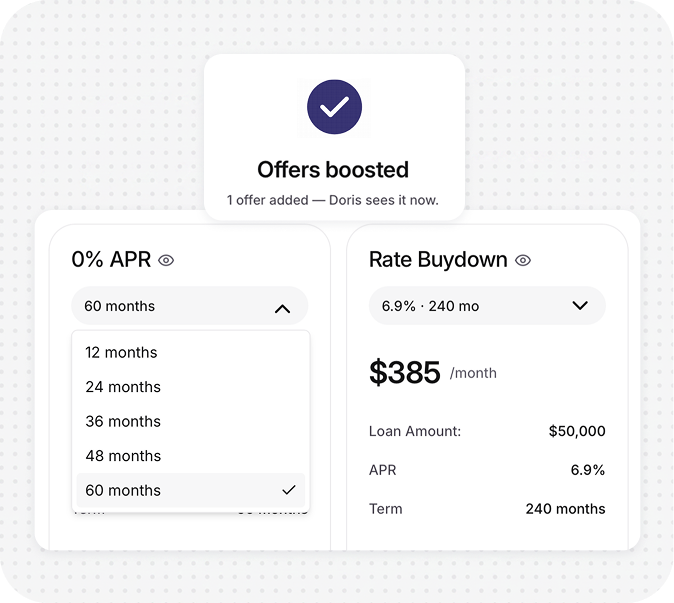
Manage supported promotions
Set up the promotions your lender programs support and see how each changes the client’s monthly options.
Design meetings and project leads
Project leads send the application at the design meeting or with the signed scope. Owners see which leads and channels turn designs into financed jobs.

Work from the field
Share a link or QR code at the design meeting, on the walkthrough or by text with the final scope.

Measure tools and rep adoption
Compare starts and completions by project lead, office, link, QR code and website button.

Measure every entry point
See which entry points bring applications: proposal QR codes, estimate emails and your website button.

Keep the experience branded
Your logo, colors and contact on every screen, so the client knows the financing comes through you.
Clients apply on their own device, under your brand, once the scope is set.

One application, multiple programs
Clients apply once, with the scope and price in front of them, and participating lenders consider it one after another.

Direct-to-business funding
On eligible programs the lender pays your business, not the client.

Links, QR codes, and messages
A link in the proposal, a QR code on the estimate or a text after the walkthrough.

Homeowner-friendly experience
Clients see each offer’s terms on their own phone before they accept, and take the time a big decision needs.

Your business stays front and center
The financing reads as part of your remodel, from the first estimate to the final walkthrough.

Available promotions
Offer a lender’s promotional plan where one exists, knowing what it costs your business first.
See which remodels need action and which tools start applications.

See what needs action
Spot applications waiting on a document, a signature or the client’s completion confirmation.
Keep follow-up in one place
Open the application, see what’s holding it and pick up where the project lead left off.
Keep remodels moving
Give project leads and the office clear next steps without asking clients to manage the financing.
See what starts applications
Compare starts from proposal QR codes, scope emails, website buttons and texts.
See where applications stall
See where applications stop between the design meeting and the signed scope, by lead and office.
Improve distribution
Put links where clients start applications: the proposal, the scope email and your website.
One lender’s no stalls the job. A network of 20 keeps it moving. All in one place.
With
A disconnected process
One lender says no, and the remodel stalls.
A cut of every promotional job, taken from the margin.
Clients sent to the bank and gone for weeks.
The office tracks funding in spreadsheets.
A different lender portal for every job.
With Ottri
Declines move to the next eligible lender, same application.
No Ottri fee anywhere in the job.
Clients apply under your brand at the design meeting.
The office sees each remodel’s funding step.
Every application and offer in one dashboard.
What remodelers ask before they offer financing.
Updated
Mark Ellison
Example: main-floor remodel
Scope and price signed
You and the homeowner
Application approved
Lender
Change order signed before work
Homeowner
Remodel finished, walkthrough
Your crew
Paid to your business
Lender, on eligible programs
Next step
Homeowner confirms the remodel is complete
When does a remodeler get paid on a financed job?
It depends on how the job is financed: at completion, at milestones, or through escrowed draws on a renovation mortgage. On the Ottri network, most programs pay your business after the work is complete; some pay at signing or in stages. Check each program’s conditions, then set deposits within your state’s limits.
- California caps the down payment at $1,000 or 10%, then bars payment ahead of the work, even from a lender.
- In California, a change order binds only if it’s signed before the work.
- Keep a contingency outside the financed amount for what’s behind the walls.
- The dashboard shows each job’s next funding step.
Sources: California Business and Professions Code §7159.5 (payments) and §7159 (change orders).
Ana Ruiz
Example: $80,000 whole-floor remodel
Prime installment loan
Lender 1
Promotional installment plan
Lender 2
Installment loan, longer term
Lender 3
Offer received
Installment loan, longer term, in the same application
Lender 3 sets the term and confirms the amount against your scope.
What happens when a remodel is bigger than one lender will lend?
The application keeps moving. Each lender sets its own maximum, and most unsecured programs stop at or below about $100,000, so a decline can be about the amount, not the client. The same application goes to the next eligible lender. Past unsecured limits, most clients add savings or their own home-equity line, so plan the split before you quote.
- Owners spending $50,000 or more made up 44% of 2023 improvement spending.
- 17% of 2025 renovators spent more than $100,000.
- Home-equity credit adds a 3-business-day right to cancel before work starts.
- Each lender confirms the amount against your scope.
Sources: Harvard Joint Center for Housing Studies, Improving America’s Housing 2025; Houzz & Home Study 2026: Renovation Trends. 12 CFR 1026.23 (Regulation Z rescission); unsecured caps from published lender terms, e.g. LightStream home improvement loans ($5,000–$100,000).
What usually pays, by job size
Harvard JCHS (2025); Houzz (2026)
| Job size | What the data shows | Programs that often fit |
|---|---|---|
| Under $10,000 | 3.9% home equity | CashInstallment |
| $10,000–$50,000 | 11.7% home equity | Installment |
| $50,000 and up | 19.7% home equity | InstallmentHome equity |
| Over $100,000 | Past most unsecured caps | Home equity |
| Whole-home gut | Savings plus home equity | CashHome equity |
Which kind of financing fits which remodel?
Savings pay for most remodels at every size, and home equity grows with the job: it was the main source of funds for 3.9% of projects under $10,000, 11.7% from $10,000 to $50,000 and 19.7% above $50,000. Installment loans fit in between, usually up to about $100,000. Match the product to the scope before you quote.
- Among 2025 renovations of $50,000 to $200,000, 81% used savings and 23% a secured home loan.
- Most unsecured installment loans stop at or below about $100,000.
- Each lender sets its own maximum and confirms it against your estimate.
Sources: Harvard JCHS, Improving America’s Housing 2025: main source of funds by project size (2023 American Housing Survey). Houzz & Home Study 2026: payment methods for 2025 renovations of $50,000–$200,000.

Renovation loans: know the limits
Should we take FHA 203(k) or HomeStyle jobs?
Know their limits first. The Limited 203(k) tops out at $75,000 and can’t be used for major remodeling: work over nine months, more than four draws per contractor, plans or a 203(k) consultant, or the family out of the home over 30 days. Standard 203(k) and HomeStyle loans cover bigger jobs, with more paperwork and inspected draws.
- 203(k) purchase-and-rehab loans were 0.5% of FHA purchase loans in fiscal 2025.
- Renovation mortgages pay in draws, on the lender’s schedule.
- For jobs under about $100,000, an installment application avoids a mortgage closing.
- Pages still citing a $35,000 Limited 203(k) cap are out of date.
Sources: HUD Mortgagee Letter 2024-13 ($75,000 Limited 203(k)) and 2026-06 (203(k) program changes); FHA production report, May 2026. Fannie Mae Selling Guide B5-3.2-02, HomeStyle Renovation.
Remodeling financing questions, answered.

How do general contractors and remodelers offer financing to customers?
Remodelers offer financing once the scope and price are settled, so the client can apply with a lender and pay for the job over time. With Ottri, your project lead shares one branded application by link, QR code or text, and participating lenders review it one after another. On eligible programs the lender pays your business, and Ottri takes nothing. Big jobs are where it matters: owners spending $50,000 or more made up 44% of 2023 improvement spending.
What does Ottri cost a remodeling company? Do lenders charge dealer fees?
Nothing from Ottri: no sign-up fee, no subscription and no percentage of the job. Promotional plans such as 12 months same-as-cash can carry a lender fee; a published 2019 lender schedule put it at 7.99%, about $4,800 on a $60,000 remodel. Offering them is your choice.
Do lenders pay in draws during a long remodel?
Usually not. Most programs on the Ottri network pay your business after the client confirms the job is complete; some pay at signing or in stages, and each program’s funding conditions show in Ottri. Plan deposits and progress payments within your state’s limits. Lender-run draw schedules come with renovation mortgages, such as a 203(k) or HomeStyle loan, which the client arranges through that lender.
What if the client wants to use their own HELOC or a 203(k)?
Let them. Offer the branded application as one option next to cash, a HELOC or a renovation loan. A home-equity line takes longer to close and carries a 3-business-day right to cancel; a Limited 203(k) tops out at $75,000 and isn’t for major remodeling. If the client goes that way, follow that lender’s draw schedule.
How do change orders work after approval?
Write the change order and get it signed before the work, as California requires, then update the estimate. The lender decides whether the existing approval covers the new amount or needs another review. Keep a contingency outside the financed amount for what turns up behind the walls.
What happens if the client is declined on a big remodel?
The same application goes to the next eligible lender, and the client doesn’t start over. On a large remodel a decline can be about the amount, not the client, since each lender sets its own maximum. If no lender covers the full scope, the client can add savings or their own home-equity line, or you can phase the work.
When should the client apply during a long design process?
When the construction scope and price are firm, because each lender checks the amount against your estimate, and an approval sent too early can expire before work starts. Ask how the client plans to pay at the first budget meeting, present financing next to cash and home equity, then send the application with the final estimate.
What do I need to sign up?
Create the account online and add your company details and EIN, your contractor license, insurance certificates, a sample client contract, the owner’s ID and the account where lenders deposit funds. There are no minimums to sign up, and each lender reviews your company against its own requirements.
Who approves the financing and sends the funds?
Each participating lender reviews the application, decides on its own and sets the terms; on eligible programs it pays your company directly. Ottri Global LLC is a licensed loan broker, NMLS 2776988, and is not a lender.
Should a remodel cost more when the client finances it?
No. Give one price whether the client pays cash or finances. Building a financing cost only into financed clients’ prices can count as a hidden finance charge under federal lending law. There’s no Ottri fee to cover, and on promotions, follow each lender program’s disclosure rules.