Multi-lender addition and ADU financing for contractors.
Conversions, bump-outs and room additions often fit an installment loan; most detached ADUs need home equity instead. Ottri passes one branded application to participating lenders in turn and charges you nothing.
Conversions, bump-outs and additions up to about $100,000.
Little equity? Installment loans don’t need it.
Already offer financing? Add Ottri for the declines.
Your brand on the application; never sold as leads.
No setup fee · No subscription · No minimums to sign up

Banks and Lenders
20
Finance projects up to
$750K
Full credit coverage
300–850
One application. Eligible lenders, considered in sequence.
Ottri is a customer financing platform for home addition and ADU builders: one branded application for conversions, bump-outs and room additions, which participating lenders consider in turn. Ottri Global LLC is a licensed loan broker (NMLS 2776988), not a lender.
Addition promotions come out of the builder’s margin. Ottri costs you nothing.
What addition builders typically give up in dealer fees to offer promotional financing, next to what Ottri charges.
−$5,600
A 12-month promo
On a $70,000 garage conversion, a 2019 national lender rate sheet charged a 7.99% fee for 12 months same-as-cash, about $5,600, and 13% for 24 months, about $9,100.
$1,500+
A yearly platform fee
Financing subscriptions bill $1,500 to $6,000 a year, whether you build two additions or twenty.
$0
Ottri never charges you
Free to sign up, no monthly charge and no cut of the build. On eligible programs the lender pays your company, not the homeowner. A lender’s promotional plans may carry their own fee, and offering them is your decision.
No setup fee · No subscription · No minimums to sign up
Promo costs: a national lender’s 2019 rate sheet (12 months same-as-cash at 7.99%, 24 months at 13%). Platform fees: published plan prices, July 2026.
Everything an addition builder needs to run a financing program.
Long builds
Additions run from a quick bump-out to ADUs that wait months on plans, permits and inspections. One place holds every application and funding step.

Run financing from one dashboard
Each build’s application, offer and funding status together, from the signed proposal to the last inspection.

Track every application
See which homeowners have applied since the proposal went out and which still have steps left.

Track funded volume
Track funded additions by estimator and month.
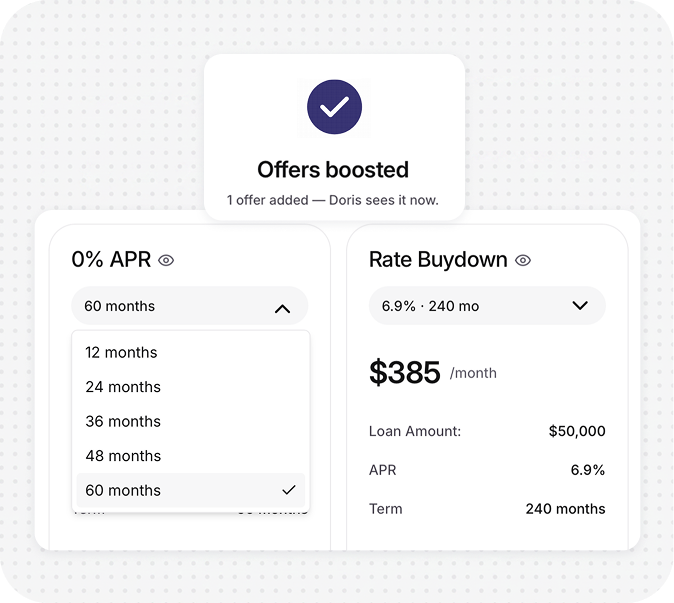
Manage supported promotions
Choose the plans your lender programs allow and see what each one costs before you put it in a proposal.
Design meetings and site visits
Builders send it with the final proposal, once plans and price are set. Owners see which estimators turn proposals into financed builds.

Work from the field
Send a link or QR code during the site visit, or include it with the proposal and plans.

Measure tools and rep adoption
Compare application starts and completions by estimator.

Measure every entry point
See whether applications start from emailed links, proposal QR codes or your website.

Keep the experience branded
The homeowner sees your logo and colors on the application, the same as on your proposal.
Homeowners apply on their own phone, under your name, once the plans and price are set.

One application, multiple programs
One application for the conversion or addition, reviewed by participating lenders one after another.

Direct-to-business funding
Approved funds go to your company on eligible programs.

Links, QR codes, and messages
A text after the site visit, a link in the plans email or a QR code on the proposal.

Homeowner-friendly experience
Homeowners see each offer’s full terms on their own phone and can take time to compare.

Your business stays front and center
Your company’s name on the application from the first proposal onward.

Available promotions
Where a lender runs a promotional plan, offer it once you know what it costs your company.
See which builds are waiting and which estimators start applications.

See what needs action
Find builds held up by a missing document, an unsigned offer or the homeowner’s final sign-off.
Keep follow-up in one place
Pull up the application, check what the lender is waiting for and clear it before the next inspection.
Keep builds on schedule
Show the office which additions have financing in place before framing crews are booked.
See what starts applications
Compare starts from plans emails, proposal QR codes, website buttons and texts.
Compare estimators
See which estimators’ proposals turn into applications and which stall.
Improve distribution
Put the link in the proposal, the plans email and your website’s project gallery.
One no shouldn’t shelve the addition. A 20-lender network helps. All in one place.
With
A disconnected process
The homeowner shelves the addition after one decline.
A big ADU quoted as if one loan covers it.
A yearly platform fee, funded or not.
A monthly payment quoted before the price.
Funding dates guessed from loans you didn’t arrange.
With Ottri
The application moves to the next eligible lender.
Home equity raised before a big ADU is quoted.
No Ottri fee on any addition.
The full price first, then every term.
Each financed build’s funding step in the dashboard.
What addition and ADU builders ask before they offer financing.
Updated
Addition and ADU cost ranges, 2025–2026
Fixr (2025–2026); This Old House (2026)
| Job | Typical cost | Programs that often fit |
|---|---|---|
| Bump-out | $4,000–$13,000 | CashInstallment |
| Add a bathroom | $10,000–$35,000 | Installment |
| Garage to living space | $9,659–$51,659 | Installment |
| Garage to ADU | $31,500–$73,200 | InstallmentHome equity |
| Room addition | $100–$300 per sq ft | InstallmentHome equity |
| Attached in-law suite | $60,000–$120,000 | InstallmentHome equity |
| Second story | $100,000–$300,000 | Home equity |
What does an addition or ADU cost in 2026?
It depends on size and whether the job needs a new foundation. A bump-out runs about $4,000 to $13,000, a garage conversion to an ADU $31,500 to $73,200, and a typical room addition $100 to $300 a square foot. New detached ADUs usually run well past $100,000, beyond what installment programs cover.
- Owners who added a room spent $27,131 on average in 2023; bedrooms, $17,607.
- Price design, engineering and permits in; design alone can run 10% to 17%.
- Quote the full price first, then the monthly option with every term.
Sources: Harvard JCHS, Improving America’s Housing 2025 (March 2025); Fixr, home addition cost (February 2025); Fixr, bathroom addition cost (January 2026); This Old House, garage conversion cost (June 2026).
Nina Alvarez
Example: $70,000 garage-to-ADU conversion
Prime installment loan
Lender 1
Promotional same-as-cash plan
Lender 2
Installment loan, 144 months
Lender 3
Offer received
Installment loan, 144 months, for the conversion
The homeowner reviews every term on their own phone.
Can a homeowner finance a $180,000 ADU through us?
Usually not with an installment loan. Unsecured programs generally stop near $100,000, so larger ADUs and second stories run on home equity, a renovation mortgage or a construction loan, often with savings, which the homeowner arranges directly. About a quarter of addition spending is home equity. Raise it before you quote, so the lender’s closing fits your schedule.
- Home-secured credit adds 3 business days to cancel before work can start.
- FHA 203(k) loans can add an attached ADU, not build a detached one.
- CalHFA’s $40,000 ADU grant has been fully allocated since December 2023.
Sources: 12 CFR 1026.23 (right of rescission); HUD Mortgagee Letter 2023-17 (ADU rental income); Freddie Mac ADU fact sheet (February 2026); CalHFA, ADU grant program.

Local code still decides the lot
Which rules decide whether and how fast an ADU gets built?
State law first, then local code. Nineteen states now have statewide ADU laws, most added since 2021. In California, cities must decide on a complete ADU application within 60 days or it’s deemed approved, and ADUs of 750 square feet or less pay no impact fees. Check the lot’s local rules before you design.
- California’s ADU law is now Gov. Code §§66310–66342, with fees in §66311.5.
- California permitted 30,354 ADUs in 2024, more than a quarter of all new homes.
- Washington’s urban areas must allow two ADUs per lot; Massachusetts, one by right.
- California cities can’t require the owner to live on site to approve an ADU.
Sources: Mercatus Center, statewide ADU laws (March 2026); West Virginia SB 659 (2026); California HCD, ADU Handbook (March 2026); California Government Code §§66311.5, 66315, 66317; RCW 36.70A.681; Massachusetts General Laws c. 40A §3.
Marcus Bell
Example: two-car garage converted to an ADU
Plans approved, permit issued
You and the city
Financing approved
Lender
Framing, plumbing, electrical
Your crew
Final inspection, homeowner confirms
Inspector and homeowner
Paid to your business
Lender, on eligible programs
Next step
Homeowner confirms the conversion is complete
It’s a six-month build. When does the builder get paid?
Usually at completion: most Ottri network programs pay your company once the homeowner signs off on the finished work; some pay at signing. Ottri doesn’t fund construction draws, so before you start, check that the offer can still fund when a long build ends, and tie any progress payments to work done.
- California treats ADUs as home improvement: $1,000 or 10% down, whichever is less.
- Beyond the down payment, California bars collecting ahead of the work, even from a lender.
- Plan check or soil surprises? Sign a written change order before the extra work.
- Standard 203(k) loans pay up to five inspected draws with a 10% holdback.
Sources: California Business and Professions Code §7159.5; CSLB, ADU payment rules; California Business and Professions Code §7159; HUD Mortgagee Letter 2026-06 (203(k) draws).
Home addition and ADU financing questions, answered.

Can homeowners finance an ADU through their builder?
Conversions and junior ADUs can fit: a garage-to-ADU conversion runs about $31,500 to $73,200. With Ottri, you send one application under your company’s name; participating lenders review it in order, and on eligible programs the lender pays your business. Not every lender program takes ADUs, and most new detached ADUs cost more and need home equity or a construction loan instead.
When does an addition need home equity instead of an unsecured loan?
Above about $100,000, or when the homeowner would rather borrow against the house. About a quarter of spending on additions is paid with home equity. Secured loans bring an appraisal, title work, closing disclosures and 3 business days to cancel before work can start.
Does home equity financing delay our start date?
Yes. No work or materials can start until the 3-business-day rescission period after closing ends, closed-end loans need disclosures 3 business days before closing, and Texas home equity loans add a 12-day wait. Build the lender’s closing into your schedule.
Does Ottri pay construction draws?
No. Each program sets its own funding conditions: most on the Ottri network pay after the homeowner confirms completion, and some pay at signing. Inspected draws come with renovation mortgages and construction loans, which the homeowner arranges directly. On a build that runs months, confirm the offer can still fund when you finish.
Can the homeowner count future ADU rent to qualify?
Only under some mortgage rules: FHA and Freddie Mac count at most 75% of the rent, capped at 30% of qualifying income, and neither counts it on a cash-out refinance. Don’t promise rental income or resale value.
Which states have statewide ADU laws in 2026?
Nineteen: California, Washington, Vermont, New Hampshire, Oregon, Utah, Connecticut, Maine, Rhode Island, Montana, Arizona, Colorado, Hawaii, Massachusetts, Arkansas, Iowa, Maryland, Nevada and, since June 2026, West Virginia. Within each state’s limits, local code still sets size, setbacks and parking lot by lot.
When should the homeowner apply: at the design meeting or closer to the permit?
Once the plans and price are firm, close to permit issue. An offer lasts only as long as its lender allows, and design, engineering and plan check can take months; California cities alone get 15 business days to call an ADU application complete and 60 days to act on it. If plan check changes the scope, ask the lender whether the amount can change.
What do I need to sign up?
Create your account online, then add your EIN and business details, your contractor license, an insurance certificate, a sample construction contract, the owner’s ID and your deposit account. There’s no minimum to join. Each lender reviews your business separately and sets its own requirements, such as time in business.
Who approves the financing and sends the funds?
The approving lender sets the amount, term and rate and, on eligible programs, pays your business directly. Home equity and renovation loans run separately, between the homeowner and that lender. Ottri Global LLC is a licensed loan broker, NMLS 2776988, and is not a lender.
What happens if the first lender declines a garage conversion?
The same application goes to the next eligible lender, which sets its own amount, term and credit standards, and the homeowner doesn’t start over. Before each review, the homeowner sees on screen whether that lender’s step is a soft or hard credit check. If no program approves the full price, the homeowner can pay the rest from savings as the work progresses, or choose a smaller scope.