Multi-lender kitchen remodeling financing for contractors.
A $40,000 kitchen shouldn’t stall on one lender’s no. One branded application goes to participating lenders in turn, and Ottri charges your business nothing.
Designers send it from the showroom or the design meeting.
Keep your current lender program. Add Ottri for the rest.
The lender pays your business on eligible programs.
Your brand on every screen. Never sold as leads.
No setup fee · No subscription · No demo · No minimums

Banks and Lenders
20
Finance projects up to
$750K
Full credit coverage
300–850
One application. Eligible lenders, considered in sequence.
Ottri is a financing platform for kitchen remodelers: one branded application that participating lenders consider one after another, so one decline doesn’t undo the design you just sold. Ottri Global LLC is a licensed loan broker (NMLS 2776988), not a lender.
Financing a kitchen usually costs you. Ottri doesn’t.
What kitchen remodelers typically pay to offer financing, next to what Ottri charges.
−$3,200
A cut of every promo kitchen
Promotional plans can cost you a slice of each job. On a $40,000 kitchen with 12 months same-as-cash, a published lender fee of about 8% comes to $3,200 of your money.
$2,000+
A yearly subscription
Some platforms bill $2,000 to $6,000 a year, even in months when no kitchen gets financed.
$0
Ottri never charges you
Nothing to sign up, nothing monthly and no percentage of your kitchens. On eligible programs, the lender pays straight into your business account, never the homeowner’s. A lender fee can apply to promotional plans, and whether to offer them is your call.
No setup fee · No subscription · No demo · No minimums
Dealer fees: published lender schedules (Goodman and EGIA, 2015: 6.25% on 12 months no interest; a 2019 national lender schedule: 7.99% on 12 months same-as-cash). Platform fees: published plan prices, July 2026.
Everything a kitchen remodeler needs to sell with financing.
Contractor operations
Cabinets, counters and appliances reach five figures fast. Track every application, offer and funding status from the design meeting to the walkthrough.

Run financing from one dashboard
Applications, offers, follow-up and funding status for every kitchen in one place, next to your production schedule.

Track every application
See where each homeowner’s application stands while your team finalizes selections, measurements and the estimate.

Track funded volume
Track funded kitchens over time by designer, showroom and month, and compare them with your own past months.
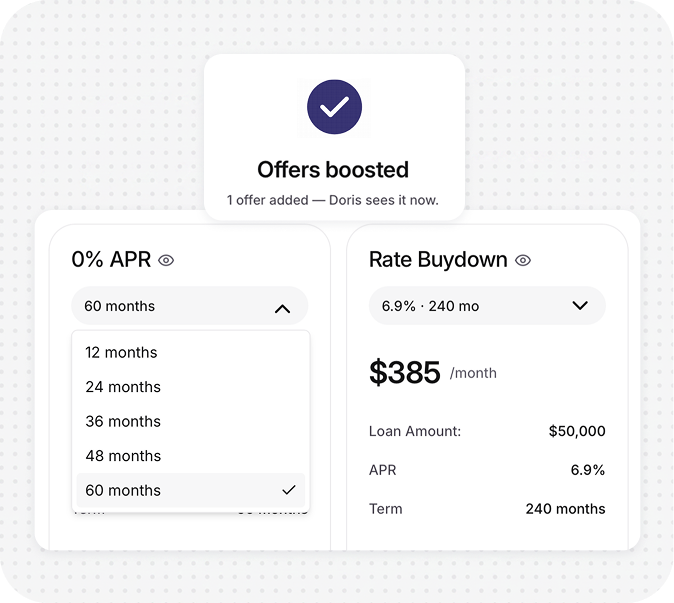
Manage supported promotions
Set up the promotions your lender programs support and see how each one changes the homeowner’s payment options.
Showrooms and design meetings
Designers send the application from the showroom, the design meeting or by text. Managers see which designers and channels turn plans into kitchens.

Work from the field
Share a link or QR code at the sample counter, during an in-home design visit or by text after the meeting.

Measure tools and rep adoption
See application starts and completions by designer, location, link, QR code and website button.

Measure every entry point
Compare starts from showroom QR codes, website buttons, follow-up texts and emails.

Keep the experience branded
Your logo, colors and contact stay on every screen the homeowner sees, from the application to funding.
Homeowners apply on their own device, under your brand, after the design meeting.

One application, multiple programs
Homeowners apply once, with the design and estimate in front of them, and participating lenders consider it in turn.

Direct-to-business funding
On eligible programs the lender pays your business, not the homeowner.

Links, QR codes, and messages
Send it at the sample counter or by text after the design meeting.

Homeowner-friendly experience
Homeowners review offers on their own phone and decide on their own schedule, with every term shown first.

Your business stays front and center
Your logo, colors and contact stay on every screen, so financing feels like part of your kitchen process.

Available promotions
Present a promotional plan where a lender program offers one, and know its cost before you do.
See which kitchens need action and which tools bring in applications.

See what needs action
Spot applications waiting on documents, a signature or a completion confirmation before the cabinets arrive.
Keep follow-up in one place
Open the application, see the blocker and pick up where the designer left off, from one shared pipeline.
Keep kitchens moving
Give designers and the office clear follow-up signals without asking homeowners to diagnose the financing.
What starts applications
Compare application starts from showroom QR codes, website buttons, texts and design-meeting links.
Compare designers
See which designers and showrooms get applications started and completed, and where they stall.
Improve distribution
Put QR codes and links where they earn applications: the sample counter, the quote and the follow-up email.
One lender, one chance. Twenty lenders, more ways to build the kitchen. All in one place.
With
A disconnected process
One lender says no and the $40,000 kitchen waits.
A cut of every promotional kitchen, priced into the job.
A different portal for every lender’s status.
The office chases designers for status.
Customers sent off to a lender’s own website.
With Ottri
Declines continue to the next eligible lender, with no new form.
Nothing from Ottri to build into the price.
Every kitchen’s application and next step in one dashboard.
The office sees what each kitchen needs next.
Your brand from the design meeting to funding.
What kitchen remodelers ask before they offer financing.
Updated
Maria Chen
Example: full kitchen remodel
Prime installment loan
First lender in sequence
Prime installment loan
Second lender
Near-prime installment loan
Third lender
Offer received
Near-prime installment loan, in the same application
Each lender sets its own rate, term and amount.
What happens when a $40,000 kitchen is declined?
The same application keeps going. Big kitchens are where one lender’s no costs the most: each lender has its own credit bar and maximum amount, and many point-of-sale programs cap unsecured loans around $55,000 to $100,000. A decline moves to the next eligible lender. If none approves, your dashboard shows it, and the homeowner can still pay cash or use a home-equity line.
- Full kitchen remodels run a median $46,000 under 250 sq ft and $75,000 above.
- Major kitchens were 23% of kitchen remodels in 2023 but 67% of the money spent.
- Home equity pays for about 15% of kitchen and bath spending, more on the biggest jobs.
- Every lender checks the amount against your estimate.
Sources: Houzz, 2026 U.S. Kitchen Trends Study: major remodel median $55,000; $46,000 under 250 sq ft and $75,000 above. Harvard Joint Center for Housing Studies, Improving America’s Housing 2025: Table A-1 and financing by project size.
Typical kitchen cost, 2025–2026
Census and HUD (2023); Houzz (2026); Cost vs Value (2025)
| Kitchen | Typical cost | Programs that often fit |
|---|---|---|
| Any project, incl. DIY | $8,000 median | CashInstallment |
| Minor remodel | $20,000 median | Installment |
| All 2025 remodels | $24,000 median | Installment |
| Minor midrange spec | About $28,500 | Installment |
| Full remodel, small | $46,000 median | InstallmentHome equity |
| Full remodel, large | $75,000 median | InstallmentHome equity |
| Major upscale spec | About $164,000 | Home equity |
What does a kitchen remodel cost in 2026?
It depends on which kitchen. Homeowners report a median of $8,000 because that figure includes DIY and small updates. Houzz puts all 2025 remodels at $24,000 and full replacements at $46,000 to $75,000, and Cost vs Value prices a midrange major remodel near $83,000. Quote the real scope, then finance that.
- Wood cabinet and countertop prices rose 5.4% and cut stone 8.0% over the past year.
- At resale, a minor midrange remodel recoups 112.9% of its cost; major remodels recoup 51% (midrange) and 36% (upscale).
- Programs across the Ottri network cover $1,000 to $750,000.
Sources: U.S. Census Bureau and HUD, 2023 American Housing Survey: Home Improvements (2024). Houzz & Home Study 2026: Renovation Trends; Zonda, Cost vs Value 2025. U.S. Bureau of Labor Statistics, Producer Price Index PCU337110337110 and PCU327991327991 (2026).
Priya Patel
Example: kitchen remodel
Design and price final
Designer
Application sent by text
Designer
Offer accepted, contract signed
Homeowner
Cabinets and counters installed
Your crew
Funds sent to your business
Lender (eligible programs)
Next step
Homeowner confirms the kitchen is complete
Will cabinet prices jump in 2027, and when do lenders pay?
For most imports, on the current schedule, yes. Imported kitchen cabinets and vanities have carried a 25% tariff since October 14, 2025, and the rate is set to rise to 50% on January 1, 2027. Put an expiry date on quotes, and check each lender’s funding conditions before you order: some pay at signing, many after the job is complete.
- The 50% step was moved from January 1, 2026 to January 1, 2027; trade-agreement countries such as the UK, EU and Japan have lower caps.
- Engineered quartz countertops picked up a safeguard tariff on August 15, 2026.
- California caps the down payment at $1,000 or 10%, whichever is less, with no special-order exception.
- Send the application with the final estimate; an early approval can expire mid-design.
Sources: Proclamation 10976 (90 FR 48127, October 6, 2025); Proclamation 11000 (91 FR 1039, January 9, 2026); Proclamation 11051 (91 FR 50645, quartz surface products). California Business and Professions Code §7159.5; planning and building times from the Houzz & Home Study 2026.

Showroom or home: different rules
Should a homeowner use home equity or an unsecured loan for a kitchen?
Mostly size and timing. Under about $50,000, an unsecured installment loan usually starts sooner. Bigger kitchens often fit home equity better, but it takes longer to close and adds a 3-business-day right to cancel before work starts. Where the contract is signed matters too: at the kitchen table, the federal 3-day cancellation rule applies.
- Home equity funds 3.9% of projects under $10,000, 11.7% at $10,000–$50,000 and 19.7% above.
- A showroom sale usually falls outside the federal rule, but Pennsylvania gives 3 days wherever it’s signed.
- California gives homeowners 65 and older 5 business days to cancel an in-home contract.
- Quote the same price whether the homeowner pays cash or finances.
Sources: 16 CFR Part 429 (FTC Cooling-Off Rule); 12 CFR 1026.23 (Regulation Z rescission). Pennsylvania Home Improvement Consumer Protection Act, 73 P.S. §517.7; financing shares from Harvard JCHS, Improving America’s Housing 2025.
Kitchen remodeling financing questions, answered.

How do kitchen remodelers offer financing to customers?
Kitchen remodelers make financing available when the design and price are settled, so the homeowner can apply with a lender and pay for the kitchen in monthly installments. With Ottri, your designer shares one branded application by text, link or QR code, and participating lenders review it one after another. On eligible programs the money goes straight to your business. Ottri takes nothing from your business, and every lender decides independently. Big kitchens are where it matters most: in 2023, major kitchen remodels averaged $48,010 and made up two-thirds of all kitchen remodeling dollars.
What does Ottri cost a kitchen remodeler, and what about dealer fees?
Nothing. There’s no sign-up fee, no monthly bill and no percentage taken from your kitchens. Promotional plans, like 12 months same-as-cash, can come with a lender fee, and offering them is your call. Published lender schedules show about 6–8% on 12-month same-as-cash plans and more on longer 0% plans: $2,400 to $3,200 or more on a $40,000 kitchen.
Most of our clients pay cash or use their own HELOC. Why offer financing?
Offer it as a choice next to the cash price, not a replacement. Big kitchens are often paid several ways: among 2025 renovations of $50,000 to $200,000, 81% used savings and 23% also used a secured home loan. A monthly option lets a client keep savings for overruns or choose the cabinets they actually want, and you quote one price either way.
When should we send the application during a long design process?
When the scope and price are firm. Kitchens take about 9.5 months to plan and 5.8 months to build on average, and an approval sent too early can expire before the design is done. Bring up financing at the first price conversation, then send the application with the final estimate.
Can cabinets, countertops, appliances and installation go on one application?
Usually, when the lender program accepts the scope. List cabinets, countertops, labor and related work on the estimate. Some programs limit appliances or materials sold without installation, and each lender confirms the amount on your estimate.
How do we handle cabinet deposits before the lender pays?
Check the lender’s funding conditions before you order. Some programs pay at signing and many pay after the homeowner confirms the job is complete, so don’t order custom cabinets on an approval alone. State law also limits deposits: California allows no more than $1,000 or 10% of the price, whichever is less, with no exception for special-order materials.
What if the homeowner changes the design after approval?
Update the estimate and check with the lender before treating the new amount as covered. A countertop upgrade or a new layout can change the amount, and the lender decides whether the existing approval stretches or needs a new review. Keep a contingency outside the financed amount for what turns up behind the walls.
What do I need to sign up?
Sign up online, then add your business details and EIN, your contractor license, insurance, a sample kitchen contract, owner ID and the bank account where lenders pay you. There are no minimums to sign up, and each lender reviews your business on its own terms before you send applications.
Who approves the financing and sends the funds?
Each participating lender makes its own credit decision and sets the terms. On eligible programs the money goes straight to your business, so you don’t have to chase the homeowner for a final payment. Ottri Global LLC is a licensed loan broker, NMLS 2776988, and is not a lender.
Will kitchen cabinets cost more in 2027?
For most imports, the schedule says yes. Imported kitchen cabinets and vanities have carried a 25% tariff since October 14, 2025, and it is set to rise to 50% on January 1, 2027; goods from countries with trade agreements, such as the UK, the EU and Japan, have lower caps. Put an expiry date on quotes, keep one price for cash and financed customers, and check each lender’s funding conditions before you order.