Multi-lender flooring financing for contractors.
Keep your store card. When it declines a customer or approves less than the job, one branded application goes to participating lenders in turn, and Ottri charges your business nothing.
Showroom staff and in-home reps send the same application.
No buying group or mill program needed to sign up.
Paid to your business on eligible programs.
Your store’s name on the application; never sold as leads.
No setup fee · No subscription · No demo · No minimums
Banks and Lenders
20
Finance projects up to
$750K
Full credit coverage
300–850
One application. Eligible lenders, considered in sequence.
Ottri is a financing platform for flooring stores and installers: one branded application, sent from the showroom or the in-home measure, that participating lenders consider in turn. Ottri Global LLC is a licensed loan broker (NMLS 2776988), not a lender.
Promotional financing usually costs the store. Ottri doesn’t.
What flooring stores typically give up to offer promotional financing, next to what Ottri charges.
−$640
A 12-month promo
On an $8,000 flooring job, 12 months same-as-cash with no payments, at a published 2019 lender fee of 7.99%, costs the store about $640.
−$1,940
A 72-month 0% promo
On the same job, 25 to 72 equal payments at 0% have been quoted at 11.6% to 24.2% of the sale: about $930 to $1,940.
$0
Ottri never charges you
No sign-up fee, no subscription and no percentage of the job. On eligible programs the lender pays your store, not the customer. Promotional plans can carry a lender fee; offering them is up to you.
No setup fee · No subscription · No demo · No minimums
Promo costs: a national home-improvement lender’s 2019 rate sheet (12 months same-as-cash with no payments at 7.99%) and a home-specialty card rate sheet revised July 2024, as quoted in July 2026 (0% equal payments over 25–72 months at 11.6–24.2%).
Everything a flooring store needs to sell with financing.
Store and install operations
Flooring jobs start at the counter, get measured at home and install weeks later. Keep every application, offer and funding step in one place.

Run financing from one dashboard
Every flooring job’s application, offer and funding step in one place, from the measure to the install date.

Track every application
See which customers applied in the showroom and which are still deciding after the in-home measure.

Track funded volume
Track funded flooring jobs by salesperson, location and month.
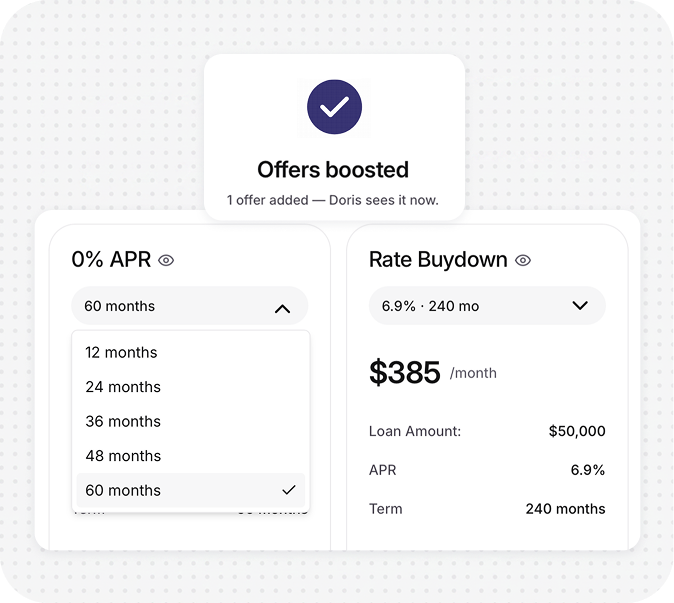
Manage supported promotions
Offer the installment plans your lender programs allow, and see each one’s monthly payment before you quote it.
Showroom and shop-at-home
Salespeople send it from the counter and shop-at-home reps from the living room. Owners see which people and locations turn quotes into financed jobs.

Work from the field
Shop-at-home reps share a link or QR code at the in-home measure, or text it with the estimate.

Measure tools and rep adoption
Compare application starts and completions by salesperson, shop-at-home rep and location.

Measure every entry point
See whether applications start from the counter QR code, the estimate email or your website.

Keep the experience branded
Your store’s logo and colors on the application, so financing feels like part of your quote.
Customers apply on their own phone, in your showroom or at home, under your name.

One application, multiple programs
The customer applies once, from the counter or the couch, and participating lenders take it in turn.

Direct-to-business funding
On eligible programs the lender pays your store, not the customer.

Links, QR codes, and messages
A QR code at the counter, a link in the estimate email or a text after the measure.

Homeowner-friendly experience
Customers see each decision privately on their own phone, so a decline is never announced at the counter.

Your business stays front and center
Your store’s name on the application, so customers know who they bought from.

Available promotions
Offer a lender’s promotional plan where one exists, knowing what it costs your store before you advertise it.
See which flooring jobs are stuck and who starts applications.

See what needs action
Spot jobs waiting on a document, the customer’s signature or their sign-off after install.
Keep follow-up in one place
Open the application, see what the lender still needs and call the customer once, not three times.
Keep flooring jobs moving
Show the install scheduler which jobs are approved and which are still waiting on the lender.
See what starts applications
Compare starts from counter QR codes, estimate emails, shop-at-home texts and your website.
Find stuck applications
See which applications stopped before the customer finished, by store and salesperson.
Improve distribution
Put the link at the counter, in the estimate email and on your website’s product pages.
One store card, one answer. A network of 20 keeps the sale moving. All in one place.
With
A disconnected process
The store card declines and the customer walks.
Approved for $1,500 on a $2,500 floor.
A promo fee on every long-term sale.
Declines announced at the counter.
Separate steps for showroom and in-home sales.
With Ottri
One application goes on to the next eligible lender.
Another lender can consider the full amount.
No Ottri fee on any job; promos are your choice.
Customers see decisions privately on their phone.
One application for the counter and the living room.
What flooring stores ask before they offer financing.
Updated
Grace Bennett
Example: LVP main floor, after a card decline
Prime installment loan
Lender 1
Promotional installment plan
Lender 2
Installment loan, 60 months
Lender 3
Offer received
Installment loan, 60 months, fixed payments
The customer reviews it on their own phone and decides.
What happens when the store card declines a customer?
The sale doesn’t have to end at the counter. Keep your store card for the customers it approves; when it declines or approves less than the job, the customer can fill out one Ottri application, and participating lenders consider it in sequence, each deciding on its own. Installment loans pay down on a fixed schedule instead of a revolving balance.
- New retail store cards averaged a 32.66% APR in December 2024.
- About one in five deferred-interest promotional balances was charged back interest.
- Ottri charges your store nothing when an application moves to the next lender.
- Each lender confirms the amount against your quote.
Sources: CFPB, The high cost of retail credit cards (December 2024), citing the CFPB’s research on deferred-interest promotions.

Cancel rights depend on where you sign
Does the 3-day right to cancel apply in the showroom or at the in-home measure?
It depends where the sale is made. The FTC’s Cooling-Off Rule covers sales of $25 or more made in the customer’s home, even when invited, but generally not a sale negotiated at your store. Give the cancellation notice with every contract signed in the home, check your state’s rules for showroom sales, and never ask a customer to waive it.
- Pennsylvania gives 3 business days on installed flooring over $500, wherever it’s signed.
- New York covers flooring but excludes carpet.
- Showroom signs and price tags with credit terms count as ads.
- Put “if paid in full” before the period, next to every “no interest.”
Sources: 16 CFR 429.0 (FTC Cooling-Off Rule definitions); New York General Business Law §770; Pennsylvania Home Improvement Consumer Protection Act, 73 P.S. §§517.2, 517.7. 12 CFR 1026.16 (Regulation Z advertising).
Installed cost per square foot, 2026
This Old House (2026); Fixr (2025); Ottri planning ranges
| Material or job | Installed cost | Programs that often fit |
|---|---|---|
| Carpet | $3–$11 per sq ft | CashInstallment |
| Luxury vinyl plank | $4–$12 per sq ft | CashInstallment |
| Laminate | $5–$14 per sq ft | CashInstallment |
| New hardwood | $6–$18 per sq ft | Installment |
| Tile | $8–$25 per sq ft | Installment |
| 1,500 sq ft of LVP | $6,000–$18,000 | Installment |
What does new flooring cost per square foot in 2026?
Installed planning ranges run about $3 to $11 a square foot for carpet, $4 to $12 for luxury vinyl plank, $5 to $14 for laminate, $6 to $18 for new hardwood and $8 to $25 for tile. A 200 square foot room runs $600 to $5,000 depending on the material; 1,500 square feet of vinyl plank, $6,000 to $18,000.
- As of October 2026, vinyl plank from China pays 42.8% in total duty; Vietnam, 17.8%.
- Wood flooring isn’t covered by the Section 232 lumber tariff.
- Hardwood flooring producer prices: up 46.7% since January 2020, 2.5% in the past year.
- Guides disagree because some include removal, subfloor and trim; compare like for like.
Sources: U.S. Census Bureau and HUD, 2023 American Housing Survey: Home Improvements; This Old House, hardwood flooring cost; This Old House, carpet installation cost; Fixr, vinyl plank flooring cost; Fixr, carpet installation cost. Harmonized Tariff Schedule of the United States, 2026 Revision 21, chapter 99 notes 20(f), 37(b) and 52; Bureau of Labor Statistics Producer Price Index, September 2026.
Tom Becker
Example: LVP, three bedrooms and hall
Measured, moisture tested
Your installer
Application approved
Lender
Change order signed for subfloor
Customer
Floor installed
Your crew
Paid to your business
Lender, on eligible programs
Next step
Customer confirms the floor is complete
When does a flooring store get paid on a financed job?
Usually after the floor is in. Most programs on the Ottri network pay your business once the customer confirms the job is complete; some pay at signing. In California, beyond a $1,000 or 10% down payment, you can’t take payment ahead of the work, even from a lender. Price the prep before you order material.
- Subfloor replacement runs about $3.50 to $12 a square foot; removal, $1 to $2.
- Vinyl and asphalt flooring installed by 1980 is presumed to contain asbestos: no sanding.
- Sanding floors in a pre-1978 home falls under the lead-safe rule unless it tests negative.
- The dashboard shows each job’s next funding step.
Sources: 29 CFR 1926.1101 (OSHA asbestos standard); 40 CFR 745.85 (EPA lead-safe work practices). California Business and Professions Code §7159 (change orders); subfloor and removal ranges from Fixr and This Old House (2025–2026).
Flooring financing questions, answered.
How can flooring businesses offer financing to customers?
Most flooring stores offer a store card through a manufacturer, buying group or bank, presented at the counter or the in-home measure. With Ottri, your staff shares one branded application by link, QR code or text; participating lenders consider it in turn, and on eligible programs the lender pays your business. Ottri charges nothing. Flooring is common work: owners reported 10.9 million flooring, paneling and ceiling-tile projects in 2021–2023, at a $3,000 median including DIY.
We already have a store card through our manufacturer or buying group. Why add Ottri?
Keep it for the customers it approves. Add Ottri for the ones it declines or approves for less than the job: the same customer fills out one application, and participating lenders consider it in sequence, each deciding on its own. Installment loans have fixed monthly payments instead of a revolving balance, and Ottri charges your store nothing.
Can Ottri be our second look when the store card approves less than the job?
The customer can still apply for the full amount through Ottri. Participating lenders consider the application one at a time, each against its own limits, so a short approval on one card doesn’t set the amount elsewhere. If no lender covers it, the customer can pay the difference another way, or you can phase the rooms.
What does Ottri cost a flooring store, and how does that compare with our card program?
Ottri charges your store nothing: no setup, subscription or per-job fee. Promotional plans usually cost the store a discount instead; published and quoted schedules from 2015 to 2024 put 6- to 12-month deferred-interest plans at roughly 4% to 8%, and 25- to 72-month 0% plans at about 12% to 24%. If your group or mill buys down your promotions, keep them. Some lender programs on Ottri, such as promotional plans, may carry a lender cost.
How do we bring up financing without offending the customer?
Make it part of every quote, for every customer: give one total price, then mention the monthly option and point to the QR code at the counter or the link in the estimate email. Quote cash and financed customers the same price. Nobody feels singled out, and each customer sees lender decisions privately on their own phone.
How do we advertise “no interest if paid in full” without breaking the rules?
Put “if paid in full” right before the promotional period, next to every “no interest” claim, and say interest is charged from the purchase date if the balance isn’t paid in time; minimum payments are still due. Showroom signs and price tags with credit terms count as ads under Regulation Z; a written estimate for one customer doesn’t.
Can customers finance a small job, like one bedroom of carpet?
Sometimes. Minimums vary by lender program, so a one-room job may fit one program and not another. The median flooring project ran $3,000 in 2021–2023, DIY included, and a 200 square foot room of carpet runs about $600 to $2,200 installed. For very small tickets, cash or a card may serve the customer better.
What do I need to sign up?
Sign up online and add your EIN and store details, your business or contractor license, proof of insurance, a sample customer contract, the owner’s ID and the bank account for deposits. There are no minimums to sign up. Each lender then reviews your store against its own requirements, such as time in business, so a newer store may start with fewer lenders.
Who approves the financing, and when do we get paid?
The participating lender reviews the application, makes the decision and sets the terms. On eligible programs it pays your store directly, usually after the customer confirms the floor is installed; some programs pay at signing. Ottri Global LLC is a licensed loan broker, NMLS 2776988, and is not a lender.
The subfloor was worse than we measured. Can the financed amount change?
Write a change order and have the customer sign it before the extra work, as California requires. Then ask the lender to review the new total, since each lender decides whether the approval covers it. Subfloor replacement runs about $3.50 to $12 a square foot, so test moisture and flatness and price the prep before you order material.