Multi-lender restoration financing for contractors.
The carrier decides the claim; the homeowner owes the rest. For upgrades, uncovered damage or a denied claim, Ottri sends one branded application to lenders in turn, free to your business.
Paid by the lender on eligible programs.
Their share of mitigation and rebuild.
Already offer financing? Add Ottri for the declines.
Your brand on the application; never sold as leads.
No setup fee · No subscription · No minimums to sign up

Banks and Lenders
20
Finance projects up to
$750K
Full credit coverage
300–850
One application. Eligible lenders, considered in sequence.
Ottri is a customer financing platform for restoration contractors, separate from business loans: one branded application for the homeowner’s share of a water, fire or mold job, which participating lenders consider in turn. Ottri Global LLC is a licensed loan broker (NMLS 2776988), not a lender.
Restoration promotions usually cost the contractor. Ottri costs you nothing.
Insurance work is usually priced off the carrier’s line items, so a dealer fee comes out of your margin. What promos typically cost, next to what Ottri charges.
−$760
A 12-month promo
On a $9,500 homeowner share, a 2019 national lender rate sheet charged 7.99% for 12 months same-as-cash, about $760, and 13% for 24 months, about $1,235.
$1,500+
A yearly platform fee
Platform subscriptions run $1,500 to $6,000 a year, before a single rebuild funds.
$0
Ottri never charges you
Nothing to join, nothing monthly and nothing taken from the job. On eligible programs the lender pays your company, not the homeowner. Lender programs such as promotional plans can carry their own fee; you decide whether to offer them.
No setup fee · No subscription · No minimums to sign up
Promo costs: a national lender’s 2019 rate sheet (12 months same-as-cash at 7.99%, 24 months at 13%). Platform fees: published plan prices, July 2026.
Everything a restoration company needs to run a financing program.
Claims and rebuilds
Restoration runs from emergency mitigation to rebuilds that wait on the carrier and the mortgage company. Keep each application and funding step in one place.

Run financing from one dashboard
Every job’s application, offer and funding step in one place, from the walkthrough to the final sign-off.

Track every application
See which homeowners started an application and which finished it.

Track funded volume
Track funded rebuilds by project manager and month.
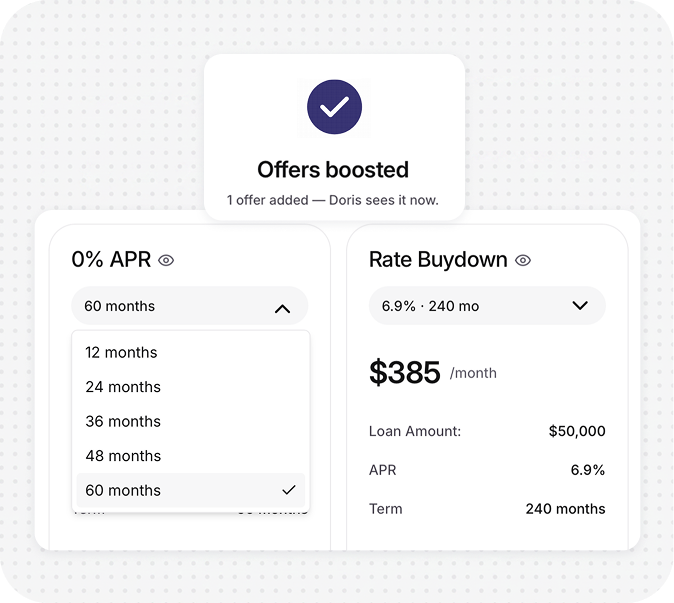
Manage supported promotions
Set up the promotions your lender programs allow and know each one’s cost to your company first.
Project managers in the field
Project managers send it at the walkthrough or with the rebuild estimate. Owners see which managers turn estimates into financed rebuilds.

Work from the field
Share a link or QR code at the walkthrough, or text it with the rebuild estimate.

Measure tools and rep adoption
Compare application starts and completions by project manager.

Measure every entry point
See whether applications start from estimate QR codes, texted links or your website.

Keep the experience branded
Your logo and colors on the application, so the homeowner knows it’s from your company.
Homeowners apply on their own phone, under your name, once their share is known.

One application, multiple programs
One application for the homeowner’s share of mitigation and rebuild, which participating lenders review in sequence.

Direct-to-business funding
On eligible programs, the lender pays your company, not the homeowner.

Links, QR codes, and messages
A link after the walkthrough, a QR code on the rebuild estimate or a text.

Homeowner-friendly experience
Before any credit check, the homeowner sees whether it’s soft or hard, and every offer’s terms before accepting.

Your business stays front and center
Your company’s name on the application, not an insurer’s or a lender’s.

Available promotions
Where a lender offers a promotion, know what it costs your company before you offer it.
See which rebuilds are waiting and which managers start applications.

See what needs action
Find rebuilds waiting on a document, an unsigned offer or the homeowner’s completion sign-off.
Keep follow-up in one place
Open the application, see what the lender still needs and settle it before the crew returns.
Keep rebuilds moving
Show the office which homeowner shares are approved before the rebuild crew is scheduled.
See what starts applications
Compare starts from estimate QR codes, follow-up texts, website buttons and emails.
Compare project managers
See which project managers get applications started and finished.
Improve distribution
Put the link on the rebuild estimate, in the follow-up text and on your website.
A denied claim shouldn’t end the rebuild. A 20-lender network helps. All in one place.
With
A disconnected process
The homeowner’s share stalls the rebuild.
A contractor quietly absorbs the deductible.
Platform fees billed whether jobs fund or not.
Claim talk mixed into the financing pitch.
A decline ends the job at mitigation.
With Ottri
One application for what the claim doesn’t cover.
The homeowner can finance their own share.
No Ottri fee on any restoration job.
Financing kept separate from the claim.
The application moves to the next eligible lender.
What restoration companies ask before they offer financing.
Updated
Water loss rebuild
Example$38,000
- Insurer’s first check$22,000
- Depreciation, paid later$6,500
- Deductible$2,000
- Upgrades$7,500
- Homeowner’s share$9,500
Amount to finance
$9,500
Where a participating program allows
What does insurance usually leave the homeowner to pay?
The deductible, plus anything the policy excludes or caps: gradual leaks, flood without flood coverage, mold past its limit, code work past the policy’s limits and upgrades beyond pre-loss condition. On a denied claim, the homeowner owes the whole job. Insurance paid 68% of owners’ disaster repairs in 2023; the rest came from savings, credit, home equity and other sources.
- Never pay, waive or rebate a deductible; Texas, Florida and many other states bar it.
- Texas counts a financing agreement for the full deductible as proof it was paid.
- Insured water claims averaged $15,400 and fire claims $88,170 (2019–2023).
Example: a $30,500 water claim with a $2,000 deductible, plus $7,500 of upgrades the homeowner chose. Sources: Harvard JCHS, Improving America’s Housing 2025 (March 2025); Insurance Information Institute, homeowners and renters insurance facts; Texas Insurance Code §707.004; Texas Business and Commerce Code §27.02; Florida Statutes §489.147; Texas Department of Insurance, water damage and mold coverage.

The rebuild contract has its own rules
Does the 3-day right to cancel apply to emergency restoration?
Usually yes, mitigation included, when the contract is signed at the home. In a genuine emergency the homeowner called you about, they can waive the 3 days in a dated statement in their own handwriting, never a printed form; the later rebuild contract keeps the right. California voids unsolicited disaster-repair contracts signed within 7 business days of a declared disaster.
- California caps repair price rises at 10% for 180 days after a declared emergency.
- Texas bars out-of-area disaster crews from requiring payment before work starts.
- Florida and New York license mold jobs over 10 sq ft, Texas from 25 contiguous sq ft.
- In Florida, Texas and New York, never assess and remediate the same mold job.
Sources: 16 CFR 429.0 (FTC Cooling-Off Rule definitions); California Civil Code §1689.14; California Penal Code §396; Texas Business and Commerce Code §58.003; Florida Statutes §468.8419; Texas Occupations Code ch. 1958; New York Labor Law art. 32.
Restoration cost ranges, 2025–2026
Fixr (2025)
| Job | Typical cost | Programs that often fit |
|---|---|---|
| Water mitigation, class 1–2 | $150–$1,000 | CashInstallment |
| Water mitigation, class 3 | $1,000–$3,000 | CashInstallment |
| Basement drying, no repairs | $2,000–$7,000 | CashInstallment |
| Class 4 or major sewage loss | $20,000–$100,000 | InstallmentHome equity |
| Mold, contained area | $1,500–$9,000 | CashInstallment |
| Fire and smoke cleanup | $3,000–$20,000 | Installment |
| Fire rebuild, per room | $15,000–$25,000 | Installment |
What do water, fire and mold restoration cost in 2026?
Water mitigation runs about $150 to $3,000 by damage class, and drying a flooded basement $2,000 to $7,000, while class 4 losses and major sewage backups reach $20,000 to $100,000. Mold remediation runs $1,500 to $9,000 for a contained area, and a fire rebuild $15,000 to $25,000 a room. Cost guides disagree by two to three times, so price the real scope.
- Financing covers the homeowner’s share, never a dispute with the carrier’s estimate.
- IICRC S500 and S520 are industry standards for water and mold work, not law.
- Quote one price for cash or financing, and never price around the deductible.
Sources: Fixr, water damage restoration cost (2025); Fixr, mold remediation cost (2025); Fixr, fire damage restoration cost (2025); IICRC standards.
Dana Whitfield
Example: kitchen rebuild after a water loss
Mitigation done, claim decided
Homeowner and insurer
Homeowner’s share approved
Lender
Cabinets and floors going in
Your crew
Completion confirmed
Homeowner
Paid to your business
Lender, on eligible programs
Next step
Homeowner confirms the rebuild is complete
When does a restoration company get paid on a financed job?
The financed share comes from the lender: most programs on the Ottri network pay your business after the homeowner confirms the job is complete; some pay at signing. The insured portion follows the claim, often actual cash value first and the rest after the work, with larger checks released by the mortgage company in draws.
- Fannie Mae servicers can release up to $40,000 or 33% first, then draws.
- Florida voids assignments of benefits on residential policies issued since 2023.
- Beyond the down payment, California bars collecting ahead of the work, even from a lender.
- Adjusting the claim takes a public adjuster license, and Texas bars adjusters from doing the repairs.
Sources: Fannie Mae Servicing Guide B-5-01, insured loss events (July 12, 2023); Florida Statutes §627.7152; Florida Statutes §627.7011; Louisiana R.S. 22:1275; California Business and Professions Code §7159.5; Texas Insurance Code §4102.163.
Restoration financing questions, answered.

How can restoration contractors offer financing to customers?
Restoration companies offer it for the share the homeowner owes, once your estimate and any claim decision are clear. With Ottri, your project manager sends one application under your company’s name; participating lenders review it in order, and on eligible programs the lender pays your business. Ottri charges your business nothing.
Can a homeowner finance their insurance deductible?
Where a program allows it, yes: the homeowner borrows the full deductible and repays it over time, and Texas lists that financing agreement as proof of payment. Programs on the Ottri network start at about $1,000, so a deductible alone fits fewer programs than the full share. Your company can never pay, waive, rebate or advertise to cover it, and a discount sized to the deductible can count as waiving it.
Can we take an assignment of benefits?
Not in Florida on residential policies issued since January 1, 2023, where post-loss assignments are void, or in Louisiana, whose law voids them too. Elsewhere the rules vary, and no assignment lets a contractor adjust or negotiate the claim. Bill the homeowner; their insurer reimburses them.
The mortgage company is on the claim check. When is the money released?
In stages. For Fannie Mae loans that are current, the servicer can first release up to the greatest of $40,000, 33% of the insurance proceeds or the amount above the loan balance, then the rest after inspections; loans 31 or more days late get 25% draws. Other investors set their own rules. The homeowner’s financed share sits outside those draws: on eligible programs, the lender pays your business directly.
Our franchise already has a financing program. Can we add Ottri?
Usually, yes. Many franchise locations choose their own lender, and your franchise agreement says whether yours can. Keep your current program for the homeowners it approves and the promotions it runs, and send the Ottri application when it declines or the amount is past its limit. Some agreements say which lender must see an application first, so check yours before you send.
Does insurance cover mold remediation, and who pays the rest?
Only when a sudden covered loss, such as a burst pipe, caused it. Mold from slow leaks, seepage or a flood is usually excluded, and many policies limit or leave out mold cleanup unless the owner added coverage. Where a participating program accepts the work, the homeowner can apply to finance what insurance won’t pay.
Can one application cover mitigation, the rebuild and upgrades?
Yes, as one amount for the homeowner’s share of both phases, including upgrades beyond pre-loss condition, when a participating program accepts the work. Show the phases on the estimate and keep the insured portion off the application. If demolition uncovers more damage, write a change order and ask the lender to review any new amount the homeowner owes.
What do I need to sign up?
Create your account online, then add your EIN and business details, your contractor or remediation license where your state requires one, an insurance certificate, a sample customer contract, the owner’s ID and your deposit account. There’s no minimum to join; each lender reviews your business and sets its own requirements, such as time in business.
Who approves the financing and sends the funds?
The lender that approves the homeowner sets the terms and, on eligible programs, pays your company directly, most often once the homeowner confirms the job is complete; the insurer pays the claim on its own track. Ottri Global LLC is a licensed loan broker, NMLS 2776988, and is not a lender.
What if the claim is denied and the first lender declines too?
Then the homeowner owes the whole job and can apply to finance it where a program accepts the work. The same application moves to the next eligible lender, which makes its own decision, so they don’t start over. If no one approves the full amount, phase the rebuild; never present financing as a way around the carrier’s decision.