Multi-lender basement waterproofing financing for contractors.
Insurance won’t pay to keep water out, so the homeowner does. They apply once under your brand and read each offer on their own phone. Ottri costs you nothing.
Drains, sumps, crawl spaces and cracks.
A decline goes to the next eligible lender.
On eligible programs, the lender pays your company.
Your brand on it; applications never sold as leads.
No setup fee · No subscription · No minimums to sign up
Banks and Lenders
20
Finance projects up to
$750K
Full credit coverage
300–850
One application. Eligible lenders, considered in sequence.
Ottri is a customer financing platform for basement waterproofing contractors: one branded application for interior drains, sumps, crawl space encapsulation and crack repair, which participating lenders consider in turn. Ottri Global LLC is a licensed loan broker (NMLS 2776988), not a lender.
Waterproofing promotions usually cost the contractor. Ottri costs you nothing.
A promotional plan’s dealer fee comes out of the job’s margin. What it typically costs, next to Ottri.
−$860
A 12-month promo
A national lender’s 2019 rate sheet charged the contractor 7.99% of the loan for a year of same-as-cash: about $860 on a $10,800 drain and sump job.
$1,500+
A yearly platform fee
Subscription platforms bill $1,500 to $6,000 a year, dry season or wet.
$0
Ottri never charges you
There’s no fee to join, nothing monthly and no share of the job. On eligible programs the lender pays your company. A lender’s promotional plans can carry a fee of their own; offering one is your choice.
No setup fee · No subscription · No minimums to sign up
Promo costs: a national lender’s 2019 rate sheet, which priced a year of same-as-cash at 7.99% of the loan and two years at 13%. Platform fees: published plan prices, July 2026.
Everything a waterproofing contractor needs to offer financing.
Inspections and the office
Jobs run from a crack injection to a full interior drain with a sump and battery backup, most done in days. Every application and payment, in one place.

Run financing from one dashboard
Each job’s offers, open items and funding status, from the inspection to the final walkthrough.

Track every application
Catch homeowners who began applying after the inspection and stopped before the end.

Track funded volume
Track funded jobs by inspector and month.
Manage supported promotions
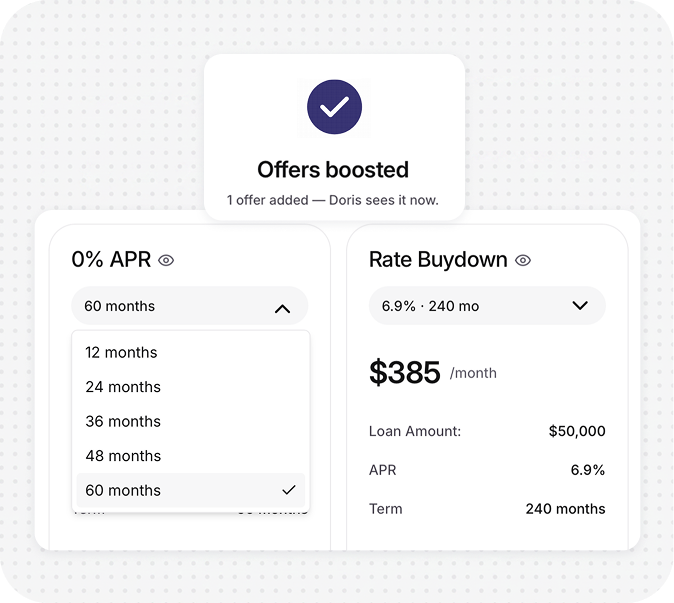
Pick the lender promotions you’ll show, with what each costs your company visible first.
Inspectors in the basement
Inspectors send it with the photos and the written scope. Owners see which inspectors’ visits turn into financed systems.

Work from the field
Leave a QR code with the written scope, or text the link after the inspection.

Measure tools and rep adoption
See how many applications each inspector starts and how many finish.

Measure every entry point
Tell whether homeowners begin from the scope’s QR code, a texted link or your site.

Keep the experience branded
Homeowners see your logo and colors on the application, not a lender’s.
With the photos and written scope in hand, the homeowner applies under your name.

One application, multiple programs
The drain, sump, backup and cracks go on one application, and participating lenders weigh it one at a time.

Direct-to-business funding
On eligible programs, approved funds go straight to your company.

Links, QR codes, and messages
A QR code on the scope, a link texted after the inspection, or one in your email.

Homeowner-friendly experience
The homeowner reviews every offer’s terms on their own phone and can decide after you’ve gone.

Your business stays front and center
Your company’s name stays on the application from inspection to walkthrough.

Available promotions
See what a lender’s promotion would cost your company before it goes on a scope.
See which jobs wait and which inspectors start applications.

Find stalled jobs
Spot jobs waiting on a document, an unsigned offer or the final walkthrough.
Keep follow-up in one place
Handle the lender’s open items before the crew breaks up the floor.
Keep crews scheduled
Let the office see which jobs have financing set before the jackhammer comes out.
See what starts applications
Line up scope QR codes, texted links, emails and website buttons by the starts each brings.
Compare inspectors
Find out which inspectors’ visits lead to applications.
Improve distribution
Place the link on every scope, follow-up text and your site.
A no shouldn’t stop the drain job; Ottri’s network counts 20 lenders. All in one place.
With
A disconnected process
Separate applications for the drain, the sump and the cracks.
One lender declines, and the written scope sits in a drawer.
A same-day-only price at the kitchen table.
A promo fee that shows up only after funding.
Approved, then stuck on a missing document.
With Ottri
The full system the inspection supports, on one application.
Another eligible lender reviews the same application.
The homeowner can finish the application after you’ve left.
What each promotion costs you, shown before you offer it.
Each job’s open items and funding status in one view.
What waterproofing contractors ask before they offer financing.
Updated

Interior drain, sump and backup
Will homeowners insurance pay for basement waterproofing?
No. Waterproofing and encapsulation are prevention. Standard policies exclude groundwater seeping through the foundation, and they exclude sewer backup and sump overflow unless an endorsement is added. That endorsement pays some damage after a covered event, under its own limit, which often starts at $5,000, and usually not the pump. Financing is separate from any claim.
- Flood policies exclude seepage unless a flood in the area caused it.
- A sump pump isn’t plumbing on standard forms, so overflow needs the endorsement.
- Maryland requires insurers to offer sewer and drain backup coverage.
Sources: 44 CFR 61, National Flood Insurance Program dwelling form (as of October 2026); HO 00 03 water exclusion, quoted in a Massachusetts FAIR Plan claim letter (2014); Maryland Insurance Administration, water backup coverage; NerdWallet, water backup coverage (July 2026).
Waterproofing costs, sources 2025–2026
HomeGuide (2026); Fixr (2026); This Old House (2026)
| Job | Typical cost | Programs that often fit |
|---|---|---|
| Crack injection, per crack | $250–$1,500 | Cash |
| Sump pump, new pit | $600–$2,500 | CashInstallment |
| Dehumidifier, installed | $1,000–$3,500 | CashInstallment |
| Crawl space encapsulation | $3,000–$15,000 | Installment |
| Drain, sump, backup and two cracks (Ottri’s sum) | $7,000–$16,000 | Installment |
| Exterior excavation and membrane | $10,000–$18,000 | Installment |
What does basement waterproofing cost in 2026?
It depends on the system. Interior drain tile runs about $40 to $85 a foot, or $4,000 to $17,000 installed, and about 140 feet of drain with a new sump, a battery backup and two cracks sealed runs about $7,000 to $16,000. Exterior excavation runs $10,000 to $18,000, and crawl space encapsulation $3,000 to $15,000.
- The $5,000 average some guides print blends paint and sealers with drain systems.
- An add-on backup battery runs $150 to $250 and lasts 3 to 4 years.
- Ottri’s network starts at $1,000, so a lone pump swap or crack is often paid in cash.
Sources: HomeGuide, basement waterproofing cost (January 2026); HomeGuide, French drain cost (February 2026); HomeGuide, crawl space encapsulation cost (January 2026); Fixr, basement waterproofing cost (February 2026); This Old House, basement waterproofing cost (March 2026) and sump pump cost (March 2026).
Caleb Morris
Example: $10,800 interior drain, sump and battery backup
Prime installment loan
Lender 1
Promotional same-as-cash plan
Lender 2
Installment loan, 96 months
Lender 3
Offer received
96-month installment loan for the drain and sump system
The homeowner reviews every term on their own phone.
Does a city help pay for a backwater valve or sump pump?
Some do, with caps and dates. DC Water pays up to $6,000 where a sewer backup was documented in a qualifying area or storm, Madison 75% up to $1,500, and a Twin Cities regional grant 50% up to $5,000 for 2026 work. Most require a permit and a licensed plumber and pay back after the work, so check the city’s program before you start.
- Many cities bar sump and footing-drain water from the sanitary sewer.
- The model code wants the ground to fall 6 inches within the first 10 feet from the wall.
- Detroit’s basement backup program is closed to new applications for now.
Sources: DC Water, backwater valve rebate; City of Madison, backwater valve program; Metropolitan Council, private property I/I grants (2026); Detroit, basement backup protection; International Residential Code 2021, R401.3 and R405.1; NEIWPCC, municipal sump pump removal programs (June 2026).
Rachel Kim
Example: interior drain, sump and battery backup
Inspection photos, cancellation window over
You and the homeowner
Application approved
Lender
Drain, sump and backup installed
Your crew
Permit signed off, homeowner confirms
Building inspector and homeowner
Paid to your business
Lender, on eligible programs
Next step
Homeowner confirms the waterproofing job is complete
How should a waterproofing job be sold, and when does the contractor get paid?
Diagnose first: check grading and downspouts before quoting a drain system, show photos from this house, and skip mold scares; EPA says sampling is usually unnecessary when mold is visible. Most programs pay after the homeowner confirms the job is complete, and some pay at signing. Put the written warranty, permit and photos in the homeowner’s file.
- Beyond the down payment, California bars collecting ahead of the work, even from a lender.
- Say whose “lifetime” a warranty means, what it covers and what upkeep it needs.
- Seller forms in Michigan, Illinois and New York ask about water in the basement.
- Sales of $25+ made at the home: 3 business days to cancel, 5 for Californians 65+.
Sources: EPA, mold testing or sampling (January 2026); 16 CFR 239 (FTC warranty advertising); 16 CFR 429 (FTC Cooling-Off Rule); California Business and Professions Code §7159.5 and Civil Code §1689.6; seller disclosure forms in Michigan, Illinois and New York.
Basement waterproofing financing questions, answered.
How do waterproofing contractors offer financing to customers?
Once the inspection is done and the written scope is priced, offer it as one way to pay beside cash, without promising an approval or a rate. Your inspector leaves a QR code or texts the link; the homeowner applies on their own phone under your brand, and participating lenders weigh it in order. On eligible programs, the lender funds your company, and Ottri charges you nothing.
Can one application cover the drain, sump, battery backup and crack repair?
Yes, if it’s one contracted system priced once and within each program’s limits. List the drain, sump, battery backup, crack repair, discharge line and permit separately so the lender sees the full scope; battery swaps, service plans and dehumidifier upkeep stay off and get billed as they come.
Will homeowners, backup or flood insurance pay for a waterproofing system?
No. A backup endorsement pays some damage after a covered event, under its own limit, and usually not the pump. Flood insurance covers a short list of basement items, such as furnaces, water heaters, sump pumps and unfinished drywall, and only when a flood hits the area. Neither pays to prevent the next leak, and a lender’s decision is separate from any claim.
Can crawl space encapsulation and a dehumidifier be financed?
Yes, as installed work on one estimate, within each program’s limits. Guides price encapsulation at $3 to $10 a square foot and a ducted or standalone dehumidifier at $1,000 to $3,500 installed. Leave filters and the dehumidifier’s running costs off the application.
Our network or bank already finances our jobs. Why add Ottri?
Keep it. Ottri isn’t a replacement for a program that works; it’s for the homeowner that program turns down and the job it won’t take or can’t cover in full. Your inspector sends one application under your name, and participating lenders weigh it in order. If a dealer or franchise agreement names a required lender, follow it. Ottri has no tie to any waterproofing network and charges you nothing.
What happens when the first lender declines a waterproofing job?
The same application goes to the next eligible lender, so the homeowner never fills it in twice, and the screen says before each lender’s step whether that credit check is soft or hard. A later lender may approve, sometimes for less; trim the scope with the homeowner before you dig. If none approves, grading and downspout fixes may fit the budget.
Does the 3-day right apply if the homeowner called us after a flood?
Yes, for a sale of $25 or more at the home, even after the homeowner called you. A genuine emergency waiver must be written in the homeowner’s own hand, and Californians 65 and older get 5 business days. Price an emergency pump fix on its own ticket and quote the full system separately.
What do I need to sign up?
Sign up online and add your EIN and company details, any contractor license your state issues, your insurance certificate, a sample waterproofing contract, the owner’s ID and the bank account for deposits. Ottri sets no minimum to join, checks each company before switching it on, and each lender then sets its own bar, such as time in business.
Who approves the financing and sends the funds?
The lender approves the application, sets the terms and, on eligible programs, pays your company directly; most pay after the homeowner confirms the job is complete, and some pay at signing. Ottri Global LLC is a licensed loan broker, NMLS 2776988, and is not a lender.
Should inspectors sell with mold tests or health warnings?
No. EPA says that when mold is visible, sampling is usually unnecessary, and no federal limits exist for mold in homes. Describe the water you found and the fix, keep humidity below 60%, and leave health and fear claims off the scope and the quote.