Multi-lender hardscaping financing for contractors.
A full outdoor living build often outgrows one lender’s limit. Your homeowner fills out one branded application for the whole project, participating lenders review it in turn, and Ottri charges you nothing.
Patios, walls, outdoor kitchens, fire pits.
Keep your paver maker’s program; add Ottri when it says no.
Eligible programs pay your company directly.
Sent under your name; applications never sold as leads.
No setup fee · No subscription · No minimums to sign up
Banks and Lenders
20
Finance projects up to
$750K
Full credit coverage
300–850
One application. Eligible lenders, considered in sequence.
Ottri is a customer financing platform for hardscape contractors: one branded application for patios, walls, outdoor kitchens and fire features, which participating lenders consider in turn. Ottri Global LLC is a licensed loan broker (NMLS 2776988), not a lender.
Hardscape promotions usually cost the contractor. Ottri costs you nothing.
What hardscape companies typically give up in dealer fees to offer promotional financing, next to what Ottri charges.
−$2,400
A 12-month promo
On a $30,000 outdoor build, a 2019 national lender rate sheet charged the contractor 7.99% of the loan for 12 months same-as-cash, about $2,400, and 13% for 24 months, about $3,900.
$1,500+
A yearly platform fee
Subscription platforms charge $1,500 to $6,000 a year, busy season or slow.
$0
Ottri never charges you
No charge to join or stay, and no share of the build. On eligible programs the lender pays your company, not the homeowner. A lender’s promotional plans may carry their own fee, and you choose whether to offer them.
No setup fee · No subscription · No minimums to sign up
Promo costs: a national lender’s 2019 dealer-fee schedule, which charged contractors 7.99% on 12-month same-as-cash loans and 13% on 24-month ones. Platform fees: published plan prices, July 2026.
Everything a hardscape company needs to run a financing program.
Design and build
Jobs run from a weekend walkway to outdoor kitchens that wait on gas permits and special-order stone. Each application and funding step sits in one place.

Run financing from one dashboard
Applications, offers and funding status for each build together, from the design meeting to the final walk.

Track every application
See which homeowners applied after the design meeting and which still need to finish.

Track funded volume
Track funded builds by designer and month.
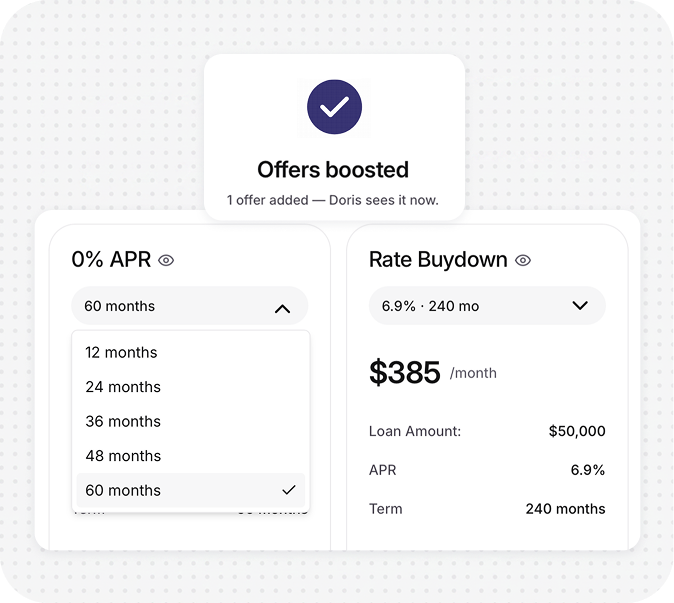
Manage supported promotions
Pick the plans your lender programs allow and know each one’s cost before it goes in a proposal.
Designers and site visits
Designers send it with the 3D rendering or the signed proposal. Owners see which designers turn renderings into financed builds.

Work from the field
Share a link or QR code at the site visit, or send it with the rendering and price.

Measure tools and rep adoption
Compare starts and completions for each designer.

Measure every entry point
See whether applications begin with a proposal QR code, a texted link or your website.

Keep the experience branded
Your logo and colors on the application, matching your renderings.
Homeowners apply on their own phone, under your name, once the design and price are final.

One application, multiple programs
One application for the patio, walls, kitchen and fire features, with participating lenders considering it in turn.

Direct-to-business funding
On eligible programs, approved money goes to your company.

Links, QR codes, and messages
A texted link after the visit, a QR code on the proposal or a link with the rendering.

Homeowner-friendly experience
Each offer’s terms appear on the homeowner’s phone, with no pressure to decide that day.

Your business stays front and center
Your company’s name stays on the application from design to funding.

Available promotions
If a lender runs a promotion, check its cost to your company before offering it.
See which builds are stuck and which designers start applications.

See what needs action
Find builds waiting on a document, an unsigned offer or the homeowner’s final walk.
Keep follow-up in one place
Open the application and clear what the lender needs before the crew’s start date.
Keep crews scheduled
Show the office which builds have financing in place before stone and crews are booked.
See what starts applications
Compare starts from proposal QR codes, rendering emails, website buttons and texts.
Compare designers
See which designers’ renderings turn into applications.
Improve distribution
Put the link in the proposal, the rendering email and your project gallery.
One lender’s cap shouldn’t shrink the build. A 20-lender network helps. All in one place.
With
A disconnected process
The kitchen and fire pit pushed to next year.
A brand program declines, and the job stalls.
Subscriptions billed whether a patio funds or not.
Deferred-interest promos sold without the terms.
Stone ordered before the 3-day window closes.
With Ottri
Patio, walls and kitchen on one application.
The application moves on to the next eligible lender.
No Ottri fee on any hardscape job.
Terms on the homeowner’s phone before they accept.
Each job’s funding step before you order.
What hardscape companies ask before they offer financing.
Updated

Wall height counts from the footing
When does a retaining wall need a permit or an engineer?
Usually once it passes 4 feet from the bottom of the footing to the top, or at any height when it holds back a driveway, slope or structure. The model code calls for engineering above 48 inches of retained soil, or lower with a surcharge, and many cities are stricter. Put engineering, inspections and any guard rail in the estimate before the homeowner applies.
- Walls run $35 to $65 per square foot of face, or $7,000 to $13,000 for 50 by 4 feet.
- Cincinnati waives the permit only for walls of 4 feet or less set 5 feet from lot lines.
- A wall redesigned after approval needs a written change order and a fresh lender look.
Sources: International Residential Code R105.2, as reproduced by Federal Way, Washington; North Carolina State Fire Marshal, R404.4 interpretation (2012); City of Cincinnati, retaining wall handout (2017); HomeGuide, retaining wall cost (January 2026).
Hannah Brooks
Example: $30,000 patio, grill island and gas fire pit
Prime installment loan
Lender 1
Promotional same-as-cash plan
Lender 2
Installment loan, 120 months
Lender 3
Offer received
120-month installment loan for the whole outdoor build
The homeowner reviews every term on their own phone.
What does an outdoor kitchen really cost in 2026?
HomeGuide prices a built-in grill island at $3,000 to $10,000, a custom kitchen at $10,000 to $35,000 and a luxury one at $35,000 to $65,000, but those prices assume the patio and utility lines are already in place. Add the patio, gas, water, power, a seat wall, a fire pit and a pergola, and the full build lands nearer $27,000 to $85,000.
- Yorba Linda permits any framed or masonry BBQ or fireplace wall 3 feet or taller.
- The model fire code keeps wood fires 25 feet from structures; cities amend it.
- Producer prices rose 28% for steel and 25% for aluminum; date pergola quotes.
Sources: HomeGuide, outdoor kitchen cost (December 2025); International Fire Code §307.4.2, as reproduced by Lincoln, Nebraska (2018 edition); Town of Prosper, Texas, fire pit and outdoor kitchen permit guides (April 2025); City of Yorba Linda, fire pit, fireplace and barbecue requirements (2018); Bureau of Labor Statistics Producer Price Index, September 2026: steel mill products, aluminum mill shapes.
Hardscape costs, sources 2023–2026
HomeGuide (2024–2026); NAR and NALP (2023)
| Job | Typical cost | Programs that often fit |
|---|---|---|
| Poured concrete, per sq ft | $4–$12 | CashInstallment |
| Stamped concrete, per sq ft | $8–$19 | CashInstallment |
| Paver patio, per sq ft | $10–$17 | CashInstallment |
| Natural stone, per sq ft | $16–$35 | Installment |
| Retaining wall, per sq ft of face | $35–$65 | Installment |
| Paver driveway, two-car | $5,700–$17,200 | Installment |
| Custom outdoor kitchen | $10,000–$35,000 | Installment |
| Full outdoor build (Ottri’s sum) | $27,000–$85,000 | InstallmentHome equity |
What do patios, walls and walkways cost per square foot?
Poured concrete runs about $4 to $12 a square foot, stamped concrete $8 to $19, pavers about $10 to $17 and natural stone $16 to $35, while landscape pros priced a full paver patio near $36 a square foot installed. Guides disagree on scope and year, so date every number and quote the real job.
- Producer prices for concrete block rose 3.5% and cut stone 8.0% in a year.
- Realtors estimated patios recover 95% and fire features 56%; make no value claims.
- Labor runs 40% to 60% of a retaining wall’s installed cost.
Sources: HomeGuide, outdoor kitchen cost, patio prices per square foot (December 2025); HomeGuide, driveway pavers cost (September 2024); HomeGuide, retaining wall cost (January 2026); NAR and NALP, 2023 Remodeling Impact: Outdoor Features; Bureau of Labor Statistics Producer Price Index, September 2026: concrete block and brick, cut stone.
Owen Carter
Example: patio, seat wall and outdoor kitchen
Design signed, permits filed
You and the homeowner
Application approved
Lender
Patio and walls set, kitchen framed
Your crew
Gas inspected, homeowner confirms
Inspector and homeowner
Paid to your business
Lender, on eligible programs
Next step
Homeowner confirms the outdoor build is complete
When does a hardscape contractor get paid on a financed job?
Most often when the build is done: the bulk of Ottri network programs pay your company after the homeowner signs off, and some pay at signing. Stone, block and appliances are often ordered weeks ahead, so keep deposits within your state’s limits and order special items only after the 3-day window closes.
- Beyond the down payment, California bars collecting ahead of the work, even from a lender.
- Maryland allows one-third down; Pennsylvania, one-third on jobs over $5,000.
- Patios often count toward lot coverage; credit for permeable pavers varies by city.
Sources: California Business and Professions Code §7159.5; Maryland Business Regulation §8-617; Pennsylvania Home Improvement Consumer Protection Act, 73 P.S. §517.9; Florida Statutes §489.126; New York General Business Law §771; 16 CFR 429 (FTC Cooling-Off Rule); lot-coverage rules: Bunker Hill Village, Texas; Bothell, Washington.
Hardscaping financing questions, answered.

How do hardscape contractors offer financing to customers?
Mention it in the budget conversation as one way to pay, next to cash, then send one application for the whole build once the design and price are set. With Ottri, your designer sends it under your company’s name; lenders on the network review it one after another, and eligible programs pay your company directly. Ottri never bills your business.
Can one application cover the patio, walls, kitchen and fire pit?
Yes, as one contracted design priced once, within each program’s limits; each lender checks the amount against your scope. Put any phases on the build schedule in writing, and if the design changes, sign a change order before the extra work and ask the lender to review the new total.
Do fire pits and outdoor kitchens need permits?
Often. Gas fire features and gas kitchens usually need a gas permit and a listed appliance, and many cities want a site plan and clearances. The model fire code keeps open wood fires 25 feet from structures and combustibles, and cities amend it: Prosper, Texas, uses 10 feet and 3 feet from lot lines.
We sell designs in winter and build in spring. When should the homeowner apply?
When engineering, permits and HOA review have fixed the design and price, not at the first sketch. Each lender sets how long an offer lasts, and a January approval can lapse before an April dig, so check the expiry before the homeowner accepts and date your quote. Reapplying after it lapses can mean another credit check. If the city trims the patio for lot coverage, sign a change order.
How much deposit can we take for stone and appliances?
It varies by state. California limits the down payment to $1,000 or 10%, whichever is less, special orders included, and bars taking more before the work is done, even through a lender. Maryland allows one-third, Pennsylvania one-third on jobs over $5,000 plus special-order materials, Florida sets permit and start deadlines above 10%, and New York requires escrow or a bond.
What if the first lender says no to the full outdoor build?
The next eligible lender gets the same application, with nothing to retype, and before each lender’s step the homeowner’s screen shows whether it’s a soft or hard credit check. Lenders set their own limits and standards, so a second or third can approve the full design. If none does, the homeowner can put savings toward part, or you can price a smaller design.
We already use a paver maker’s financing program. Why add Ottri?
Keep it for the homeowners it approves. A paver maker’s program usually sends every application to one lender and is open only to its authorized contractors. When that lender declines or approves less than the design, send the Ottri application, which participating lenders review in turn, whatever block or stone you install. If your program names which lender sees an application first, follow it.
What do I need to sign up?
Open your account online and add your EIN and company details, contractor license, insurance certificate, a sample build contract, the owner’s ID and your deposit account. There’s no minimum to join Ottri, and each lender reviews your business on its own terms, such as time in business.
Who approves the financing and sends the funds?
Approval, terms and payment come from the lender, which on eligible programs pays your company directly, most often after the build is done. Ottri Global LLC is a licensed loan broker, NMLS 2776988, and is not a lender.
Can we tell homeowners an outdoor kitchen pays for itself?
No. Realtors in NAR’s 2023 survey put an outdoor kitchen at 100% of its cost recovered and a fire feature at 56%, but only 1% recommend a kitchen before selling. Those figures are opinions, not sales; sell the way the space will be used.