House painting financing for your customers.
For painters who write prep, repairs and coats into estimates. The homeowner borrows, not your company: your branded application opens on their phone and goes to participating lenders in order. No setup fee or subscription.
Exteriors, whole interiors and cabinets.
On the estimate beside check and card.
On eligible programs, the lender pays you.
Under your brand and never sold as a lead.
No setup fee · No subscription · No minimums to sign up

Banks and Lenders
20
Finance projects up to
$750K
Full credit coverage
300–850
One application. Eligible lenders, considered in sequence.
Ottri is a customer financing platform for house painting contractors: one branded application for exteriors, interiors, cabinets and the prep and repairs behind them, which participating lenders consider in turn. Ottri Global LLC is a licensed loan broker (NMLS 2776988), not a lender.
Promotions on a repaint can cut into your margin. Ottri has no setup fee or subscription.
Promotional plans tend to carry a dealer fee that comes out of the painter’s margin. Here is one published 2019 schedule, next to Ottri.
−$735
A 12-month promo
On a $9,200 two-story repaint, a 2019 national lender rate sheet set a 7.99% dealer fee for 12 months same-as-cash, about $735, and 13% for 24 months, about $1,200.
$1,500+
A yearly platform fee
Subscription platforms bill $1,500 to $6,000 a year, slow season included.
$0
To open an account and apply
No setup fee and no subscription. The cost of a financed repaint to your business, dealer fee included, shows up before you pick that program.
No setup fee · No subscription · No minimums to sign up
Promo costs: a national lender’s 2019 rate sheet (7.99% of the loan for 12 months same-as-cash; 13% for 24). Platform fees: plan prices published as of July 2026.
Everything a painting contractor needs to offer financing.
Sales and the office
From a week-long exterior to cabinets, rain can move the finish date; each application and its funding status sits in one dashboard.

Run financing from one dashboard
Each repaint’s offers, lender requests and payment status, from the walkthrough to the final coat.

Track every application
Spot homeowners who started an application after the color consultation and stalled.
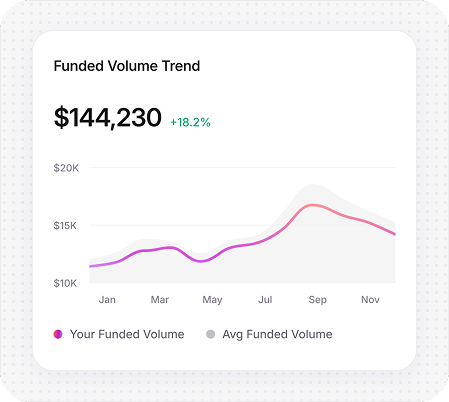
Track funded volume
See funded painting jobs by estimator, crew and season.
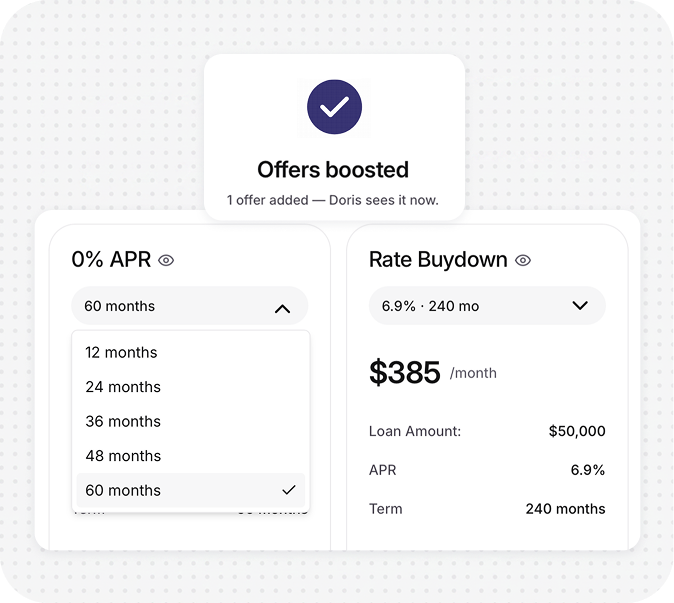
Manage supported promotions
Decide which lender promotions to offer after seeing what each one costs you.
Estimates
Estimators send the link with the written estimate, and the homeowner applies whenever they’re ready. Owners see which estimates turn into applications.

Work from the field
Add the QR code to the estimate, or text the link after the walkthrough.
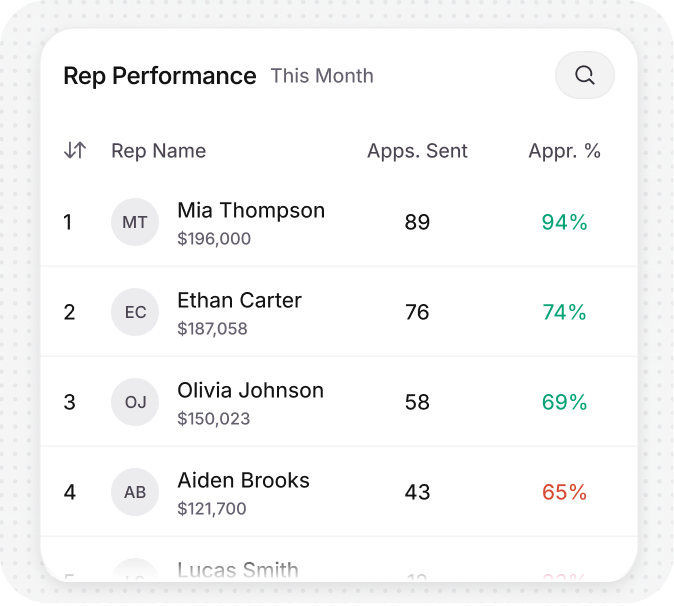
Measure tools and rep adoption
Rank estimators by the applications their walkthroughs produce.
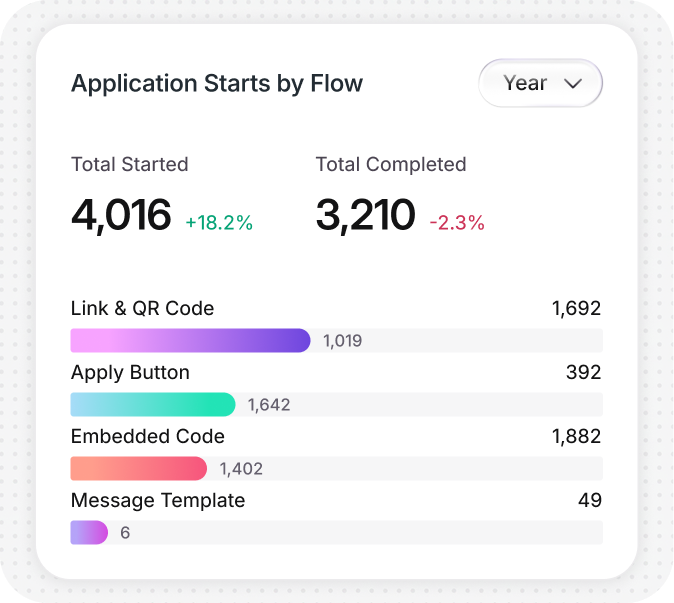
Measure every entry point
Learn whether homeowners start from the estimate’s code, a text or your painting page.

Keep the experience branded
Homeowners see your company’s name from the first screen to the last.
Leave the estimate; the homeowner opens the application on their own phone.

One application, multiple programs
Prep, wood repair, primer and finish coats go on one application that participating lenders consider in order.

Direct-to-business funding
On eligible programs, approved funds are paid to your company.

Links, QR codes, and messages
The estimate’s QR code, a link by text, or one in your follow-up email.

Homeowner-friendly experience
Homeowners read each offer’s terms on their own phone, away from the walkthrough.

Your business stays front and center
Your company’s name stays on the application from estimate to final walkthrough.

Available promotions
See what a lender promotion costs you before it goes on a painting estimate.
Jobs on hold, and the estimates that start applications.

Spot what’s waiting
See jobs waiting on a signature, the HOA’s color approval or a dry forecast.
Keep follow-up in one place
Settle what the lender still needs before ladders go up.
Keep crews scheduled
Schedule crews around rain dates once the job’s financing is in place.
See what starts applications
Compare the estimate code, texts, emails and your website by the applications each one starts.
Compare estimators
See which estimators’ walkthroughs lead to applications.
Improve distribution
Put the link on estimates, color schedules and your painting page.
One decline shouldn’t stop the repaint: 20 lenders in the network. All in one place.
With
A disconnected process
Exterior, trim repair and cabinets on separate plans.
A decline, and the peeling paint stays.
A sign-today discount and a vague lifetime promise.
Promotion costs that appear after funding.
Approved, then stalled on a missing signature.
With Ottri
The whole painting scope on one application.
The application goes on to the next eligible lender.
One price on paper, with the warranty terms written out.
Each promotion’s cost, shown before you offer it.
Open items and funding status for each repaint, together.
What painting contractors ask before offering financing.
Updated

Pre-1978: lead-safe prep
What does the EPA lead rule require of painters on pre-1978 homes?
Certification and paperwork before the scraper comes out. The firm must be EPA-certified before it advertises or does paint-disturbing work, a certified renovator is assigned to each job, and the homeowner gets the Renovate Right pamphlet within 60 days before work, with a signed acknowledgment that can go in the contract packet. Records are kept for three years.
- Scraping and sanding count past 6 sq ft per room inside or 20 sq ft outside; same-room jobs within 30 days add up.
- No open-flame burning, no unshrouded power sanders, and heat guns below 1,100°F.
- The 2026 dust-lead change left the renovation rule’s cleanup steps as they were.
Sources: EPA, renovation rule for contractors (March 2026) and firm certification (May 2026); 40 CFR 745 subpart E; 89 FR 89416 (dust-lead rule, November 2024).
Painting costs by job, 2025–2026 guides
This Old House (March–April 2026); HomeGuide (February 2025)
| Job | Typical cost | Programs that often fit |
|---|---|---|
| One bedroom | $300–$800 | Cash |
| Kitchen cabinets | $2,000–$6,500 | CashInstallment |
| Whole interior | $1,800–$10,000 | CashInstallment |
| Exterior, one story | $4,400–$8,800 | Installment |
| Exterior, two stories | $6,900–$12,700 | Installment |
| Interior and exterior | $9,000–$20,000 | Installment |
What do painting jobs cost in 2026, and which ones fit financing?
It depends on stories, prep and what’s being painted. Guides put a 2,000 sq ft exterior at $4,400 to $8,800 for one story and $6,900 to $12,700 for two, a whole interior at $1,800 to $10,000, and cabinets at $2,000 to $6,500. Rooms and touch-ups usually sit below program minimums.
- Itemize wood and trim repair; guides put rot repair at $400 to $1,300 per 100 sq ft.
- Price by the surface you paint, not the home’s floor area, and list the coats.
- A bedroom at $300 to $800 is usually a card or check job, not a financed one.
Sources: This Old House, exterior painting (March 2026) and interior painting (April 2026); HomeGuide, kitchen cabinets (February 2025) and siding repair (June 2025). Exteriors are for about 2,000 sq ft; interior and exterior is a rounded planning range built from those bands, not a guide figure.
Teresa Lund
Example: $9,200 two-story repaint with trim repair
Prime loan
Lender 1
Mid-tier loan
Lender 2
Installment loan
Lender 3
Offer received
A loan offer covering the whole repaint
Each offer opens on the homeowner’s own phone.
How do weather and deposits affect when a painting job gets paid?
Paint sets the calendar. Exterior latex generally needs 50°F air and surfaces, 5°F above the dew point, and about 8 dry hours, so rain moves the finish date. On eligible programs the lender pays your company; most programs pay after completion and some at signing, so set deposits by the schedule and your state’s cap.
- Contracts signed at home can be canceled within 3 business days, or 5 for Californians 65 and up.
- Maryland caps deposits at one-third; Pennsylvania does the same on jobs over $5,000.
- Beyond the down payment, California bars collecting ahead of the work, even from a lender.
Sources: A paint maker’s exterior latex application bulletin; FTC Cooling-Off Rule, 16 CFR 429; California Civil Code §1689.6; deposit rules in Maryland §8-617, Pennsylvania §517.9 and California §7159.5.
Grace Holloway
Example: two-story repaint with trim repair
HOA color approval in writing
Homeowner
Estimate with license number
Your estimator
Signed; 3-day window passed
Homeowner
Second coat on body and trim
Your crew
Paid to your business
Lender, on eligible programs
Next step
Final walkthrough with the homeowner
Which licenses, HOA rules and warranties shape a painting contract?
State rules, the HOA’s color approval, and two separate warranties. California requires a license at $1,000 and Washington registration at $500, while Florida bars local painting licenses. Get HOA color approval in writing before scheduling. Paint makers’ warranties cover the paint, not labor; the workmanship warranty is yours to write.
- Arizona and Oregon exempt jobs under $1,000, but advertising can end the exemption.
- Use coatings that meet the VOC rules where the job is; some air districts bind the applicator.
- The painting trade’s own standard judges a finished surface from 39 inches under finished lighting.
Sources: California Business and Professions Code §7048; Washington RCW 18.27.090; Florida Statutes §489.117 (2026); Arizona §32-1121; Oregon ORS 701.010; California Civil Code §4765 (HOA decisions); South Coast AQMD Rule 1113; the painting trade’s P1 workmanship standard (September 2023).
House painting financing questions, answered.

How can painting contractors offer customer financing?
Show it on the paint estimate next to check, card and whatever financing you already offer. After the walkthrough the homeowner fills out your branded application on their own phone, participating lenders consider it one after another, and a contract signed at home keeps its 3-day right to cancel. Ottri has no setup fee or subscription.
What does a house painting job cost in 2026?
Guides put a 2,000 sq ft exterior at $4,400 to $8,800 for one story and $6,900 to $12,700 for two, a whole interior at $1,800 to $10,000, and kitchen cabinets at $2,000 to $6,500. A bedroom runs $300 to $800, and rotted trim or siding repair is extra.
Is a single room or touch-up worth financing?
Usually not. Programs have minimums, and a bedroom at $300 to $800 or a touch-up sits below most of them, so card or check fits better. Financing fits full exteriors, exteriors with wood repair, whole interiors, and cabinets with walls and trim.
Do we need EPA lead certification to paint older homes?
Yes, for paid work on a home built before 1978 that disturbs more than 6 square feet of paint per room inside or 20 outside, and before you advertise that work. Firm certification costs $300 and lasts five years, and each job needs a certified renovator assigned.
If a homeowner finances the repaint, who carries the loan and collects the payments?
The participating lender that approves it. The loan is between the homeowner and that lender, which sets the terms, collects every payment and pays your company on eligible programs. You don’t sign a note, chase installments or decide who qualifies, and you still stand behind your workmanship as on any job.
Most of our homeowners pay cash or check. Why offer financing at all?
Keep cash as the default; nothing changes for those customers. Financing is for the homeowner facing a full exterior with rot repair, or a whole interior, who would otherwise cut the prep, split the job across two seasons or try it themselves. Put it on every written estimate, so no customer is singled out.
Can prep and wood-rot repair go on the same application?
Yes, when they’re part of the contracted job and inside each program’s limits. Itemize washing, scraping, wood and trim replacement, caulk, primer and coats, plus lead-safe prep where the rule applies, so the lender sees the whole job. Revise the estimate before work starts if the scope grows.
Do we still take a deposit when the homeowner finances, and when are we paid?
Yes, if the program allows it: keep it modest and tied to the start date, under your state’s cap. California limits it to $1,000 or 10%, whichever is less, and Maryland to one-third. Most programs pay when the homeowner confirms the repaint is done and some at signing, so rain or cold that pushes back an exterior’s finish date pushes back your payment too.
Who approves the financing and pays for the job?
Most programs pay your company directly after the homeowner confirms the work is finished, and some pay at signing; each lender decides, sets its own terms and also reviews your painting company on things such as time in business, so a recently founded firm may see fewer programs at first. Ottri Global LLC is a licensed loan broker, NMLS 2776988, and is not a lender.
Can we tell homeowners paint saves energy or adds value?
Leave both out. The FTC sued sellers of “insulating” paint whose claimed R-values didn’t hold up, the federal energy-efficiency credit for home improvements listed no paint from 2023 to 2025 and has ended, and no dated national study shows a paint job returns its cost at sale. Sell the scope, the prep and the warranty.