Multi-lender solar financing for installers.
For solar installers who quote the real payment, no tax credit assumed. Each homeowner applies on their phone under your brand, and participating lenders whose programs take solar review the application in turn.
Panels, batteries and re-roofs, by program.
For licensed solar, roofing and electrical firms.
Eligible programs pay at their milestone.
Your brand; never sold as a lead.
No setup fee · No subscription · No minimums to sign up

Banks and Lenders
20
Finance projects up to
$750K
Full credit coverage
300–850
One application. Eligible lenders, considered in sequence.
Ottri is a customer financing platform for solar installers: the homeowner borrows, not your company. One branded application covers panels, batteries, panel work and re-roofs, which participating lenders consider in turn where their programs accept solar. Ottri Global LLC is a licensed loan broker (NMLS 2776988), not a lender.
Solar promotions can cost the installer. Ottri has no setup fee or subscription.
A promotional plan usually comes with a dealer fee taken from the job’s price. A published 2019 lender schedule shows the scale:
−$1,600
A 12-month promo
A 2019 national home-improvement lender’s rate sheet charged the contractor 7.99% of a $20,000 job, about $1,600, for 12 months same-as-cash, and 13%, or $2,600, for 24.
$1,500+
A yearly platform fee
Subscription platforms bill $1,500 to $6,000 a year, slow season included.
$0
To open an account and apply
No setup fee, no subscription. Before you offer a program, you see everything a financed system will cost your business.
No setup fee · No subscription · No minimums to sign up
Promotion costs: a 2019 national lender schedule (a 7.99% dealer fee for 12 months same-as-cash, 13% for 24). Platform fees: published plan prices, July 2026.
Everything a solar installer needs to offer financing.
Sales and the office
Permit, install day and the utility’s permission to operate can sit weeks apart; each financed system’s milestones stay in one dashboard.

Run financing from one dashboard
Offers, lender requests and milestone status for every system, from signed contract to permission to operate.

Track every application
See which homeowners started an application after the proposal and went quiet.

Track funded volume
See funded systems and batteries by consultant, crew and month.
Manage supported promotions
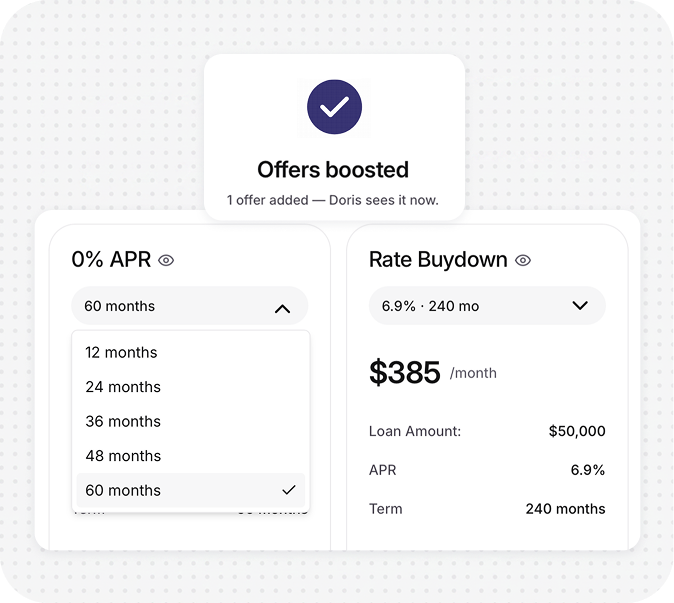
Decide which lender promotions to offer once you see what each one costs you.
Estimates
Consultants leave the link with the written proposal, and the homeowner applies when they’re ready. Owners see which proposals become applications.

Work from the field
Put the QR code on the proposal, or text the link after the site survey.

Measure tools and rep adoption
Compare consultants by the applications their proposals start.

Measure every entry point
Learn whether homeowners begin from the proposal’s code, a text or your solar page.

Keep the experience branded
Your company name appears on each step the homeowner sees.
The proposal stays with the homeowner; the application opens on their phone.

One application, multiple programs
Panels, a battery, panel work and a re-roof can share one application, within each program’s limits.

Direct-to-business funding
Eligible programs pay your company at their funding milestone.

Links, QR codes, and messages
A code on the proposal, a texted link, or a link in your follow-up email.

Homeowner-friendly experience
Homeowners read each offer’s full terms on their phone, with the real payment shown.

Your business stays front and center
From the site survey to permission to operate, the application carries your name.

Available promotions
See what a lender promotion costs you before it appears in a proposal.
Jobs waiting on the utility, and proposals that start applications.

Spot what’s waiting
See systems waiting on a permit, an inspection or permission to operate.
Keep follow-up in one place
Answer the lender’s open items before the install crew is booked.
Keep crews scheduled
Set install dates once financing on the system is settled.
See what starts applications
Find out whether the proposal code, texts, emails or your site start the most applications.
Compare estimators
See whose site surveys lead to applications.
Improve distribution
Add the link to proposals, follow-up texts and your solar page.
One decline shouldn’t end a solar sale: the next eligible lender looks. All in one place.
With
A disconnected process
Panels, battery and roof on separate loans.
A decline, and the array stays unsold.
A payment that assumes a tax credit.
Promotion costs that appear after funding.
Approved, then lost between install and turn-on.
With Ottri
The whole system on one application, where programs allow.
The application moves to the next eligible lender.
The real, fully amortizing payment, labeled as an example.
Each promotion’s cost, shown before you offer it.
Milestones and funding status for every system, together.
What solar installers ask before offering financing.
Updated

No credit in the payment
How do we sell solar now that the homeowner tax credit is gone?
Quote the real payment. The federal credit ended for owned systems installed after 2025, batteries included, so a loan built for a 30% paydown would re-amortize, often at month 19, and the payment would jump by about half. Show the fully amortizing payment from day one, and leave savings and payback out of the pitch.
- Systems installed in 2025 can still be claimed, and unused credit carries forward.
- Leases and PPAs can still use a commercial credit on a deadline; Ottri arranges loans.
- One price for cash and financed buyers; the financing cost belongs in the disclosures.
Sources: Public Law 119-21 §§70506 and 70513 (July 2025); IRS, residential clean energy credit (July 2026) and Notice 2025-42; CFPB, solar financing issue spotlight (August 2024).
Solar, battery and re-roof costs, 2026 guides
EnergySage (June–October 2026); Fixr (January 2026)
| Job | Typical cost | Programs that often fit |
|---|---|---|
| Battery added later, 13.5 kWh | $12,000–$18,300 | Installment |
| 6 kW rooftop system | $16,000–$21,000 | Installment |
| 8 kW rooftop system | $21,000–$28,000 | Installment |
| 10 kW rooftop system | $25,800–$35,000 | Installment |
| Re-roof plus 8 kW system | $27,000–$41,000 | Installment |
| 7 kW system with a battery | About $34,000 | Installment |
What do solar systems, batteries and re-roofs cost in 2026?
Guides put 2026 prices at about $2.57 to $3.04 a watt before incentives, against a 2024 cash median of $3.50, so an 8 kW system runs about $21,000 to $28,000. A 13.5 kWh battery is about $15,600, and a re-roof plus an 8 kW array about $27,000 to $41,000. Date every proposal; prices move.
- Itemize panels, inverters, racking, rapid shutdown, permit and interconnection.
- List panel work on its own line when the backfeed calculation fails.
- Never show an “after credit” price or payment for a 2026 install.
Sources: EnergySage, solar panel cost (June 2026), battery cost (July 2026) and H1 2026 market report (October 2026); Fixr, solar panel installation (January 2026). Upper bounds use the 2024 national cash median of $3.50 a watt that EnergySage cites.

Battery on its own line
How should we quote batteries, added later or paired from day one?
As their own itemized scope. California’s net billing tariff, since April 2023, pushed battery attachment from about one in ten systems to about six in ten there, while one national marketplace saw 31% in early 2026. There’s no federal battery credit for 2026, and California’s main rebate is now limited to low-income homes.
- Home batteries are listed to UL 9540 and kept out of sleeping rooms.
- Quote the gateway or backup panel and the electrical work with the battery.
- Don’t promise a rebate; state and utility programs set their own rules.
Sources: CPUC, net billing tariff (D.22-12-056) and SGIP (read October 2026); Lawrence Berkeley National Laboratory via Solar Power World (May 2024); EnergySage, H1 2026 market report (October 2026).
Paul Ferreira
Example: 8 kW rooftop system
Disclosure signed, window passed
Homeowner
Permit approved
Your office
Array installed and inspected
Your crew
Permission to operate
Utility
Paid to your business
Lender, at its milestone
Next step
Upload the utility’s approval letter
What do solar contracts require, and when does the installer get paid?
Disclosure up front and payment at a set milestone. California’s solar disclosure document leads the contract with the total cost, including financing. Texas gives buyers 5 business days to cancel and makes a referred lender cancel the loan too. On eligible programs the lender pays your company at the milestone it sets, such as install or permission to operate.
- Texas requires a licensed electrical contractor, named in the contract, for every install.
- The utility controls permission to operate; build that wait into the schedule.
- Beyond the down payment, California bars collecting ahead of the work, even from a lender.
- Confirm when a program pays before ordering panels or booking the crew.
Sources: California Business and Professions Code §7169 and §7159.5; CSLB, solar requirements and California Licensed Contractor (Summer 2026); Texas SB 1036 (89th Legislature, effective September 2025).
Solar financing questions, answered.

Can my customers still get the 30% federal solar tax credit?
Not for a system they own whose installation was completed after December 31, 2025, and battery storage lost the credit at the same time. Systems installed in 2025 can still be claimed, and unused credit carries forward. Quote 2026 jobs with no federal credit in the price or the payment.
Should we keep offering a loan built around a tax-credit paydown?
Not for a 2026 install. Those loans set a low early payment that assumes a 30% prepayment, then re-amortize, often at month 19. With no credit to prepay, the payment jumps by about half. Show the fully amortizing payment from day one, labeled as an example.
Do leases and PPAs still get a federal credit?
The lessor may use the commercial credit for solar that began construction by July 4, 2026 or is placed in service by December 31, 2027; storage isn’t subject to that cutoff. Ottri arranges loans from participating lenders for homeowners who want to own the system, not leases or power purchase agreements.
Our proposal software already shows lenders. Why add Ottri?
Keep it, and put your Ottri link or QR code on the same written proposal, so a job outside your current lenders’ limits, such as a battery added later, can still be considered where a participating program accepts it.
Can a homeowner finance a battery added to existing panels?
Where a participating program accepts storage, yes, as its own itemized job. Coverage for solar and batteries varies by program and state, and each lender decides. Price the battery, gateway or backup panel, electrical work and permit on one written proposal.
Can one application cover a re-roof and solar together?
Where a participating program accepts both, yes: one contracted scope, with the roof and the array itemized. If the roof has only a few years left, re-roofing first avoids a later detach-and-reset, which one guide puts at about $3,800.
What do lenders look for in a solar company?
Each lender reviews your business as well as the job: a state license for solar or electrical work, insurance, time in business and sometimes revenue, so a newer company, or one that sells only solar, may find few or no programs at first. Roofing, battery and electrical jobs you also sell can use the same account, each described as what it is.
How long from install to turn-on?
Permit sign-off, inspection and the utility’s permission to operate usually take weeks after install, and the utility controls the last step. Programs set their own funding milestone, so confirm whether yours pays at install or at permission to operate before you order panels.
Who approves the financing and when are we paid?
The participating lender decides and sets the terms; on eligible programs it pays your company directly at the milestone its program sets, such as install or permission to operate. Ottri Global LLC is a licensed loan broker, NMLS 2776988, and is not a lender.
What must a solar contract include in California and Texas?
California requires the solar disclosure document on the cover page, with the total cost including financing, in the language of the sale; its large utilities now collect it at interconnection. Texas gives buyers 5 business days to cancel, and a lender referred by the seller must cancel the loan if the buyer does.