Customer financing for insulation contractors.
For the homeowner’s attic, wall or spray foam job, not a loan for your rig. Homeowners apply on their own phones under your name, and participating lenders weigh each in turn.
Attics, walls, spray foam and air sealing.
For insulation and spray foam contractors.
The lender pays you on eligible programs.
Your name on the application; never sold as a lead.
No setup fee · No subscription · No minimums to sign up

Banks and Lenders
20
Finance projects up to
$750K
Full credit coverage
300–850
One application. Eligible lenders, considered in sequence.
Ottri is a customer financing platform for insulation contractors: one branded application for removal, air sealing, blown-in insulation and spray foam, which participating lenders consider in turn. Ottri Global LLC is a licensed loan broker (NMLS 2776988), not a lender.
Insulation promotions can cost the contractor. Joining Ottri doesn’t.
A promotional plan usually comes with a fee taken from the job’s margin. Here is what one published schedule charges, next to Ottri.
−$510
A 12-month promo
For a $6,400 attic job, a 2019 national lender rate sheet priced 12 months of same-as-cash at a 7.99% dealer fee, about $510, and 24 months at 13%, about $830.
$1,500+
A yearly platform fee
Subscription platforms bill $1,500 to $6,000 a year, slow season included.
$0
No setup fee or subscription
No subscription, no setup fee and no minimums to sign up. Eligible programs pay your company directly, and whether to offer a promotion with its own fee is up to you.
No setup fee · No subscription · No minimums to sign up
Promotion costs come from a 2019 national lender schedule that charged contractors 7.99% for a year of same-as-cash and 13% for two. Platform fees: published plan prices, July 2026.
Everything an insulation contractor needs to offer financing.
Sales and the office
From an attic air seal to whole-house spray foam, most jobs take a day or two; each financed job’s paperwork sits in one place.

Run financing from one dashboard
Offers, lender requests and payment status for every attic, from measured estimate to signed receipt.

Track every application
Find homeowners whose application stalled after the estimate.

Track funded volume
See funded jobs by estimator, crew and month.
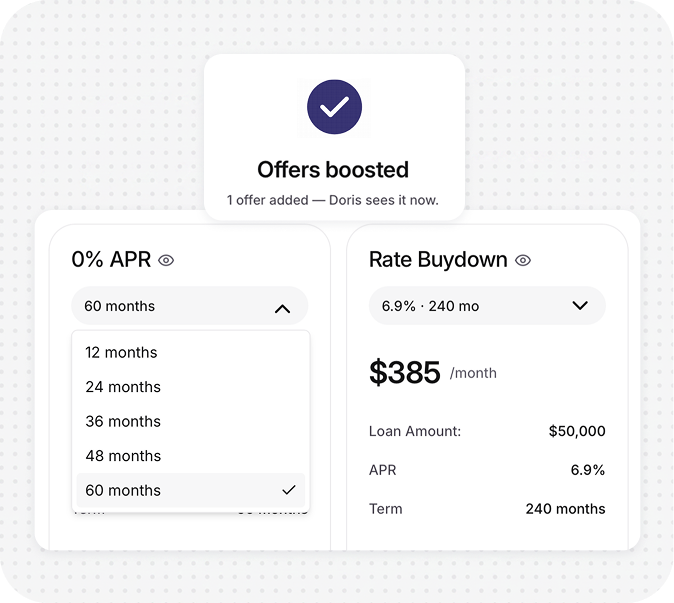
Manage supported promotions
Choose lender promotions to offer, each with its cost to you up front.
Estimates
Estimators leave the link with the measured estimate, and the homeowner applies on their own time. Owners see which estimates become applications.

Work from the field
Print the code on the measured estimate, or text the link from the driveway.

Measure tools and rep adoption
Rank estimators by applications their measured estimates produce.

Measure every entry point
Track whether homeowners start from a printed code, a text message or your website.

Keep the experience branded
The homeowner sees your company on every step of the application.
Your estimate goes home with them; the application opens on the homeowner’s phone.

One application, multiple programs
Removal, air sealing and new insulation share one application that participating lenders review in turn.

Direct-to-business funding
Approved funds go straight to your company on eligible programs.

Links, QR codes, and messages
A code on the estimate, a texted link, or a link in the thank-you email.

Homeowner-friendly experience
Terms reach the homeowner’s own phone, to read later with no one waiting on an answer.

Your business stays front and center
Your company name stays on the application from estimate to signed receipt.

Available promotions
Know what each lender promotion costs you before it reaches an estimate.
Jobs waiting on paperwork, and which estimates start applications.

Spot what’s waiting
Find jobs waiting on a document, a signature or the crew date.
Keep follow-up in one place
Settle the lender’s open items before the truck rolls.
Keep crews scheduled
Dispatch sees which jobs have financing settled before the crew is assigned.
See what starts applications
Learn which link starts the most applications: estimate code, text, email or site.
Compare estimators
Find out which estimators’ visits lead to applications.
Improve distribution
Add the link to estimates, receipts and your insulation page.
A decline shouldn’t stop the attic job; Ottri’s network has 20 lenders. All in one place.
With
A disconnected process
Removal, air sealing and insulation on separate plans.
A decline, and the attic stays where it was.
A guessed attic size and a promised savings number.
Promotion costs surface after funding.
Approved, then waiting on a missing receipt.
With Ottri
The whole insulation scope on one application.
The application moves to the next eligible lender.
Your measured estimate, and no savings claim in the application.
Each promotion’s cost, known before you offer it.
Open items and funding status for every job, together.
What insulation contractors ask before offering financing.
Updated
Insulation costs by job, 2023–2026 guides
HomeGuide (2023–2026); Fixr (2025)
| Job | Typical cost | Programs that often fit |
|---|---|---|
| Attic air sealing | $350–$3,000 | CashInstallment |
| Attic top-up, blown-in | $900–$3,600 | CashInstallment |
| Rim joists, spray foam | $2,000–$2,500 | CashInstallment |
| Exterior walls, blown-in | $1,900–$7,800 | Installment |
| Remove and re-insulate attic | $3,200–$10,800 | Installment |
| Whole-house spray foam | $8,000–$20,000 | Installment |
What do attic, wall and spray foam jobs cost in 2026?
It depends on what comes out first. Guides put a blown-in attic top-up at $900 to $3,600, about $1,800 on average, and removing and re-insulating at $2 to $6 per square foot. Spray foam runs $1.50 to $5 per square foot, from $2,000 rim joists to $8,000–$20,000 whole-house jobs. Quote by measured area and R-value.
- Network programs start at $1,000; a small attic top-up is often a card or cash job.
- Quote measured square feet, the R-value target and thickness, never a guessed area.
- Itemize removal, air sealing, baffles and the hatch dam on the same estimate.
Sources: HomeGuide, attic insulation (January 2026), insulation removal and spray foam (November 2025) and blown-in insulation (2023); Fixr, spray foam and blown-in insulation (2025).

Depth markers every 300 sq ft
What does the FTC R-value Rule require of insulation installers?
Paperwork that proves the job. Show the homeowner the fact sheet before they agree to buy, and leave a dated, signed receipt with coverage area, thickness and R-value; for loose-fill, add settled thickness and bag count. Savings claims need a reasonable basis and the FTC’s “Savings vary” line, and any tax-benefit claim must be true.
- Civil penalties run up to $53,088 per violation.
- The code’s installer certificate and depth markers every 300 sq ft tell the same story.
- R-value claims for paints and coatings must be tested like insulation.
Sources: FTC R-value Rule, 16 CFR 460 (fact sheets, receipts, savings and tax claims) and 16 CFR 1.98 (penalty amounts); International Energy Conservation Code 2021, R303.1.1 (installer certificate and depth markers).
Ellen Brooks
Example: $6,400 attic removal, air sealing and re-insulation
Top-tier loan
Lender 1
Second program
Lender 2
Attic installment loan
Lender 3
Offer received
Covers removal, air sealing and re-insulation
Each offer opens on the homeowner’s own phone.
Are there still credits or rebates for insulation in 2026?
Fewer than many homeowners think. The federal credit ended for insulation installed after 2025 and never covered labor. Federal rebates pay up to $1,600 for insulation, air sealing and ventilation, only for households under 150% of area median income and only in the 13 states and DC that have launched them. Rebates belong to the program; the application finances the homeowner’s share.
- Never estimate a rebate or put it inside the monthly payment math.
- Utility programs set their own contractor rules; some require testing before and after.
- Beyond the down payment, California bars collecting ahead of the work, even from a lender.
Sources: IRS, home improvement credit (April 2026); rebate caps in 42 U.S.C. §18795a and launch status from NASEO (September 2026); FTC Cooling-Off Rule, 16 CFR 429; California Civil Code §1689.6; California Business and Professions Code §7159.5.
Martin Shaw
Example: 1,500 sq ft attic, removal and re-insulation
Attic measured; no vermiculite
Your estimator
Offer accepted; 3-day window closed
Homeowner
Old insulation out, air sealed
Your crew
R-60 blown in, markers set
Your crew
Paid to your business
Lender, on eligible programs
Next step
Homeowner signs the installer’s receipt
Which codes and hazards change an insulation scope?
R-values, barriers and what you find in the attic. Outside the hottest zones, the 2021 code sets R-49 to R-60 for new attic work and the 2024 edition R-38 to R-49, so check the local edition. Spray foam needs a thermal barrier unless an exception applies. Stop for vermiculite, which EPA says to treat as asbestos, and for knob-and-tube in insulated cavities.
- Blower-door testing is a new-construction rule; the 2024 code exempts alterations.
- Rim joist foam up to 3¼ inches can skip the thermal barrier if it meets code limits.
- Attic baffles must extend over the insulation and keep the eave vents open.
Sources: International Energy Conservation Code 2021, Table R402.1.3, 2024, Table R402.1.3 and 2024, R503 (as adopted in Colorado); International Residential Code 2021, R316 (foam plastic); EPA, vermiculite insulation (April 2026).
Insulation financing questions, answered.
How can insulation contractors offer customer financing?
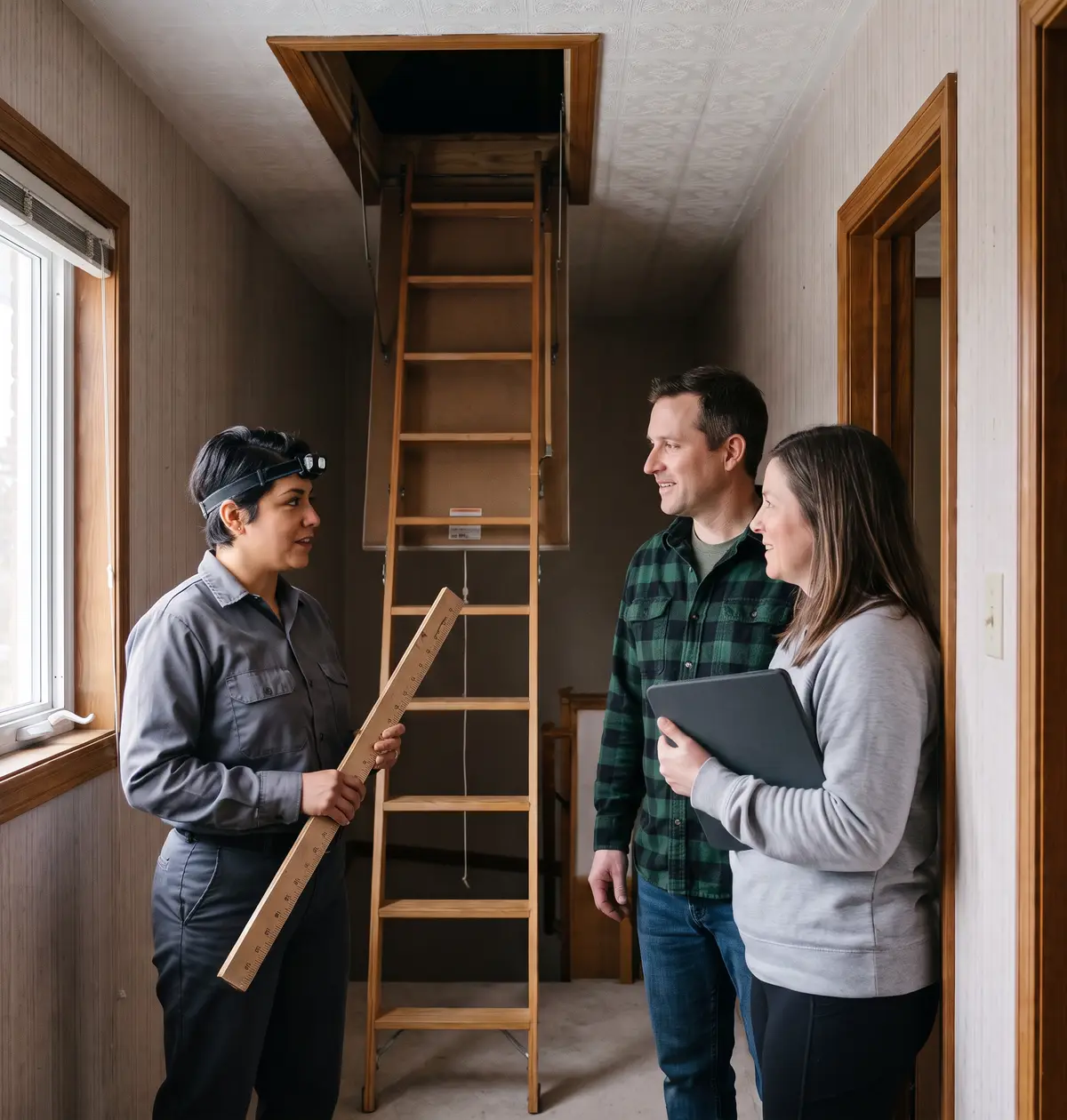
Put it on the measured estimate as one way to pay beside cash, card and any program you already use. The homeowner applies under your company’s name from their own phone; participating lenders review it in order, and an eligible program pays your company. Joining has no setup fee or subscription; each lender also checks your company, on criteria such as time in business.
Can spray foam, removal and air sealing go on one homeowner application?
Yes, as one contracted scope priced once, within each program’s limits: foam or blown-in insulation, removal, air sealing, baffles and the hatch dam, each listed by area, thickness and R-value. It finances the homeowner’s job, not your rig or blower. Below the network’s $1,000 floor, a top-up is a card or cash job.
Is there still a federal tax credit or rebate for insulation?
No federal credit: it ended for insulation installed after December 31, 2025, and even then it covered materials, not labor, within a $1,200 yearly cap. Federal rebates pay up to $1,600 for insulation, air sealing and ventilation, only for households below 150% of area median income and only where a state program has launched: 13 states and DC by September 30, 2026.
Does this work alongside a utility rebate or program loan?
Yes, beside it, not instead of it. The program keeps its own rules, contractor list and paperwork; the application through your link can cover the homeowner’s share or work the program won’t pay for, at the same price you quote for cash. Never net a rebate into a monthly payment.
What do we have to give the homeowner under the FTC R-value Rule?
The fact sheet before they agree to buy, and a dated receipt signed by the installer with coverage area, thickness and R-value. For loose-fill, the receipt also lists settled thickness and the number of bags. The code’s installer certificate and attic depth markers back it up.
Can we tell homeowners how much they’ll save?
Only with a reasonable basis and the FTC’s required statement: “Savings vary. Find out why in the seller’s fact sheet on R-values. Higher R-values mean greater insulating power.” Never compare the monthly payment to a utility bill; Ottri’s application makes no savings claims.
Can a homeowner still cancel after an assessment they asked for?
Yes. When the sale is made in the home, the FTC’s Cooling-Off Rule gives three business days to cancel any purchase of $25 or more, even after an assessment the homeowner booked, and Californians 65 and older get five. Quote one price, cash or financed, and let them apply on their own phone after the estimate is written.
What happens if the first lender declines?
Nothing is retyped: the next eligible lender picks up the same application, and the screen says before each step whether that check is soft or hard. A lower approval may still cover air sealing and a top-up now; if no lender approves, other payment remains open.
Who approves the financing and pays for the job?
The lender, never Ottri, decides and sets the terms. On eligible programs it pays your company directly, usually once the homeowner confirms the work is done and on some programs when the papers are signed. Ottri Global LLC is a licensed loan broker, NMLS 2776988, and is not a lender.
What if we find vermiculite or knob-and-tube in the attic?
Stop and refer. EPA says to treat vermiculite as if it contains asbestos and leave removal to a trained professional, and the electrical code bars insulating over concealed knob-and-tube. Price abatement or rewiring as separate scopes, and revise the estimate before anyone signs.