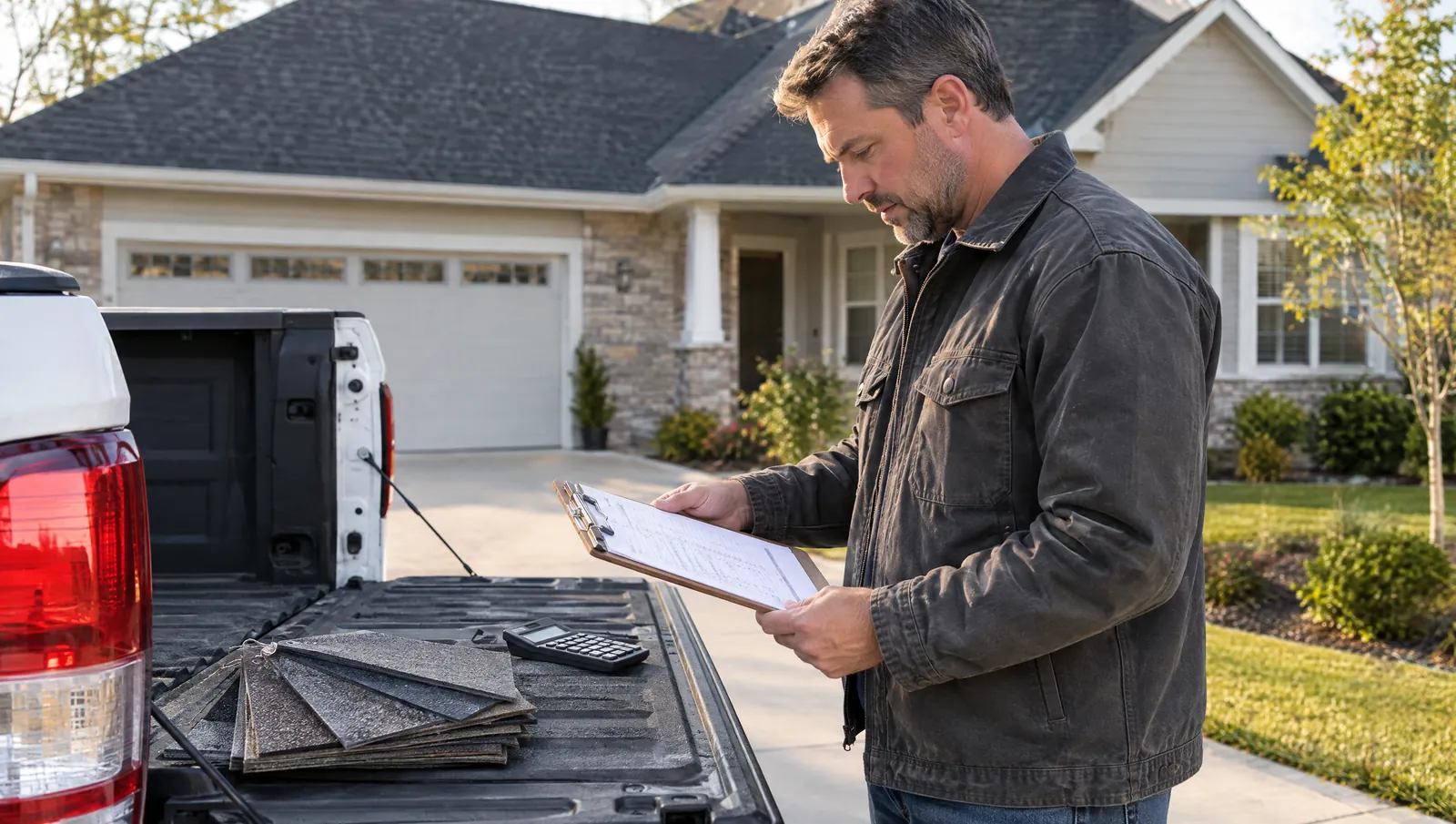
To offer financing as a roofing contractor, you partner with a lender or a multi-lender platform, get approved as a dealer, and give every homeowner a way to apply at the estimate. The lender makes the credit decision, sets the terms and funds the loan; your company never lends money. Before your first financed roof, decide how you'll price financed jobs, train reps on what they can say, and build the federal cooling-off and lending rules into your paperwork.
The short version, in seven steps:
- Decide which jobs need financing: full replacements, insurance gaps, upgrades.
- Choose a financing model: a single lender, a marketplace or a multi-lender platform.
- Get approved as a dealer: license, EIN, bank account, insurance and owner details.
- Set one price for cash and financed customers.
- Offer the same application to every homeowner, early in the sale.
- Keep your ads and contracts compliant with lending and cooling-off rules.
- Track every application to funding, including change orders.
Why should a roofing company offer financing?
Roofs are among the largest expenses a homeowner faces. Homeowners spent $93.5 billion on roofing across 8.3 million projects in 2021–2023, and the median roofing project cost $10,000, against $6,500 that the median homeowner spent on all improvements combined.
Financed projects are bigger. Harvard's Joint Center for Housing Studies found projects paid with contractor-arranged financing averaged $10,600, against $5,000 from savings and $4,000 on credit cards (Improving America's Housing 2025). Only 2% of projects were paid mainly with contractor-arranged financing, and the report adds that "offering homeowners additional financing options could be a promising growth opportunity for the remodeling industry."
One honest caveat: we found no independent study that measures how much financing raises a roofer's close rate. The lift figures online are self-reported by lenders and software vendors.
What are the ways a roofer can offer financing?
With every third-party option, the lender owns the credit relationship. What changes is who gets paid, when, and what it costs you.
| Option | Who funds, who gets paid | Cost to the roofer | Watch out for |
|---|---|---|---|
| Single-lender dealer program | The lender pays your business, usually after completion | A dealer fee per loan, higher on 0% APR promotions | One decline ends the financing conversation |
| Financing marketplace | The lender funds the homeowner, who pays you | Often a yearly subscription, or free | You don't control when you're paid |
| Multi-lender platform (point of sale) | One application goes to participating lenders in sequence; on eligible programs the lender pays your business | Varies: lender fees, subscriptions or no platform fee | Ask who pays the platform and what each program costs |
| Financing built into roofing software | Usually one partner lender | Usually a merchant fee per loan | Often limited to that one lender |
| Homeowner's bank, HELOC or personal loan | The bank funds the homeowner | $0 | Weeks of delay; a HELOC adds a 3-business-day rescission period before work |
| In-house payment plan | You are the creditor | Default risk and cash-flow gap | Lending rules, state registration and collections become yours |
| PACE (property-tax assessment) | Repaid on the tax bill | Varies | Residential PACE is offered only in California, Florida and Missouri (PACENation), under a federal ability-to-repay rule effective March 1, 2026 |
You don't need special software for any of these: lenders and platforms give you a link or QR code that the homeowner opens on a phone.
Single lender or multi-lender: what's the difference?
A single-lender program considers the homeowner once. That keeps things simple, with one set of rules and one promotion menu, and it can work well if most of your customers have strong credit. The drawback is the decline: if that lender says no, the sale either ends or the homeowner starts over elsewhere.
A multi-lender platform passes one application to participating lenders in sequence. If one lender declines, the next can consider the same application and makes its own decision, and the homeowner fills out one form under your brand. For the common reasons homeowners get declined, see why customers get declined for financing.
Roofers often worry that a second lender "sees the first decline." A declined loan doesn't appear on a credit report, according to Experian, but a hard inquiry does, so the real issue is stacked hard pulls. Whether a step uses a soft or hard inquiry depends on the lender, the product and the step; a good process shows the homeowner which kind before they continue.
How do you choose a roofing financing company?
Compare providers on what affects your margin and your cash flow, not on the logo:
- Cost per program: the dealer fee for each program you'd offer, plus any subscription, setup or monthly minimum.
- Homeowner cost: the rate ranges and promotions your customers will actually see.
- Who gets paid, and when: whether the lender pays your business or the homeowner, and what triggers funding.
- Decline handling: what happens after a "no," and whether each step uses a soft or hard inquiry.
- Approval bar for your company: years in business, volume minimums and owner credit checks.
- Project range: the smallest and largest amounts available, for repairs through full replacements.
- Your brand and your customer: whether the application carries your brand, and whether applications are ever sold as leads.
- Recourse: chargeback, holdback and reserve terms in the dealer agreement.
What do lenders require to approve a roofing company?
Every lender reviews the contractor before the first homeowner applies. The requirements below appear across published dealer applications; banks tend to set the highest bars, and many platforms ask only for the basics.
| Requirement | What to have ready |
|---|---|
| Contractor license | A current license for every state where you'll do financed work |
| Business identity | Your EIN, legal business name and years in business |
| Bank account | A business checking account, often verified with a voided check |
| Insurance | A certificate of general liability insurance; some lenders also ask about bonding |
| Owners | ID for every owner above a threshold (commonly 10% or 25%), sometimes with a soft or full credit check |
| Sales contract | A blank copy of your homeowner contract or work order |
| Track record | Some bank programs publish minimums such as several years in business, annual residential sales or an average job size |
| Agreement | A signed dealer or merchant agreement, often after a verification call |
If you're a newer company, look for providers that don't set minimum years or volume; the difference between programs is large.
How much does offering financing cost?
You pay in one of three ways: a dealer fee on each financed job, a platform subscription, or no platform fee on platforms that don't charge contractors. Dealer fees climb with promotions: roughly 0–4% for standard-rate loans, about 8% for 12-month same-as-cash and 11–13% or more for 24-month plans.
Whatever you pay, charge cash and financed customers the same price. Under Regulation Z, a higher price for financed customers can count as a finance charge. The full breakdown, with the math, is in what financing costs a roofing company.
When does a roofer get paid on a financed job?
In dealer programs and point-of-sale platforms, the lender pays your business, usually after the homeowner confirms the work is complete. Lender agreements typically bar accepting a completion certificate before the work is actually done. In marketplaces, the homeowner receives the loan and pays you.
Four things decide how fast, and how surely, the money arrives:
- Completion sign-off. If the homeowner won't sign, funding waits.
- Change orders. Rotten decking or a permit increase means the lender must approve the new amount before funding.
- Chargebacks and recourse. Read the dealer agreement for clawbacks after a homeowner dispute, holdbacks and reserve requirements.
- The FTC Holder Rule. Consumer credit contracts arranged through a seller must carry a notice that lets the homeowner raise claims against the lender (16 CFR 433). That's why lenders vet contractors and tie funding to completion.
What laws apply when a roofer offers financing?
You aren't the lender, but these federal rules still reach your sales process. This is general information, not legal advice.
- FTC Cooling-Off Rule. Sales of $25 or more made at the homeowner's home can be cancelled until midnight of the third business day. You also may not assign the note "to a finance company or other third party prior to midnight of the fifth business day" (16 CFR 429.1).
- Right of rescission on home-secured credit. When a HELOC or other loan is secured by the homeowner's primary residence, "no services shall be performed and no materials delivered until the rescission period has expired," three business days (12 CFR 1026.15 for HELOCs; 1026.23 for closed-end loans).
- Equal Credit Opportunity Act (Regulation B). Its commentary names "home-improvement contractors" that accept applications and refer them to lenders. You may not discriminate or discourage applicants, so offer the same application to every homeowner (12 CFR 1002).
- Truth in Lending advertising (Regulation Z). Contractors who advertise financing must follow the ad rules even though they aren't the lender; the commentary covers "home builders, merchants, and others who are not themselves creditors."
- In-house financing. If your payment plans carry a finance charge or more than four installments, extending them more than 25 times a year (or 5 times when secured by a dwelling) makes you a creditor under Regulation Z (12 CFR 1026.2(a)(17)).
What can a roofer say in ads about financing?
Under Regulation Z §1026.24, certain details in an ad are trigger terms: once you use one, the ad must also state the down payment, the repayment terms and the APR.
| Triggers full disclosures | Doesn't trigger them |
|---|---|
| A monthly payment amount ("$129 a month") | "Financing available" |
| A number of payments or repayment period ("60 months") | "Monthly payment terms arranged" |
| A down payment amount or percentage ("10% down") | "No down payment" |
| A finance charge amount | "Take years to repay" |
| An implied term ("80% financing") | "Monthly payments to suit your needs" |
Two more rules: any rate must be stated as an "annual percentage rate" (§1026.24(c)), and on card-style deferred-interest offers, "if paid in full" must come before the deferred-interest period (§1026.16(h)). On installment loans, state the payoff condition anyway; "same as cash" without it invites a deception claim. A cost estimate prepared for one homeowner isn't an advertisement, so a payment option on an individual estimate is fine; the same number on a yard sign is not.
What do state laws say about deposits on financed roofs?
States set their own home-improvement contract rules, and many cap deposits. A few examples, current as of October 2026; check your state before you set terms:
| State | Rule |
|---|---|
| California | Down payment may not exceed $1,000 or 10% of the contract price, whichever is less; the ban on advance payments extends to money from a lender (Bus. & Prof. Code §§7159, 7159.5) |
| Maryland | Deposit capped at one-third of the contract price (Bus. Reg. §8-617) |
| Pennsylvania | On contracts over $5,000, deposits capped at one-third of the price (or one-third plus designated special-order materials); no arranging financing for more than the actual price (73 P.S. §517.9(7), (10)) |
| New York | Under its roofing contract law, a roofing contractor may not require a deposit or mandate a particular form of payment (Gen. Bus. Law §771-b) |
| Massachusetts | Deposit capped at the greater of one-third or the cost of special-order materials (c. 142A §2) |
| Florida | Taking more than 10% obliges you to apply for permits within 30 days and start work within 90 (Fla. Stat. §489.126) |
Because most lenders fund at completion, deposit caps decide how much of the materials cost you carry on a financed roof.
Do you need a license to offer financing?
For offering a lender's application for an unsecured loan, generally no federal license is required when the lender makes and funds the loan and doesn't pay you for the referral. Two situations need a closer look:
- Home-secured loans. Being compensated to refer or steer homeowners into loans secured by their home can make you a loan originator under federal rules (Regulation Z comment 36(a)-1 and Regulation H §1008.103).
- State rules. Some states license loan brokers (California Financing Law), and Texas requires sellers that extend credit under retail installment contracts to register with its Office of Consumer Credit Commissioner.
How should reps present financing at the estimate?
Financing works best as part of the offer, not a rescue when the price lands:
- Mention it when you confirm the appointment, again at the inspection, and with the estimate.
- Show options side by side. Present the full price and the monthly option together, for every package you quote.
- Offer it to everyone. Don't pre-judge who will qualify; that's both a lost sale and a Regulation B problem.
- Cover insurance gaps. Deductibles and depreciation holdbacks often leave homeowners short. Where a program allows, they can pay their share over time; see financing a roof insurance deductible for the rules.
- Answer the real questions. "Will applying hurt my credit?" depends on the lender, product and step, and the homeowner should see which before continuing. "Is 0% free?" Not to everyone: promotions carry costs, and deferred-interest offers charge interest back if not paid in time.
How do you start offering financing this week?
- List your last 20 estimates and mark the ones that stalled on price.
- Pick a provider model and confirm who pays the fees and who gets paid.
- Gather your license, EIN, insurance certificate, bank details and a blank contract.
- Set your pricing policy: one price, with average financing cost built in.
- Write a two-sentence script for the appointment call and the estimate.
- Send your first application on a real job, and track it through funding.
Ottri, which publishes this guide, charges roofing companies no setup fee, no subscription and no platform fee, and no demo is required. You create a business account, complete onboarding, and send your first branded application by link, QR code or text as soon as your programs are active. Eligible participating lenders consider it in sequence, from a network of 20, and each makes its own decision; on eligible programs, the lender pays your business directly. Ottri Global LLC is a licensed loan broker, NMLS 2776988, not a lender. See how it works on the roofing financing page.
Sources
- U.S. Census Bureau and HUD, 2023 American Housing Survey: Home Improvements (October 2024).
- Harvard Joint Center for Housing Studies, Improving America's Housing 2025 (March 2025).
- PACENation, PACE programs (checked October 2026); CFPB, Residential PACE Financing final rule, 90 FR 2434 (effective March 1, 2026).
- Experian, "Does a declined loan appear on your credit report?" (September 2026).
- 16 CFR Part 433 (FTC Holder Rule) and 16 CFR Part 429 (FTC Cooling-Off Rule).
- 12 CFR 1026.2, 1026.15, 1026.16, 1026.23, 1026.24 and Official Interpretations (Regulation Z); 12 CFR Part 1002 (Regulation B); 12 CFR 1008.103 (Regulation H).
- Cal. Bus. & Prof. Code §§7159, 7159.5; Md. Bus. Reg. §8-617; Pennsylvania Home Improvement Consumer Protection Act, 73 P.S. §517.1 et seq.; N.Y. Gen. Bus. Law §771-b; Mass. Gen. Laws c. 142A §2; Fla. Stat. §489.126.
- Dealer requirements: published dealer and merchant applications from national lenders, checked October 2026.
Frequently asked questions
- Do I need a license to offer financing as a roofing contractor?
- Usually not, if you simply offer a lender's application for an unsecured loan and the lender doesn't pay you for the referral; the lender makes and funds the loan. Home-secured credit is different: being paid to steer homeowners into loans secured by their home can make you a loan originator under federal rules, and some states license brokers or register sellers that finance purchases. Check your state's rules with counsel.
- How does a roofing contractor get paid when a homeowner finances?
- In dealer programs and point-of-sale platforms, the lender pays your business directly, usually after the homeowner confirms the work is complete. In financing marketplaces, the lender funds the homeowner, who then pays you. Ask which model a provider uses before you sign up.
- Can a new roofing company offer financing?
- Often, yes, but requirements vary widely. Some bank-run dealer programs ask for several years in business and minimum annual sales, while many platforms ask mainly for a license, an EIN, a business bank account and the owners' identities. Each lender reviews your business against its own criteria.
- Do I need special software to offer roofing financing?
- No. Lenders and financing platforms give you a link or QR code that the homeowner opens on a phone, so you can offer financing from any estimate. Some roofing software includes a built-in lender, usually just one.
- What happens when a homeowner is declined for financing?
- With a single lender, the financing conversation usually ends there or moves to a costlier second-look program. On a multi-lender platform, the next participating lender can consider the same application and makes its own decision. If no lender approves, the homeowner can still pay another way, such as their own bank.
- Does a declined financing application hurt the homeowner's credit?
- A decline itself doesn't appear on a credit report, but a hard inquiry does, so several hard pulls add up. Whether a program uses a soft or hard inquiry depends on the lender, the product and the step, and homeowners should see which before they continue.
- Can I advertise 0% financing or a monthly payment for roofs?
- Only with full disclosures. Under Regulation Z, a payment amount, number of payments, repayment period, down payment or finance charge in an ad triggers required disclosures, including the APR. Phrases like 'financing available' or 'monthly payment terms arranged' don't trigger them. A payment shown on one homeowner's estimate isn't an ad.
- Should a roofer offer an in-house payment plan instead?
- It's riskier than it looks. If your plans carry a finance charge or more than four payments, extending them more than 25 times a year (5 times if secured by the home) makes you a creditor under Regulation Z, some states require registration or a license, and you carry the default risk and the cash-flow gap yourself. Third-party financing keeps the lender as the creditor.