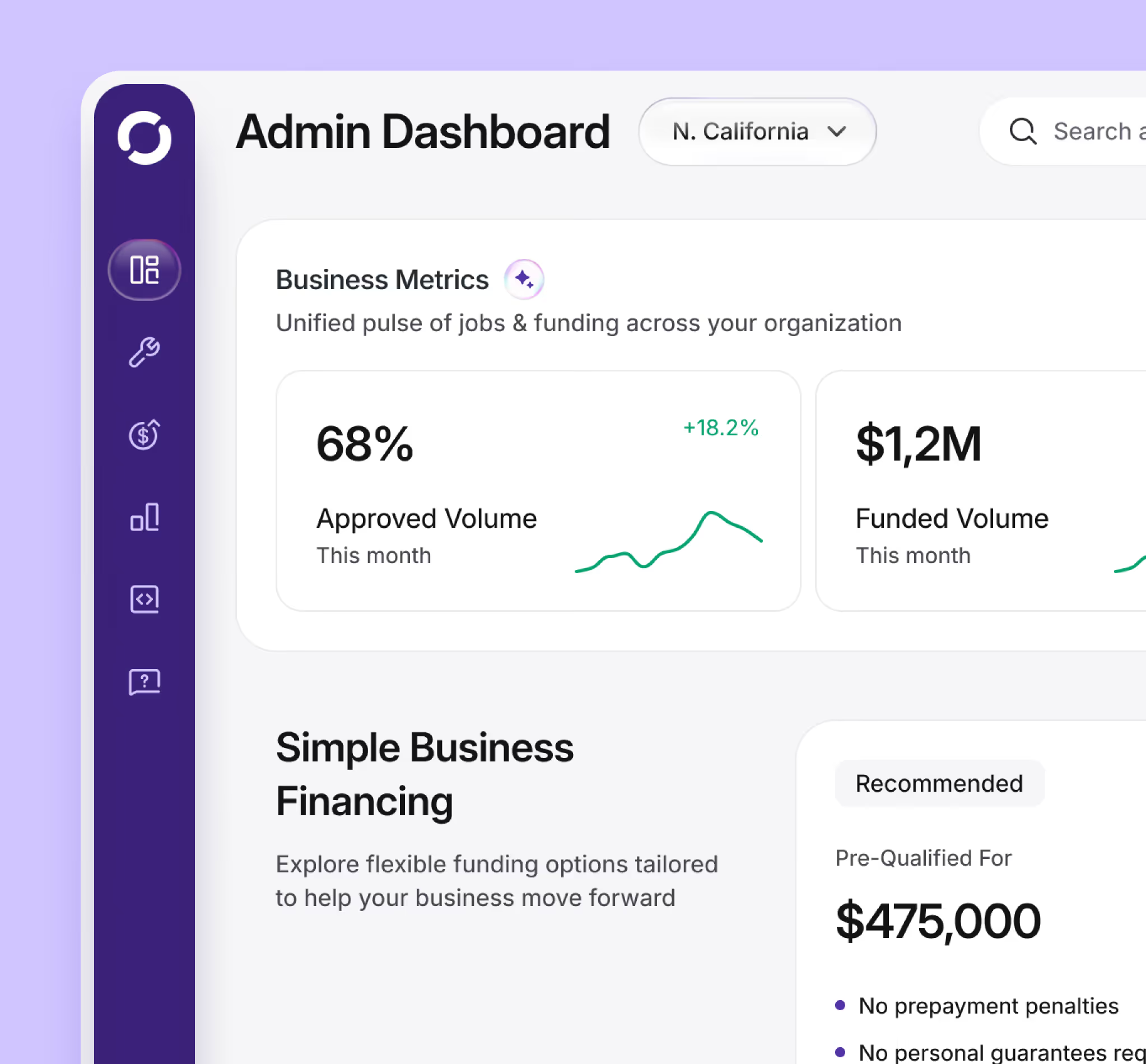
Embedded financing and white-label financing solve different problems. Embedded financing answers, “Where does the financing experience appear?” White-label financing answers, “Whose brand does the experience carry?” Neither question, by itself, answers the one that matters most: Who is responsible for what?
Putting a financing flow inside a product does not create an operating model. Putting a logo on it does not create one either.
The interface is what the customer sees. The responsibility model is what the system actually is.
What is embedded financing?
Embedded financing makes a financing capability available inside a nonfinancial product, platform, sales process, or customer workflow.
A contractor may present financing inside field-service software. A patient may begin an application inside a practice-management system. A marketplace may let a business access capital without leaving its dashboard. A merchant may place financing inside checkout.
The embedding can range from a link to a deeply integrated application and status experience. The phrase does not guarantee a particular integration method, number of products, customer journey, decision model, or division of responsibilities.
A Federal Reserve advisory council record, for example, discusses embedded finance as financial products or services offered within nonbank companies' digital platforms. That is a useful description of placement, not a universal legal definition or operating blueprint.
What is a white-label financing platform?
A white-label financing platform presents some or all of a financing experience under the brand of a business, software company, distribution partner, or financial institution.
That branded surface might include a domain, application flow, communications, portal, reporting environment, support experience, or program identity. The scope can be narrow or extensive.
“White label” is not a magic transfer of responsibility. It does not determine:
- which entity is the lender or creditor;
- who defines the product and eligibility criteria;
- who makes a credit decision or sets final terms;
- which licenses or approvals are required;
- who provides disclosures and obtains consent;
- who owns customer and business support;
- who handles fraud, disputes, or complaints;
- who funds or services an account; or
- which data each participant may receive and use.
Those answers come from the actual activities, products, agreements, disclosures, program design, and applicable law—not from the logo in the header.
The four deployment modes people often confuse
Financing deployments are better understood as a progression of technical and operating scope than as interchangeable labels.
| Deployment mode | What the user may experience | What it does not establish by itself |
|---|---|---|
| Referral or hosted flow | A link or handoff to another party's application | Shared identity, status, data, support, or program governance |
| Embedded component | A financing module appears inside the host product or workflow | Ownership of credit decisions, disclosures, complaints, or servicing |
| API-connected experience | The host product exchanges defined data and events with financing systems | A complete customer journey or a complete responsibility model |
| White-label platform | A broader experience operates under the deploying organization's brand | That the branded organization is the lender or that every function has transferred to the technology provider |
These modes can overlap. A white-label platform may use APIs and embedded components. An embedded experience may open a hosted lender flow. An API integration may power a co-branded rather than white-label journey.
The decision should therefore begin with the desired operating relationship, then select the technical and brand expression that supports it.
Brand is the promise; the responsibility matrix is the truth
Branding changes what a customer reasonably expects.
If a financing experience carries a platform's or financial institution's brand, users may expect that organization to understand the journey, protect the relationship, explain what happens next, and help when something goes wrong. That expectation can exist even when another party supplies the technology and an independent lender supplies the credit product.
The stronger the branded promise, the more dangerous an undefined handoff becomes.
Before choosing an embedded or white-label model, the participants should create a responsibility matrix that answers questions like these:
| Operating area | The question that must be answered |
|---|---|
| Brand and customer promise | Which organization is presented at each stage, and what does that presentation imply? |
| Product | Which entity owns and controls each financial product? |
| Eligibility and routing | Who defines which paths may be considered and under what approved rules? |
| Credit decision | Which lender evaluates the application and communicates or supplies the decision? |
| Licensing and approvals | Which activities require which permissions, and who verifies them? |
| Disclosures and consent | Who presents each disclosure, obtains consent, and preserves evidence? |
| Data | What information is collected, where does it move, and which party may use it for which purpose? |
| Integration | Who owns uptime, changes, versioning, event accuracy, and fallback behavior? |
| Fraud and security | Who detects, investigates, escalates, and resolves suspicious activity or incidents? |
| Customer support | Who answers questions at application, decision, acceptance, funding, and servicing stages? |
| Business support | Who helps the merchant, location, partner, or platform user? |
| Complaints and disputes | Who receives, routes, investigates, responds to, and records each issue? |
| Economics | What event creates compensation, and how is it calculated, attributed, reconciled, and disclosed where required? |
| Funding and servicing | Who funds the transaction, owns the account relationship, and supports it after closing? |
| Program change | Who can change, pause, or end a program, and how are affected participants notified? |
There is no responsible universal answer to this table. The correct owner can vary by product, jurisdiction, activity, agreement, and deployment.
The point is to make the boundary explicit before the interface makes it invisible.
Does outsourcing the technology outsource the obligation?
Not automatically.
Federal banking regulators describe third-party risk management as a lifecycle that includes planning, due diligence, contracting, ongoing monitoring, and termination. Their interagency guidance also makes clear that using third parties does not remove a banking organization's responsibility to operate safely, soundly, and in compliance with applicable law.
The same operating lesson applies more broadly: assigning work and transferring accountability are not the same event.
A technology provider can perform an agreed function. A platform can own a customer surface. A partner can distribute a program. A lender can rely on third-party systems. But the participants still need to know which entity owns the underlying product, decision, control, evidence, and customer obligation.
This is why a strong white-label model is not the one that hides the most. It is the one that creates the most coherent branded experience while preserving the clearest responsibility boundaries.
Which model should a business or platform choose?
Choose based on the experience you need to control and the responsibilities you are prepared to operate.
Use a referral or hosted model when:
- speed and simplicity matter more than complete experience control;
- the external provider can own most of the downstream journey;
- limited status visibility is acceptable; and
- the handoff can be explained clearly to the user.
Use an embedded component or API-connected model when:
- financing must appear inside an existing workflow;
- identity, transaction context, status, or attribution needs to move between systems;
- the host product needs meaningful control of the user experience; and
- the parties can support integration and lifecycle changes.
Consider a broader white-label model when:
- the financing experience is part of the organization's own strategic promise;
- brand continuity matters across onboarding, application, status, support, and reporting;
- the organization needs a governed program rather than a single integration; and
- every operating and regulatory responsibility has an explicit owner.
White label is not simply “more embedded.” It is a decision to place another organization's brand—and therefore its customer promise—across a larger part of the financing system.
Twelve questions to answer before signing
Whether the proposal is called embedded finance, white label, lending as a service, or an API, ask these questions in writing:
- Who is the lender or provider for every product shown?
- Which products, geographies, transaction types, and participants are actually approved at launch?
- Which capabilities are live, built, pilot, designed, roadmap, or dependent on a third party?
- Where does the customer leave our product or brand, if anywhere?
- What information and consent are required at each stage?
- Who owns eligibility, routing, lender decisions, offers, funding, and servicing?
- Which data and events return to our system, at what latency, and under what permitted use?
- Who supports the customer and the business when the process stalls or fails?
- Who handles complaints, adverse-action communications where applicable, disputes, and fraud?
- What happens if a lender program changes, pauses, or terminates?
- Can we add another approved program without rebuilding the complete experience?
- How will every performance, coverage, and customer-impact claim be substantiated?
If the answer to a responsibility question is “the platform handles it,” ask which legal entity, team, system, agreement, and control that sentence refers to.
A hypothetical software-platform example
Consider a hypothetical field-service software company that wants contractors to offer financing during an in-home sale.
In a light embedded model, the software displays a financing button and passes basic transaction context into a hosted application. The lender or program provider owns most of the journey after the handoff. The software company may receive limited status information.
In a deeper API-connected model, the contractor and customer stay within more of the software workflow. Identity, job details, approved program availability, consent, and lifecycle events move through defined interfaces. Independent lenders still own their products and decisions.
In a white-label platform model, the software company's brand may extend across contractor onboarding, customer application, program presentation, communications, dashboards, and support. That creates a stronger product experience—and a larger operating surface. The parties must define who owns every disclosure, decision, data flow, support moment, complaint, program change, and servicing handoff.
The white-label version is not better merely because it is more branded. It is better only if the company wants the expanded promise and the operating model can keep it.
How does Ottri approach embedded and white-label financing?
Ottri treats embedded, branded, and lender-operated experiences as configurations of shared financing infrastructure, not as synonyms.
Ottri has infrastructure primitives that can support branded experiences, role-based environments, participant onboarding, program connectivity, lender-owned decisions, workflow, status, reporting, and assigned operations. The exact scope and maturity of a deployment vary. A complete lender-operated or white-label program may include live or built components alongside approved implementation work, pilot elements, program-specific integrations, or designed capabilities. It should not be represented as one universally available package without confirming the deployment.
The stable boundary is that lenders remain the lenders. Participating lenders retain control of their products, criteria, lending decisions, final terms, funding, and servicing. Ottri does not originate, underwrite, fund, or service loans and does not make final lending decisions.
That lets a business, platform, or financial institution create a more coherent experience without using design to obscure who provides the financial product.
Explore Ottri for software platforms or financial institutions, review the white-label responsibility model, or discuss a deployment.
Sources and review
“Embedded financing” and “white label” are used descriptively here; neither label replaces analysis of the actual activities, parties, agreements, products, disclosures, and applicable law. This article is educational information, not legal, financial, or credit advice.
- Federal Reserve advisory council record discussing embedded finance — an example of embedded finance described as financial capabilities offered within nonfinancial digital platforms.
- Federal Reserve, FDIC, and OCC interagency guidance on third-party relationships — lifecycle governance for third-party relationships and the responsibilities that remain with banking organizations.
- FDIC resources on third-party relationships — supervisory materials emphasizing that third-party use does not diminish an insured institution's responsibility.
- CFPB Regulation B definitions — relevant distinctions among applications, credit, creditors, and adverse action.
- NMLS Consumer Access — an independent place to verify licensing records rather than inferring status from a brand or interface.
Author: Ottri
Published and last reviewed: August 20, 2026
Frequently asked questions
- What is embedded financing?
- Embedded financing makes a financing capability available inside a nonfinancial product, platform, sales flow, or customer experience. It describes where the experience appears, not by itself who owns every responsibility behind it.
- What is a white-label financing platform?
- A white-label financing platform presents some or all of the financing experience under another organization's brand. The label does not determine who is the lender, who makes decisions, or who owns licensing, disclosures, support, complaints, and servicing. Those boundaries must be defined explicitly.
- Does putting a company's logo on an application make it the lender?
- No. Branding does not determine creditor or lender status. The actual products, activities, agreements, disclosures, and applicable law control, and the lender should be identified accurately throughout the experience.
- Is an API integration the same as a white-label platform?
- No. An API is a technical integration method. A white-label deployment is a brand and operating arrangement. Either may be narrow or extensive depending on the actual workflow, data, responsibilities, and participants.
- Does Ottri provide a standardized white-label lender platform?
- Ottri has branded and lender-operated infrastructure primitives, but the complete scope and maturity of any white-label deployment depend on the approved program, integrations, agreements, responsibilities, and implementation. It should not be assumed to be one universal package.